Sparks of Creativity
A liberal arts education fuels imagination, inspiration
Story By Kathy Andrews
Illustrations by Peter Oumanski
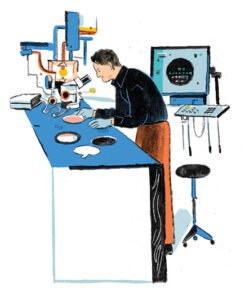
“Curiosity, a willingness to play, and the desire to make things.” These are traits Jane Bearinger ’90 says drive her to create, whether in a science lab or an art studio—both of which, as it happens, are settings where she feels very much at home.
Bearinger is among Trinity community members we spoke with about the role of creativity in their lives and some of the ways Trinity helped to shape their paths.
Unscripted curriculum
At Tr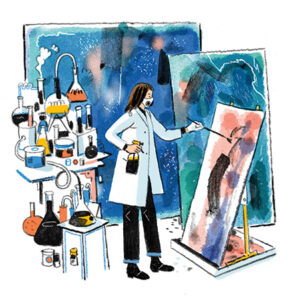 inity, Bearinger focused on the sciences but relished a variety of subjects, including architectural studies, philosophy, and international studies. She regularly stopped by Austin Arts Center to view artwork or performances. Studying abroad at King’s College in London—primarily chemistry—was “a phenomenal experience,” she says.
“I will always cherish the fact that Trinity gave me that opportunity to try a little bit of this and a little bit of that,” she notes. “It wasn’t so scripted. It led you to try things, to discover what you like.”
After graduating with a B.S. in biochemistry, Bearinger landed a job at Merck as a chemist, earned an M.S. and a Ph.D. in biomedical engineering from Northwestern University, did postdoctoral research in Switzerland, and ran the Medical Technologies Program at Lawrence Livermore National Laboratory in California. She steadily built expertise in minimally invasive medical innovations, eventually founding a diagnostics start-up and building a portfolio of technologies for the U.S. government to detect presymptomatic illness. She holds numerous patents for health care inventions involving diagnostics, nanotechnology, and coatings for implants and devices.
No ‘coulda, shoulda, woulda’
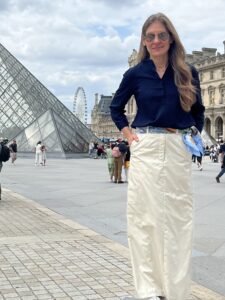
A few years ago, as her family’s changing needs called for more of her attention, Bearinger stepped away from her med-tech career. She also began spending more time making art. Based in Greater Philadelphia, she specializes in chemical reactions on copper that create abstract depictions of nature. Her artwork often features bold and vibrant colors. In her role as artist, she admits that she sometimes feels “a bit of imposter syndrome” but is not letting that stop her. “I have a hard time living with ‘coulda, shoulda, woulda.’ I’d rather fall on my face and get back up than not try.
“I used to apply that attitude to biomedical design,” says Bearinger. “Now I apply it to oxidation reactions on copper. I mimic reactions that take years to naturally create blues or greens on rocks by the sea or in a mine. Using similar chemistries and creating optimized conditions, I catalyze those colors in days or weeks rather than years.”
All about passion
Ever since high school, Steve Syz ’17 has been riveted by epic music, so orchestral and dramatic. “It riles me up,” he says. “It feels like you’re heading into war.” He would wonder why certain film trailers motivated him so much to see those movies, including Marvel Studios’ Avengers: Infinity War. “I realized it was the music and thought, ‘I want to do something like that.’ ”
 A music major, Syz studied music production and theory. Performing at Trinity’s annual Samba Fest—he played the shaker—was a highlight, as was the time he collaborated with a few students to record original music at The Mill. Syz composed the music and wrote the lyrics, a second student sang, and a third ran the recording booth. “The music wasn’t that good, but it was good experience, learning from scratch,” he says.
Eight years into a career composing trailer music, Syz, who resides in Jersey City, New Jersey, says, “The driving thing is passion. If you don’t have passion for something, it’s hard to continue doing it for years.”
Green tea all-nighters
The two sides to the trailer music business, says Syz, are custom work and themed albums. “With custom, you get a brief, maybe just a paragraph, describing the story, characters, and themes for a specific movie.” Typically, a brief is emailed in the early evening. “I’ll make a cup of green tea and work through the night, till 3:00 or 4:00 a.m.,” he says.
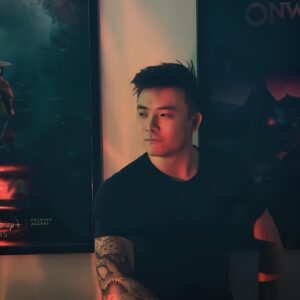
For themed album work, as many as 10 composers come up with music to fit a theme, such as sci-fi or horror. “A horror track could be themed around a door knock or a loose spring, so it’s fun,” says Syz. Studios then pick and choose tracks for TV spots.
One of his favorite projects was Raya and the Last Dragon, a 2021 animated fantasy action film by Walt Disney Animation Studios, for which four tracks of his music were used. “It’s set in Southeast Asia, so I included sounds from that part of the world, like gamelans [gongs and other metal instruments], wood blocks and sticks, and an ocarina, too.
“Only about one in 10 projects will land—the other nine just die. And it can take as much as a year to hear back,” he says. “You just hope for that one placement that lands!”
A lifelong process
As a finalist for the 2025 National Book Award for Fiction for North Sun: Or, the Voyage of the Whaleship Esther, Associate Professor of English Ethan Rutherford was on a New York City stage last fall, reading from his novel to a huge crowd. Knowing Jim Shepard ’78 was in the audience made the moment even sweeter, for it was in Shepard’s Williams College creative writing class where Rutherford first realized writing fiction was what he really wanted to do.
“Meeting him, taking his class, and reading his work—I’ve come to see it as the great good luck of my life,” Rutherford says. “He’s been an incredible mentor and friend,” he adds, noting the two have stayed in regular contact since Rutherford’s 2002 Williams graduation.
Rutherford, a Trinity faculty member since 2014, says, “With any teaching of art, not just creative writing, it’s about reminding students it’s a lifelong process. It’s an iterative process. Even if you abandon a story, that story taught you something and can end up informing the next attempt,” he says. “Being an artist is about honing that mechanism, learning how to pay attention to the world and trying to figure out what your place is in it.”
The secret ingredient
“Writing can be arduous but should also always be fun,” Rutherford says. “You need to have fun while you’re making things—that seems to be the secret ingredient.”
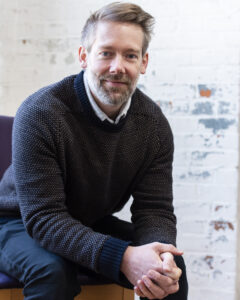
While writing North Sun, he borrowed a technique from the music of Prokofiev’s Peter and the Wolf. He listened to the album often as a child and says he remains haunted by the French horns representing the wolf. At a point when he felt stuck with his novel, Rutherford tried matching each North Sun character with a specific instrument. The exercise “opened up” the characters and helped him get back to writing the story. “It was a wonderful moment when I realized that just as other books are going to inform this novel, music can inform it, too.
“A liberal arts education requires that you stay open to information and consider different ways of solving problems,” he says. “I think that’s fantastic for someone who is interested in being creative.”
A professor steps in
Ted Moise ’87 (pronounced “mo-EES”) recalls, “My first two years at Trinity, I was studying physics because I wanted to really understand how things worked. I declared a physics major and then realized I wanted not just to understand things but also to try to make something with what I was learning—that’s where engineering came in.”
 Moise set about pursuing engineering as a second major but had missed a few core classes offered only in a certain sequence. It seemed impossible to catch up and stick to his graduation timeline, until David J. Ahlgren ’64, Karl W. Hallden Professor of Engineering, Emeritus, volunteered to mentor him in an independent study arrangement. “He made a huge difference,” Moise says. “I don’t think that would have happened at another school.”
Moise, who also holds a Ph.D. from Yale University, was honored as a National Academy of Inventors 2024 fellow for pioneering work at Texas Instruments (TI) developing a memory technology, ferroelectric random-access memory (FRAM), that allows electronic devices to store data 100 times faster while using less power than other approaches. In biomedical applications such as pacemakers and glucose monitors, FRAM has helped achieve improved outcomes for millions of patients.
Imagination to benefit humanity
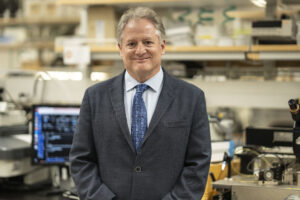
In 2021, after 29 years at TI, Moise joined the University of Texas at Dallas as a research scientist and director of UT Dallas’s North Texas Semiconductor Institute. One lesson Moise has learned: “Sometimes the problem as presented is not really the problem to be solved.”
When working with customers, he says, “The first step is to really listen and to listen with as few filters as possible. At TI, our job was to create technologies that would help solve customers’ problems, both near term and longer term. We had to understand where the market was going and then figure out a way to develop a technology that would intersect with the path of the market and be useful for customers and hopefully also provide a differentiation, not only for TI but for TI’s customers.”
Asked about his approach to solving problems with a creative mindset, Moise, a Trinity Board of Fellows member, says, “I like to get into work super early, completely by myself. I’ll listen to music on my headphones and just start looking at the data to understand the root causes of the issues that we need to solve.”
Adds Moise, “I think of creativity as a kind of imagination, applied to benefit humanity.”
More food for thought
Read on for more thoughts on creativity, the liberal arts, and Trinity community members who were impactful for these four creative individuals and hear more related to their work.
Jane Bearinger ’90
“The creative process is so different for everyone. To me, it’s an all-encompassing thing. To somebody else, it may be a very specific mode they get into in order to produce a piece of music or write a poem. With my mutt of a background, whether I was working on chemical strategies for medical devices or now, if I’m trying to create a specific patina shade, it’s the creative process that helps me figure out how to attack that.”
About William H. Church, associate professor of chemistry and neuroscience, emeritus
“He would ask students to go explore something, then come back and teach the rest of the class—an invaluable way of learning.”
On James K. Heeren, professor of chemistry, emeritus (who died in 2023)
“Doc Heeren said, ‘It’s not what you do in the classroom. It’s what you do in the lab.’ ”
Check out Bearinger’s artwork on Instagram @jpb_studios.
Steve Syz ’17
“My freshman year, I had a keyboard in my single room in Jones. I thought, ‘I’m going to start this thing and see how it goes.’ And in that one room, everything started.”
On Dan Román, associate professor of music
“He taught me the technical side of music production, including digital production, putting music into the computer.”
About John Platoff, professor of music, emeritus, and Gail Woldu, Charles A. Dana Professor of Music
“On the theory side, they were the ones who helped me make music feel more colorful.”
To listen to music by Syz, visit his website.
Ted Moise ’87
“The daily interactions that occur with students who have widely varying backgrounds, viewpoints, and interests within a liberal arts environment force aspiring engineers to assess the motivations for creating technologies and the different ways in which they can be used to benefit society.”
On Eric Fossum ’79, H’14, inventor of the CMOS image sensor “camera on a chip”
Note: While a Trinity student, Moise first heard from his professors about Fossum—at the time a young professor at Columbia University—because Moise was thought to be the first student at Trinity since Fossum to double major in engineering and physics. When looking into graduate programs, Moise visited Fossum at Columbia and considered joining his lab there. While Moise didn’t end up in New York City, he entered the same Ph.D. engineering program at Yale University from which Fossum graduated, so the two share a bond as alumni of the same programs at both Trinity and Yale.
“Eric is an innovator who has long been an inspiration. I feel fortunate that over the years I’ve had a chance to get to know him through both of us serving on various Trinity committees.”
Read an article from UT Dallas’s engineering magazine about Moise and others at the North Texas Semiconductor Institute accelerating involvement in semiconductor research and workforce development in the North Texas region.
View a Texas Instruments video about Moise’s innovative work in developing FRAM technology.
Ethan Rutherford
“I teach creative writing, but at this point I think of it more as just teaching creativity in the classroom, using text as a way to explore creativity.”
On co-teaching in the InterArts Program with Lynn Sullivan, assistant professor of fine arts
“In talking to Lynn, in particular about how she teaches sculpture, that helped me really think about the way that I teach. I think I was set on teaching creative writing in a certain way, all text based. But hearing from Lynn how she approaches teaching sculpture and art and making things in a multidimensional and iterative process, and how she finds her inspiration, was wonderful. It was being involved in the InterArts community that led me to change the way that I approach teaching creative writing in the classroom. It’s much more open-ended in questioning, which is a much happier classroom.”
View video of Rutherford reading an excerpt from his novel, North Sun: Or, the Voyage of the Whaleship Esther, at the November 2025 National Book Awards Finalist Reading.
Read about music that was important to Rutherford while he was in the process of writing North Sun in a post he wrote for the literature and music website blog, Largehearted Boy, which invites authors to “create and discuss a music playlist” relating to their recently published books.