200+ Years of ‘Beautiful Music’
The Chapel Singers, Trinity’s oldest student group, still making music and memories
By Andrew J. Concatelli
While many factors might explain the extraordinary endurance of The Chapel Singers—the choral group recognized as the College’s oldest continuously active student organization—one in particular stands out to its director.
“We always need beautiful music,” says Christopher Houlihan ’09, John Rose Distinguished College Organist, director of Chapel music, and artist-in-residence, who has led the group since 2017. “The music that The Chapel Singers study and perform is timeless and adds tremendous beauty to our world, which is absolutely necessary in any era.”
The group originated as the Chapel Choir in 1825, just two years after Trinity was founded. To celebrate the 200th anniversaries of both the College and the choir, The Chapel Singers recorded The Bicentennial Album in 2024 and released it in 2025. The music is entirely by composers with connections to Trinity, including Robert Edward Smith, the Chapel composer-in-residence since 1979. The album also features music by alumni and faculty members.
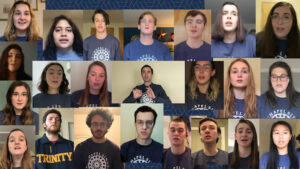
“The particulars of the group have changed over time, but the constant that endures is the importance of offering music that really transcends the difficulties of the world,” says Houlihan, who was a member of The Chapel Singers and also occasionally accompanied the group on the organ when he was a student at Trinity.
The choir was all male before Trinity became coeducational in 1969 and had once shrunk to a quartet, but today it comprises about two dozen undergraduates of all genders. The members are from diverse backgrounds and academic disciplines, and no religious affiliation is required.
The Chapel Singers perform at special Chapel services, including Choral Evensong and the annual Christmas Festival of Lessons and Carols, and at major College events, including Convocation and Baccalaureate. The group also sings at regular Sunday services at the Trinity College Chapel and performs other concerts on campus and on tour throughout the year.
The group’s repertoire spans eras from Gregorian chants to choral music from the 16th and 17th centuries to contemporary music. “The applied musicianship students learn is important,” Houlihan says. “For some Chapel Singers who are music majors and minors or taking other music courses, it connects to their music studies and is an important part of their education.”
John Rose, College Organist-and-Directorship Distinguished Chair of Chapel Music, Emeritus, and director of The Chapel Singers for four decades (1977–2017), says that the music created by the group honors the beauty and inspiration of the Chapel building, which has been treasured by the College since it opened in 1932. “Much of the history of the College is memorialized in the Chapel, by the wood carvings of the pew ends, among other things,” Rose says. “When you are singing there, you are part of the history of the College.”
Shayla L. Titley ’02 remembers processing into her first Lessons and Carols service singing Christmas hymns. “The Chapel was packed!” she says. “It was a beautiful and sacred moment, and I felt so connected to the importance of The Chapel Singers to the College and this Hartford community tradition.”
Houlihan points to the connections formed among students as another important aspect of the group. “While undertaking this focused musical study together, they build a close-knit community of Trinity friends,” he says. “They also get to share this very powerful, beautiful music with the campus community and the broader Hartford community. All of those things make it a unique and rewarding Trinity experience.”
Mark “Scotland” Davis ’88 notes, “The Chapel Singers is that thread that will always connect me to that place in time when beauty, music, truth, and sincere effort were the mark of youth. The group has endured for more than two centuries because each new generation finds those same values waiting there.”
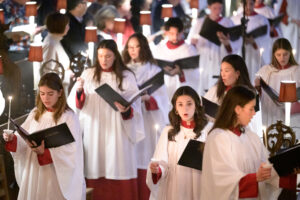
Will Bannon ’28, a current member, says that the group exists alongside coursework and research rather than in competition with it. “It offers a peaceful counterbalance to academic life while also contributing meaningfully to the broader Trinity community,” he says. “Weekly rehearsals, shared repertoire, and the rhythm of services create continuity over time, and being part of that collective sound fosters connection across class years, majors, and backgrounds.”
Rose points out that students form lifelong friendships through the group. “A number of alumni met their future spouses in The Chapel Singers,” he says.
Among those future spouses were Jamie Tracey Szal ’06 and Timothy Szal ’06. Jamie says, “I think students who sing in The Chapel Singers not only benefit from improving their musicianship but also really enjoy spending time in the company with other musicians who enjoy singing beautiful music.” She says that a favorite memory is touring Argentina with the group in 2005. “We sang in some really incredible spaces, and we enjoyed a lot of seriously good food. . . . That was a trip of a lifetime.”
Rose also took the group to perform in Venice, London, and San Francisco, among other cities around the world. Under Houlihan’s direction, The Chapel Singers have performed in New York City several times in the last decade.
Houlihan says he hopes the group will continue to find ways to create music that inspires the Trinity community in the broadest sense possible. “Directing The Chapel Singers is a privilege and very important part of my work here at Trinity,” he says. “I try to program music that inspires people of all backgrounds. It has been rewarding to offer concerts that speak to our shared experience; I hope that will continue to grow.”
Bannon says he believes that The Chapel Singers have endured for more than 200 years because the group has always been rooted in the practice of showing up regularly, listening closely, and making music together in a shared space. “That kind of commitment does not age out. While styles, students, and even the campus itself change, the core experience remains the same,” he says.
“What sustains the group is that each generation steps into something already in motion,” Bannon adds. “You are aware that the sound you are helping to create has been shaped by countless voices before you, even though every rehearsal and service exists only in the present moment. The tradition lasts because students are trusted to take part in something that matters and to carry it forward in their own time.”
Header image by Nick Caito, 2024
More musical memories
Will Bannon ’28
Majors: Neuroscience and Music
“As an organ student, being involved with Chapel music felt like an obvious choice. While I had sung in choir when I was younger, I never seriously pursued singing, so The Chapel Singers became a familiar part of my musical life, approached from a new perspective. I look forward to every rehearsal because it engages a different part of my mind than coursework or research and, in that way, complements and enriches my organ and music studies more broadly. One of the highlights for me was our trip to New York City, where we sang at Jazz at Lincoln Center as part of Trinity’s All In campaign celebration.”
Mark “Scotland” Davis ’88
Major: Religion
Occupation: Project Manager
“Harmony is the goal of singing—not only musically but also emotionally and personally for me. It has always described how I feel when I’m part of a group that sings together. Unlike the larger concert choir, The Chapel Singers’ limited number created a tight‑knit family for me. We teased, encouraged, and celebrated one another. It was members of The Chapel Singers who pinned my nickname on me after my return from my semester abroad. I wore some Scottish garb to a rehearsal. My answer to, ‘Where’d you get that?’ was ‘Scotland.’ It stuck. The ensemble was lovingly led by an exceptional director who taught demanding music that required nothing less than our very best. It is led today by someone cut from the same magic cloth.”
Kate Brennan Ersevim ’91
Major: Psychology
Occupation: Data Analyst
“I love to sing classical and sacred music, which is especially beautiful in the inspiring space of Trinity Chapel. Making music in the Chapel is a special feeling, especially those times when we all come together and sing something really well—a cappella in harmony—ending with an echo that reverberates through that sacred space. Some favorite memories of the group were meeting my future husband, Michael, the first week of college at the first Chapel Singers rehearsal, making lifelong friends I still keep in touch with today (including John Rose and Christopher Houlihan), and our tour to England in 1989, including singing in the London Underground.”
Michael Ersevim ’91
Major: Music
Occupation: Actuary and Data Scientist
“I wanted to be a part of a high-quality ensemble, singing in the unmatched acoustics of the absolutely gorgeous and iconic Trinity Chapel. Hearing or performing with the formidable Austin organ is not to be missed either. Being part of The Chapel Singers, you get to be a part of an unbroken chain of liturgical music in a Gothic space that can transport you back in time as well as meeting you where you are, temporally, spiritually, and emotionally. The focus and teamwork it takes to sing with precision—ensemble, tone, diction, and pitch— is a real natural high when you’ve done a piece justice.”
Kendra Keelan ’23
Majors: Political Science and Urban Studies
Occupation: Analyst at the U.S. Department of Justice
“Once I heard the group perform in the stunning Chapel during the first-year orientation ceremony, I was hooked. Students gain a strong sense of camaraderie with each other and find their own meaning of community within Trinity College itself. There’s a reputation that befalls each Chapel Singer, one of tradition and elegance. As an example of the strength for the oldest student organization on campus, in 2020, during the COVID-19 pandemic, Professor Houlihan found clever ways to lift spirits with music by moving rehearsals to the outside cloister of the Chapel, utilizing singing masks while indoors, and conducting rehearsals and performances via Zoom. In the fall of 2025, Professor Houlihan invited past and present Chapel Singers to the Chapel to perform at his wedding. It was a magical moment for both him and us. Every attendee (singer or not) got to feel the bond ‘Chappies’ have, no matter our stage in life.”
Matthew Phinney ’10
Majors: Mathematics and Music
Occupation: Software Technology for Climate Change Mitigation
“I joined the group during my sophomore year—after studying organ with John Rose in my first year—because of the high degree of artistry in the group, as well as the wonderful tradition and the opportunity to create music in the beautiful Chapel. Students gain a sense of community and purpose in the group, as well as a calming and peaceful space to make music. Lessons and Carols was always a highlight for me, as was the 75th anniversary of the Chapel, for which we held a great service with many alumni Chapel Singers and at which I accompanied The Chapel Singers on the organ.”
Beck Smith ’29
Major: Environmental Science
“Being a part of ‘Chappies’ gives you connection, not only to the students singing beside you but also to the broader community. The choir is often asked to perform at some of the most important events on campus—for example, President Dan Lugo’s Inauguration in the fall—which gives you a real sense that you’re a part of the happenings at Trinity, not just a bystander. I think The Chapel Singers have been around for so long because music itself is resilient and because it brings people together during times of hardship. Trinity has such an active religious community, and people fall back on religion when they’re struggling.”
Jamie Tracey Szal ’06
Major: International Studies
Occupation: Tax Attorney
“I think the longevity of The Chapel Singers comes down to the power of music to shape, build, and sustain community. Chapel Singers intrinsically know and understand how music not only nourishes us as individuals but also nourishes the entire Trinity community that we serve. I think The Chapel Singers take sacred our role of helping the Trinity community celebrate, worship, grieve, or connect. One incredible memory as a Chapel Singer was having the group sing at my wedding several years after graduating. Given that I married another Chapel Singer, and that we married in the Chapel, it was a particularly meaningful way to help us celebrate.”
Shayla L. Titley ’02
Majors: Political Science and Theater and Dance
Occupation: Director of Patron Program and Services for The Public Theater in New York City
“Once you’re in The Chapel Singers, you gain friendships with folks that you might not otherwise interact with. They might not even be of the same faith, but there is a love of music and a respect for what the Chapel symbolizes that connects everyone. A favorite moment was traveling to Venice, Italy, for a Chapel Singers tour. We sang in beautiful churches and cathedrals in the area, got lost in the piazzas, and I, in particular, indulged—maybe overindulged—in the delicious tiramisu that Liesl Odenweller ’88 had prepared for us. She was a featured soloist throughout the tour.”