Opening Doors of Opportunity
Trinity College Fund donors share heartfelt reasons for giving
Story by Mary Howard
Photos by Anne Day
If you received a call from a student about the Trinity College Fund, you may have spoken to Demetra Danas ’26. A public policy and law major, Danas took a job as a student advancement officer in her sophomore year “with no experience or knowledge if the job was for me.” Now, she says, she loves connecting with alumni and hearing their stories about Trinity. “I hope to work in college advancement after graduation.”
Danas also is chair of the Senior Class Gift Committee, which encourages seniors to donate to the Trinity College Fund. Just two weeks after launching the campaign last fall, she and her team surpassed their yearlong goal, reaching 260 donors and raising nearly $6,000 in support of the College.
She stresses that gifts of any size make a difference: “No matter the amount, giving means that those who follow in our footsteps will have the same experience or better.”
Annual giving is key to Trinity’s success, says Ben Anderson, vice president for advancement.
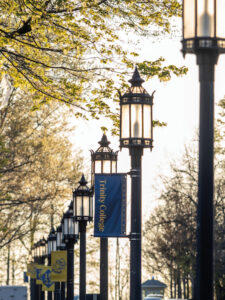 “Annual giving through the Trinity College Fund is one of Trinity’s most enduring traditions—alongside the lemon squeezer and signing the Matriculation book,” says Anderson. “From our earliest days, generations of alums and families have joined together as a community of support. Year after year, these committed donors give at every level, and together, we fuel every aspect of the Trinity experience and create possibility for our students. The historic achievements of the recently completed All In campaign—which elevated annual support of the Trinity College Fund to $10 million—serve as a launchpad for the future.”
Like Danas, Matt Schiller ’01 gives to the Trinity College Fund “so other students can have the same opportunities I had.” He’s a Loyal Bantam, meaning he’s given for five or more consecutive years, and a Reunion donor, celebrating his 25th in June. A scholarship student, he says his Trinity experience developed his entrepreneurial and leadership skills, setting him on a course to start his own business. He is a founding partner with Murphy Schiller & Wilkes LLP, a boutique law firm in Newark, New Jersey, that represents clients in a wide range of commercial real estate transactions and litigation matters throughout the country.
Growing up in Vernon, Connecticut, Schiller said, he saw Trinity as a school with an excellent reputation, where he could “work hard and play hard.” He also liked the idea of following in the footsteps of his mother, Amy Kravitz Schiller ’76, P’01. A political science major, he was part of the Cities Program that focused on urban studies in Hartford and globally. He says the program helped form his decision to pursue a career in commercial real estate law.
“I had so many experiences at Trinity that built my entrepreneurial and leadership skills,” he says. Among those was being chosen as captain of the men’s varsity swim team by then-head coach Kristen Noone, now deputy director of athletics. “I wasn’t the best swimmer, but she saw something in me,” he says. “The confidence I gained on the swim team provided me with the leadership skills necessary to build my own firm and assume key roles in state and national legal and real estate organizations. It was truly one of the greatest experiences of my life.”
Georgia Cantrell ’26 also found her calling at Trinity, much to the delight of her parents, Sean and Caley Cantrell P’26. The family lives in Richmond, Virginia, but Georgia “made it very clear she wanted to be above the Mason-Dixon line,” says Caley Cantrell. After visiting many New England colleges, Georgia’s search ended when they stopped at Trinity on a whim. “She said she could see herself there,” says Cantrell.
Their first Family Weekend confirmed that Georgia had made the right choice. “She escorted us around campus, introduced us to friends, and even showed us the carrel where she studied,” says Cantrell. “She is so comfortable there.”
Georgia explored multiple disciplines and found her passion when she took her first art history class. “We never thought art history would be her major,” says Cantrell. A study-abroad trip to Paris was a “big growth experience” for Georgia, as was working as a teaching assistant for her advisers, Jean Cadogan, now professor of fine arts, emerita, and Alden Gordon, now Paul E. Raether Distinguished Professor of Fine Arts, Emeritus.
Georgia plans to pursue a career in art and is hoping to work at Christie’s auction house in New York City, says Cantrell. She says her gratitude as a parent motivates her to support the Trinity College Fund. “I want other students to have the same experiences as Georgia,” she says. “It’s important to set the table for the next person in line.”
Setting the table for the next person resonates with Joshua Frank ’16. “Someone at some point decided to give money to Trinity to help people like me,” he says.
A dedicated student from Brooklyn, New York, Frank took advantage of the many opportunities offered at Trinity, serving as vice president and president of the Student Government Association. He also fondly remembers being a student representative on the search committee that hired former President Joanne Berger-Sweeney.
Frank, who earned a B.A. in political science, notes, “Trinity College provided the platform to explore public policy and law through internships at the Equal Employment Opportunity Commission, the Connecticut General Assembly, and Bloomberg Law.”
After graduation, he received a Fulbright grant to teach English in Malaysia. He then earned a J.D. from Berkeley Law and now serves as a legal fellow with the Franklin H. Williams Judicial Commission in New York City.
Frank expresses gratitude to his family, College offices, and the broader Trinity community for their continued support throughout his academic and professional journey. Giving to the Trinity College Fund, he says, is a way to show this appreciation. He’s does so as a Nest Builder, part of a special giving society of young alumni dedicated to supporting Trinity’s future and the next generation of students. Frank also is a Loyal Bantam and a Reunion donor, as well as a member of the Long Walk Societies, making a leadership gift every year.
“I’m also giving because I believe deeply in preserving Trinity for the future,” Frank adds. “At a time when many are questioning the value of a college degree, I think there is real truth to the idea that a strong liberal arts model, paired with a robust and engaged alumni community, is one of the best antidotes to the economic and professional challenges people face today.”
For many, the Trinity experience is about relationships—with classmates, professors, coaches, staff, and administrators. And Reunions offer a way for alumni to celebrate those relationships.
“Trinity provided me with many special, lifelong friendships,” says Chip “Goodie” Goode ’76. Vice president of his class and Reunion co-chair with Sue Weisselberg ’76, he will celebrate those friendships at his 50th Reunion in June.
Goode applied to Trinity Early Decision while a student at Noble and Greenough School just outside Boston. An urban studies major and part of the Cities Program, he spent his junior year at The London School of Economics, Oxford University, and the University of Freiburg. During his senior year, he traveled to Russia on a trip led by Samuel D. Kassow ’66, now Charles H. Northam Professor of History, Emeritus. “Both on and off campus, Trinity opened me up to the world.”
In classes with professors like Kassow, Goode learned to think critically, to question the status quo, and to show resilience and perseverance. “I also learned to accept and learn from failure, and that has been tremendously helpful as an entrepreneur.”
After earning an M.B.A. in entrepreneurship from Babson College, Goode and spouse Laura built several successful businesses, including Kiradjieff & Goode, one of the country’s leading super-boutique executive search firms.
If Goode has his way, his 50th Reunion will set College records, particularly in attendance and in 50th Reunion giving to the Trinity College Fund. “I would encourage everyone,” he says, “to reflect on their Trinity experiences and please give back so current and future students can have the same experiences we all benefited from!”