Coming to Light
A professor’s final research paper is published posthumously
By Andrew J. Concatelli
Kathareeya (Tonyai) Medeiros ’17 didn’t want to miss pancake night at Mather Dining Hall. She was hungry after track and field practice and would have loved to sit and relax, but work still needed to be done. She took her pancakes to go and headed back outside into the warm evening air, to a different kind of field.
It was time to collect fireflies.
Medeiros was one of the Trinity College students working with the now late Associate Professor of Biology Scott R. Smedley in researching the chemical defenses that fireflies use to protect themselves. While some fireflies they studied were raised in the lab, many of the glowing research subjects were gathered in the dark, using nets and jars.
“It was like a mystical, magical moment out of a fairytale,” Medeiros recalls of her time collecting fireflies with Smedley on Trinity’s former Church Farm property in Ashford, Connecticut.
Research that Medeiros and Smedley had compiled nearly 10 years ago finally was published in September 2025 in the American Chemical Society journal ACS, thanks to the efforts of scientist colleagues, friends, and family who wanted to honor the pair’s work and Smedley’s legacy.
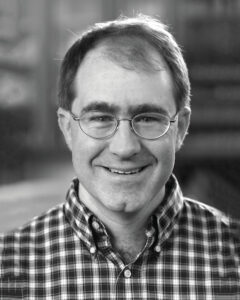
While the academic paper—“The Source of Firefly Chemical Defenses: Endogenous Biosynthesis of Lucibufagins from Cholesterol”—might not be considered unusual, the circumstances around its long gestation and eventual publication are. Smedley and Medeiros are credited as the first and second authors, respectively; their co-authors include a team from Siena University led by Smedley’s friend and longtime research collaborator Stephen T. Deyrup, professor of chemistry and biochemistry.
Craig W. Schneider, Charles A. Dana Professor of Biology, Emeritus, who worked with Smedley at Trinity for nearly 20 years before Smedley died on October 10, 2017, says, “You see posthumous publications occasionally, but it’s usually just a year or two after the person passed, and that person usually isn’t the first author.” He adds, “This paper is the culmination of Scott’s prominent body of work on the chemical defenses of certain organisms—particularly caterpillars, some moths, beetles, and fireflies—that was already significant to the field. The paper is nicely done, and it’s worthy of Scott’s approval.”
Smedley joined Trinity’s faculty in 1997. With a passion for the natural world, he grew up exploring the beaches and woodlands of Cape Cod, where he created an inventory of native moths and butterflies for the local natural history museum. Smedley earned a B.A. from Williams College and a Ph.D. in chemical ecology from Cornell University, where he also completed a postdoctoral fellowship. His teaching and research in Trinity’s Biology Department covered insect chemical ecology, invertebrate zoology, vertebrate animal visits to compost piles, and winter ecology. He also led Trinity’s Citizen Science project, which recruited participation from the public.
“Scott was serious about his work, but he also had a great sense of humor,” Schneider says. “He was so dedicated to his job, and in particular to his students and their research. He was a perfectionist; he’d have three or four students repeat experiments to make sure the data was correct.
“Scott told me many times that Trinity was a perfect place for him,” Schneider adds. “If he had gone to a larger university, he wouldn’t have had the kinds of interactions that he wanted, which was sitting side by side with students at the research bench.”
Although Medeiros was a biology major at Trinity, she never took a class with Smedley. After learning about his research and discovering their common interest in ecology, she secured a spot in his lab during her junior and senior years. The pair published several papers together, in addition to the most recent one, which is based in part on Medeiros’s senior thesis.
“Professor Smedley was an excellent mentor to have,” says Medeiros, now a physician assistant in Virginia. “He wrote me a recommendation letter for P.A. school. Having the letter and his words of support is something that still means so much to me. I carried his letter with me to P.A. interviews for good luck.”
Medeiros says that Smedley inspired those around him. “Even when we were in the field and it was negative 10 degrees, he didn’t have any complaints,” she says. “He had such enthusiasm for the work and for being outdoors. He was present in the moment and did so much for his students, putting kindness and care into every single thing.”
Creating lab experiments and collecting samples often were challenging, character-building endeavors, Medeiros says, similar to running track in the rain. “The writing, research, critical thinking, and analysis that I practiced at Trinity is what I’m doing every day in the medical field,” she says. “Professor Smedley made my time at Trinity a unique experience with lots of memories to keep me smiling through the hard times.”
Soon after Medeiros graduated from Trinity in May 2017, she visited Smedley in Hartford Hospital, where he was being treated for cancer. They talked about their research and what to do with it. “He wanted to keep pursuing publication, to make what we had done known,” Medeiros says.
Smedley’s death that fall, at age 54, hit the Trinity community hard. “He was loved,” Schneider says. “It was a great loss to the College.”
Schneider also knew that Smedley would have wanted to make sure his student’s work was published. “Scott’s students worked hard and loved working with him, and he would have felt bad if this research didn’t get published,” he says. “I knew that Scott was working with Steve [Deyrup, the Siena University professor], so I contacted him and we spent a whole day looking at data books and things they were working on together.” Smedley’s wife, Melanie, provided Deyrup with access to her husband’s computer, Medeiros offered her original research, and Deyrup said he would do his best to champion the project.
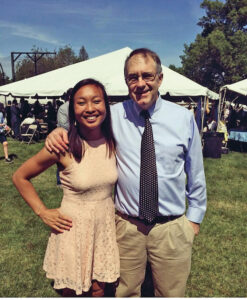
Deyrup first met Smedley through a mutual connection. “Scott was already at Trinity, but he was working with my postdoctoral adviser at Cornell,” Deyrup says. “When I got my chemical position, he reached out and asked me to work with him on fireflies. This is the third paper on firefly chemistry that we did together. Scott was an amazing biologist—these were his ideas. We could not have done any of the work without him.”
Most of the in-lab work was done when Smedley was leading the project and was completed shortly after his death, Deyrup says. But the research paper faced many delays and overcame several challenges along the way to publication. “In addition to being a great biologist, Scott was also great with statistics, so I needed to find somebody to fill those roles,” Deyrup adds.
The emotional burden of the situation proved to be even more difficult to face. “Scott was not only a good collaborator but also a great friend,” Deyrup says. “It was very emotional for me to work on this project. For a long time, it was still so raw. But it was weighing on me to complete it because he was passionate about this work and I knew that he wanted it out there.”
Deyrup involved Medeiros in the review and editing process, while Melanie Smedley provided the team with partial manuscripts and data files that she had in her possession.
“I made sure to explain to the editors of the journal that Scott is the first author,” Deyrup says. “He did so much of the work and so much of the design that he just had to be the first author. He had looked at different versions of the paper, and I know he approved of it getting published.” A special note on the paper reads, “This article is dedicated to the memory of Scott R. Smedley.”
Melanie Smedley said that she and her two children—who were 13 and 10 when Scott died—were honored that Deyrup put in so much effort and reached out to her regarding the paper’s publication. “I think it would mean a lot to Scott to have it published,” she says. “Scott cared a lot about the research itself from a purist level, but also about his students and wanting them to have insight into the rigors of good research.”
Schneider adds that the paper represents the continuation of Smedley’s legacy. “It’s a legacy to the College, a legacy to all those students he taught, that he cared for, and that he worked closely with. It’s certainly a legacy to the field of chemical ecology,” Schneider says. “Scott realized that his job meant more than himself. He actually took to heart teaching scholarship and service and truly exemplified the teacher-scholar. He had an indelible impact on Trinity and his students’ lives.”
Header photo: Ali Majdfar/Getty Images