Empowering Youth through Sport
Capitol Squash focuses on more than just the game
Story by Andrew J. Concatelli
Photos by Nick Caito
Before representatives from the nonprofit Capitol Squash came to his sixth-grade classroom at Hartford Magnet Trinity College Academy, Angel J. Salgado ’29 had never heard of the sport of squash.
The visitors were there to tell Hartford students about the free after-school program based at Trinity College that pairs the fast-paced sport with academic support, mentoring, and community activities.
“I had no idea what squash was, but I knew I wanted to meet new people, learn new things, and be fit and active, and I saw Capitol Squash as a great way to start doing that,” Salgado says. “I thought it would be something fun to do after school for a couple of months, but I never thought it would get me to where I am today.”
Seven years later, in the 2025–26 academic year, Salgado became the first Capitol Squash graduate to attend Trinity, where he joined one of the most prestigious and successful men’s squash teams in the country. The Bantams are 18-time national champions, have won the New England Small College Athletic Conference (NESCAC) championship for 19 consecutive years, and hold the record for the longest winning streak—252 consecutive matches—of any intercollegiate sport in U.S. history.
Back to the Basics
“We didn’t touch a racquet for a couple of weeks,” Salgado says of his introduction to the sport and to the mission of Capitol Squash. “It was about teamwork and building connections at first. For me, Capitol Squash was a place to do homework, have 100 percent focus, and get help if I needed it.”
Capitol Squash Executive Director Meg Taylor says that while squash is the hook that gets kids interested, the program’s goal is improving educational outcomes and empowering Hartford youth to reach their potential as athletes, students, and engaged citizens.
“It’s a high-intensity program with long-term expectations and commitments,” Taylor says. “We typically recruit students in third or fourth grade from neighborhood elementary schools. They come to us [in Trinity’s Ferris Athletic Center] after school three days a week to work on academics and learn squash.” Students also take part in weekend activities and a summer program.
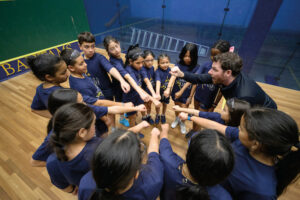
Today, 63 students from grades 3 through 12 participate, Taylor says, and an additional 25 high school graduates still receive support from Capitol Squash. Taylor calls the services and attention offered to students “really high-impact and wide-ranging.”
In addition to academic assistance, Capitol Squash provides squash equipment and uniforms and covers the costs of SAT-prep work and college visits. “It’s a way to level the playing field for our students,” Taylor says. “Visiting colleges helps them to see themselves on a college campus. Most of our students are first-generation college students, so this gives them an added level of confidence.”
Salgado notes that the care for participants goes well beyond the classroom and the court. “When my dad passed away when I was 16, everyone at Capitol Squash was there for me,” he says. “That was a very dark time, and they were the only bits of light I had.”
Participants work regularly with the six full-time Capitol Squash staff members, Trinity squash coaches and student-athletes, and volunteers to learn technique, footwork, and match play. As the younger student-athletes gain skills and confidence, they may compete in U.S. Squash Junior tournaments against members of other programs within the Squash and Education Alliance (SEA), Capitol Squash’s umbrella organization.
The Trinity Advantage
The Trinity–Capitol Squash partnership was launched in 2014 with support from Paul D. Assaiante, athletics ambassador and special assistant to the athletic director, and Wendy C. Bartlett, professor of physical education, emerita, longtime head coaches of Trinity’s men’s and women’s squash teams who retired from coaching in 2023 and 2024, respectively. Both remain active with Capitol Squash as honorary board members.
Trinity’s teams are now led by Moustafa Hamada ’15, instructor in physical education and head men’s squash coach, and Lauren Patrizio, instructor in physical education and head women’s squash coach, who encourage interactions between their players and Capitol Squash participants. Patrizio is the founder and former executive director of SquashDrive near Oakland, California, which—like Capitol Squash—is a member program of SEA.
Bantam squash players volunteer to run instructional clinics with Capitol Squash and participate in large events, including an annual fundraiser. Trinity students also may earn credit through Capitol Squash internships. Taylor says that the younger players watch some of Trinity’s matches. “It’s fun to see it start to register with our younger students that the Trinity players they know are world-class athletes.”
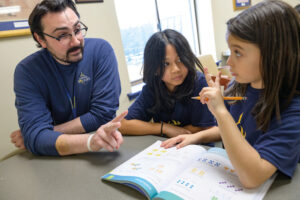
Taylor says that while 20 programs like this one exist across the country, few partner with a squash powerhouse like Trinity. “To have a small liberal arts college in a city, within walking distance to where our students live, is unique,” she says. “We’re not busing kids to another town; they live right here, and the squash courts are right here. It’s a perfect combination of all these pieces working together, which is really special.”
Gavin Viano, Trinity’s director of athletics and recreation, says that the connection between Capitol Squash and Trinity is an example of how the College and the city of Hartford support each other and thrive together. “This program helps Hartford students find pathways to education, in this case through athletics.
“Trinity’s squash program has attracted student-athletes from all over the world for the better part of a quarter century, and we now have a Capitol Squash graduate from our hometown playing squash at Trinity,” he adds. “It’s hopefully the beginning of many Hartford students attending this caliber of school, all because of what Capitol Squash offers and because Trinity is invested in their success.”
Salgado has spent a good deal of time this year with Capitol Squash participants, assisting at tryouts and serving as a mentor. “To give my input and sometimes be able to help out on the court is a full-circle moment,” he says. “I remember first seeing the glass courts as a kid. Now I’m on the Trinity team, playing on the same courts. I can’t believe I’ve come this far.”
Preparation for Life
Taylor says that the program’s success is measured by the success of its participants, who have achieved a 100-percent high school graduation rate, with 19 of those 25 graduates going on to college. “Twelve play college squash: eight varsity and four club,” Taylor says. “In the four classes that have graduated high school so far, our students have earned $3.8 million in scholarships.”
Trinity’s Admissions and Aid Office hosts workshops to help guide Capitol Squash participants through the college application process. Seeing a long-term commitment to an academic and athletic program on an application can hold great appeal to admissions teams, Taylor notes. “Colleges want to know they are investing in someone who will stick with something, who shows resilience. This kind of discipline, sportsmanship, and teamwork are things that colleges look for,” she says.
The members of Capitol Squash’s oldest class—who joined when they were in fifth grade—are graduating college this year. “One accepted a full-time job through a connection made through Capitol Squash,” Taylor says. “It’s not just about getting into college, but through college, and then preparing for a career.”
Today, the support that Salgado and other postsecondary students receive from Capitol Squash takes the form of alumni gatherings, career advancement opportunities, informational meetings with various businesses, and work on applications for internships or jobs. “The program helped to make me the person that I am,” Salgado adds. “I have no idea where I’d be right now without Capitol Squash.”
Header: Capitol Squash alum and current Trinity’s men’s squash team member Angel J. Salgado ’29, in back, joins several current Capitol Squash student-athletes on the court.