Khaoula Ben Haj Frej, M.D., ’18
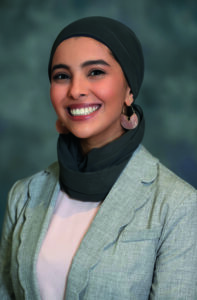 Degrees: B.S. in neuroscience; M.D., University of Connecticut School of Medicine
Job Title: General surgery resident, The Johns Hopkins Hospital
Favorite Trinity Memory: The first thing I think of is sitting on the quad with my roommates on a really beautiful, sunny day. We were just lying on our blankets and talking, and I remember thinking that I had experienced a hard four years—and wow, we did it!
Would you tell us a little about your educational path?
I was born and raised in Connecticut, and I wanted to stay close to home. The College had a Preview Weekend, and that’s when I fell in love with the campus and decided to go to Trinity. I did the Genomics Research Program, which was a pathway to research. I took all the premed classes and did research every summer and sometimes during the academic years, and I worked in a few labs. I was getting exposed to what it meant to collect scientific data and present it in a tangible way. I also studied abroad in Trinidad and did a rotation in an emergency room. My family is from Tunisia, so I got some exposure there to a different health care system, a less privileged one than we have here. Still, I really didn’t know what I wanted to do with my life, so I took some gap years. I worked at the Dana Farber Cancer Institute in Boston, starting out in a basic science lab. We lost our grant in the first year of a two-year position, so I switched to a different position in clinical trials. That kind of cinched it for me, working with cancer patients and getting to know them on a personal level and also on a data level. Then COVID hit, and I saw how impacted they were by that. I applied to med school and from there decided that I wanted to be a physician-scientist. General surgery training is five years, and Johns Hopkins encourages research years, so I’m looking to also pursue two to three years of research.
What do you do now in your role? Is it like what’s on TV?
I think some of Grey’s Anatomy is accurate. There’s a lot of running around taking care of patients, but it’s a lot less sordid, less of a soap opera. In the morning, we round on our patients as a team with our chief. I spend the rest of the day in the operating room, and between cases, I’ll check in on patients on the floor or work on discharges. I see everything from breast surgery to colorectal to surgical oncology. We also do a lot more medicine than the TV shows portray; when a surgical patient is admitted, we’re taking care of their blood pressure and diabetes and other conditions as well as postoperative care.
What do you enjoy most about what you do?
I think there is the really mind-boggling trust that patients put in us and this vulnerability that they have that never fails to blow me away. I enjoy knowing that I have the ability to build these relationships with patients. And there’s the operating, of course, and the opportunity to learn technical skills.
What challenges do you face?
The emotional losses are always difficult. Seeing patients have bad outcomes takes its toll. We also deal with systemic challenges, taking care of patients who might be uninsured and jumping through hoops to try to get them their surgery or medication. The hours are hard, the time that you’re on your feet, needing to triage what is important, what is crucial in this moment, what is urgent, and what is emergent. It has been a challenge as a first-year resident, just learning to be a doctor.
Did you have a professor who was particularly influential?
Hands down, Dr. Alison Draper. She wasn’t even my formal adviser; she was a premed adviser who became my personal adviser and my life adviser. I had a lot of challenges at Trinity. I was a lot younger than many of my peers; I graduated from high school at 16. I also worked full time, and I had a hard time balancing academics. It was the first time I was away from home. She was there for me for so much of it. When my lab lost its grant and I found out that I no longer had a contract, she came to Boston to see me. I had graduated from Trinity, and I was no longer a student. But I was so distraught, and I thought my world was caving in. She is an incredible teacher, an incredible scientist, but above all else, she is an incredible person.