Widener Gallery to Present Exhibition by Dennis Delgado, Are You Also Divergent, Friend?
Content
Story
Posted
Category
Announcement
An exhibition featuring four projects by artist Dennis Delgado, Are You Also Divergent, Friend?, will open at Trinity College’s Widener Gallery in the Austin Arts Center on Monday, October 6. The exhibited work includes video, tapestries, installation, and collage, most of which are on view for the first time.
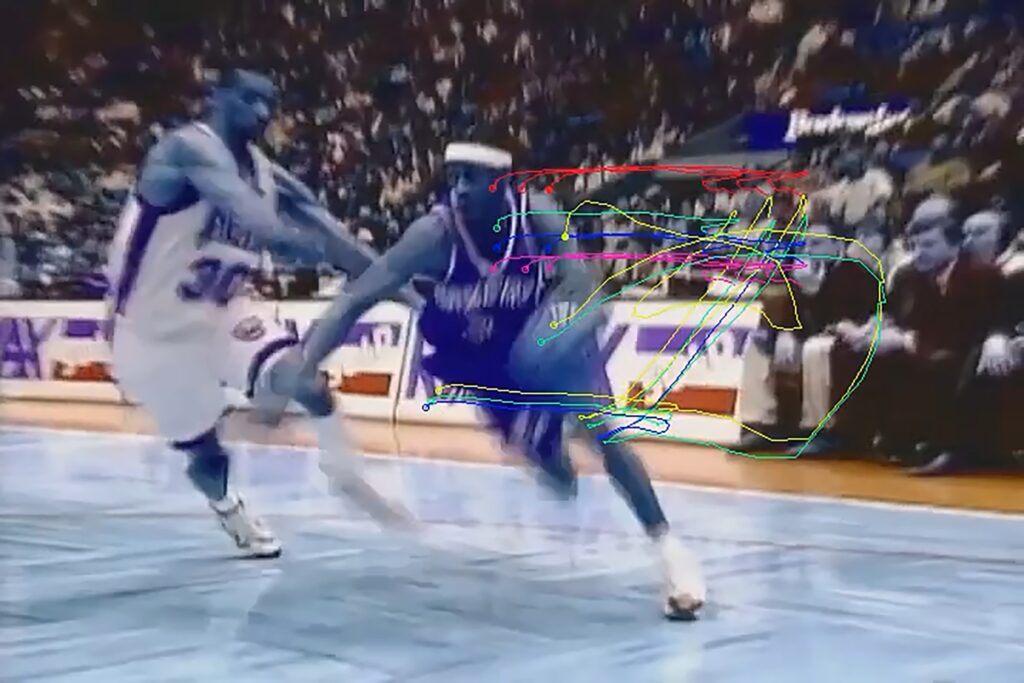
Dennis Delgado, Mapping AI
Sponsored by Trinity’s Studio Arts Program, the exhibition will be open through December 5, 2025 (closed October 13–14 and November 26–28). The gallery hours are Monday through Friday, 10:00 a.m. to 5:00 p.m., and by appointment. Delgado will give an artist talk on November 6 at 12:15 p.m., followed by a reception later that day at 4:00 p.m. The Widener Gallery is free and open to the public.
In the midst of increased controversy over artificial intelligence and its impacts on individuals and society, Delgado focuses on the experience of being a person of color in a new age of automated and algorithmic surveillance. Each project explores how technologies of vision shape the discursive formation of the “Other,” and how the colonialist gaze was coded into the surveillance tools of today, revealing a historical presence in the current moment.
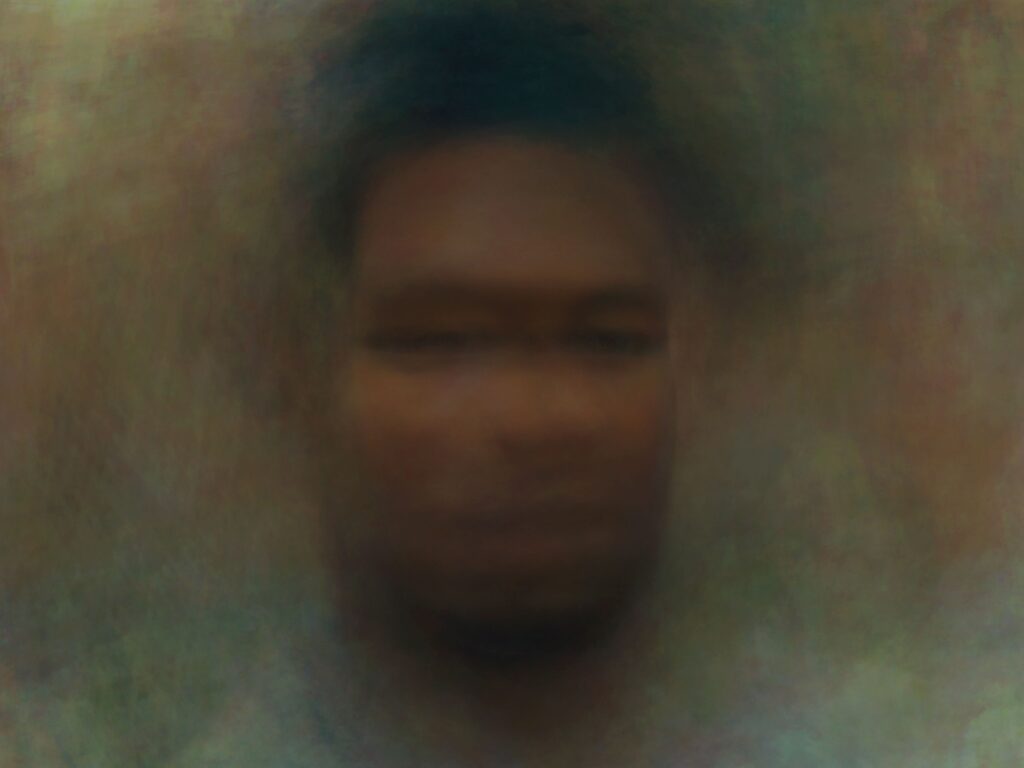
Delgado’s work utilizes technologies of vision, often combining them with existing visual culture to reveal gaps in sight and training data. In Mapping AI, an Open Computer Vision co-tracking algorithm labors to delineate the movements of now-retired NBA basketball player Allen Iverson. In The Dark Database, four tablets present digital portraits composited using the results of a facial recognition algorithm performed on films directed by and often starring men of color. Delgado says that each of his projects reveals the lingering presence of Eurocentric bias in tools for automating how computers process images.
Dennis Delgado, Moonlight
Ultimately, Are You Also Divergent, Friend? asks, can computers be taught to regard every subject/object as equal if they diverge from invisibly established norms? Or has the colonialist gaze been embedded into their software from its inception, pointing their development in a direction that is generative, cumulative, and therefore difficult to reverse?
Delgado was born in the South Bronx in New York City. He received a B.A. in film studies from the University of Rochester, as well as an M.F.A. in sculpture from The City College of New York (CUNY). He is an assistant professor of new media at Baruch College’s Weissman School of Arts and Sciences. Delgado’s work has been exhibited at the Bronx Museum of the Arts, the Schomburg Center for Research in Black Culture, UC Irvine, UT Austin, Palo Alto Center for the Arts, El Museum del Barrio, and at the Cooper Union.
The grant for Susan A. Masino, Paul E. Raether Distinguished Professor of Applied Science, and David N. Ruskin, research associate professor, will provide summer research opportunities for Trinity students.
A page of 15th century text—hidden for more than 100 years in an uncatalogued scrapbook in the Watkinson’s archives—has connections to famed printer Johannes Gutenberg and may represent one of the earliest generations of European printing.
The digital humanities website Public Art CT—sponsored in part by Trinity College and created by a Trinity faculty member—has received a 2026 Award of Excellence from the American Association for State and Local History (AASLH).
A book by Associate Professor of American Studies Juliet Nebolon was named a co-winner of the 2026 Association for Asian American Studies (AAAS) History Book Award.