
Faculty Member Wins History Book Award from Association for Asian American Studies
A book by Associate Professor of American Studies Juliet Nebolon was named a co-winner of the 2026 Association for Asian American Studies (AAAS) History Book Award.
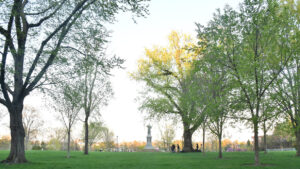
The Trinity College campus is among thousands of landscapes featured on the Olmsted Trail, a new online resource offered by the Olmsted Network cataloging projects shaped by pioneering landscape architect Frederick Law Olmsted and his successor firms.
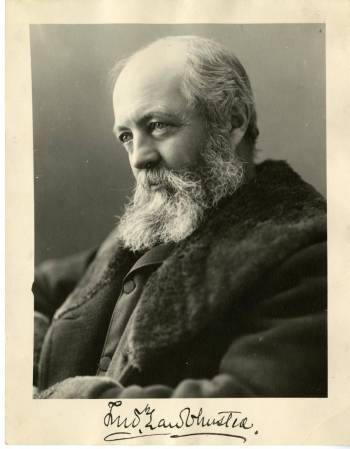
The Olmsted Network is a national organization dedicated to championing Olmsted parks, places, and principles through advocacy, education, and stewardship. Starting with New York City’s Central Park in 1858, Olmsted and his firms touched nearly 6,000 landscape designs.
On its project page about Trinity College, the Olmsted Network says that the Trinity campus was designed over the course of several decades with involvement from the Olmsted firm.
According to the Olmsted Network, “In 1872, Frederick Law Olmsted returned to his hometown of Hartford, Connecticut, to contribute to the planning and design of Trinity College. In post-Civil War America, Olmsted believed universities should play a critical role in advancing democracy. As he saw it, the physical environment (buildings and grounds) contributed to both the success of education as well as the shaping of character.”
Olmsted suggested several potential locations for Trinity, visiting sites for the city of Hartford and Board of Trustees, before sketching out his ultimate vision, the Olmsted Network says. “In a letter to the college president, Olmsted wrote ‘a well-designed campus’ would foster ‘acquisition of the general quality of culture which is the chief end of a liberal education.’ Although the trustees selected a different location than the ones presented, Olmsted’s sketches influenced the development of the college and provided guidance on how to navigate the uneven terrain of the site they chose.”
 “Inspired by British design, the main campus includes an elevated quadrangle that frames the campus’ iconic Long Walk,” the Olmsted Network says. “The Long Walk is positioned to orient campus buildings along Rocky Ridge, a prominent trap rock ridge in Hartford. The quadrangle featured elm trees to provide shading and decoration.”
The Olmsted Network adds that Olmsted and his sons remained involved at Trinity College until the early 1890s, advising the planning and development of the campus for more than 20 years.
As cited in Encyclopedia Trinitiana, the Trinity Tablet reported in 1883 on campus improvements which included the planting of several rows of “young trees and evergreens,” attributed to Olmsted’s landscape design plan for the campus grounds. In the 1890s, Olmsted was contracted to design a park-like area west of the Long Walk, extending along Summit Street in the area used as a quarry by the city of Hartford. Some of the Olmsted firm’s designs for this area are implemented there.
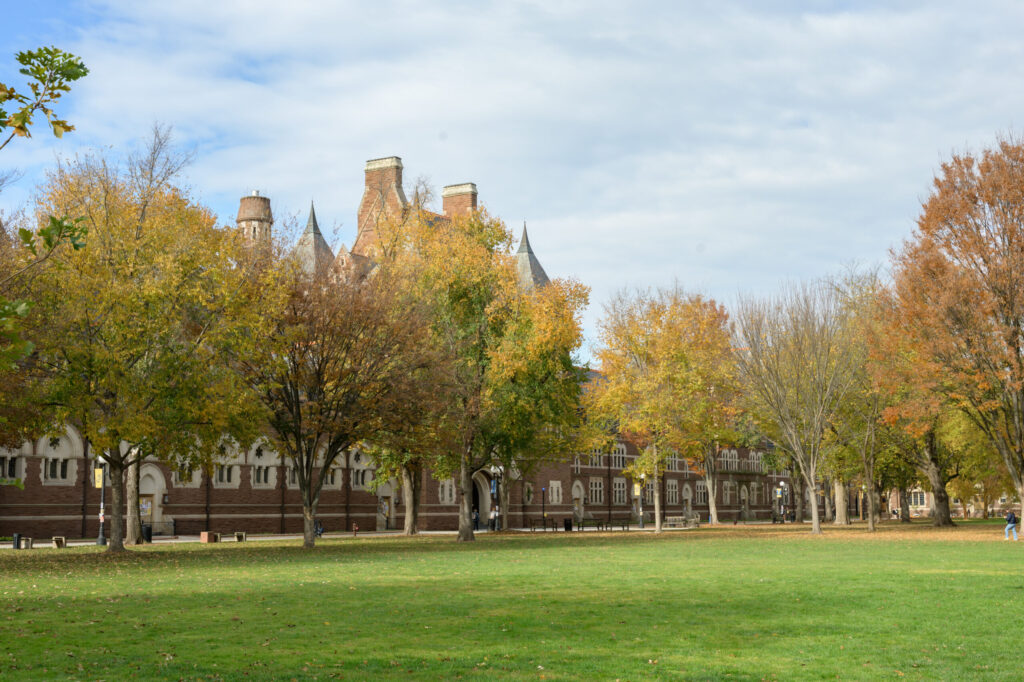 Today, many species of trees now shade the Main Quad, and in 2023, the Trinity campus became an accredited Level I arboretum.
After his death in 1903, Olmsted was buried at Old North Cemetery in Hartford. The work of Olmsted and his firms may be found in commissioned projects which span the country and include landscape design for academic institutions, public parks and grounds, residential communities, and private estates.
Learn more about Trinity College and Frederick Law Olmsted here.
A book by Associate Professor of American Studies Juliet Nebolon was named a co-winner of the 2026 Association for Asian American Studies (AAAS) History Book Award.
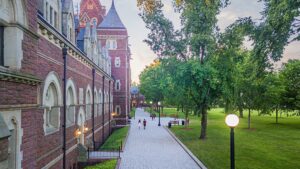
Anthony M. Messina, John R. Reitemeyer Professor of Political Science, Emeritus, has received a 2026 Career Achievement Award from the American Political Science Association’s Section on Migration and Citizenship.

Katsuya Izumi, senior lecturer in language and culture studies, has received a grant award from the Northeast Asian Council of the Association for Asian Studies to support research for an upcoming book.

Trinity College Assistant Professor of International Studies Natassja B. Gunasena was awarded a Career Enhancement Fellowship for Junior Faculty by the Institute for Citizens & Scholars to support research that she plans to publish as a book.