Science on Screen: Trinity Faculty Member to Deliver Talk at Showing of My Octopus Teacher
Content
Story
Posted
Category
Faculty
A Trinity College faculty member will share her expertise at a screening of the Academy Award-winning documentary My Octopus Teacher in Hartford.
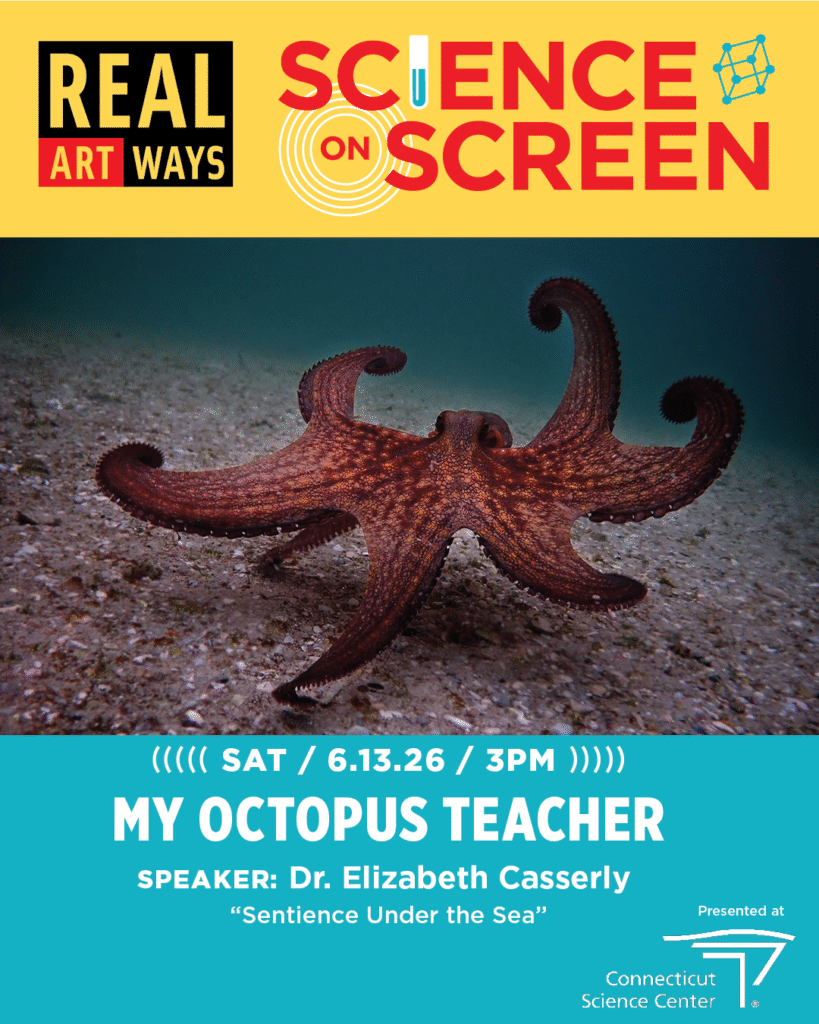
Associate Professor of Psychology Elizabeth D. Casserly will present a talk about interspecies communication and non-human animal cognition as part of the “Science on Screen” series hosted by Real Arts Ways. The event will be held on Saturday, June 13, at the Connecticut Science Center at 3:00 p.m. Learn more here.
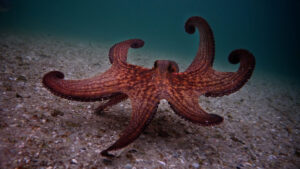
My Octopus Teacher is a 2020 Netflix documentary film directed by Pippa Ehrlich and James Reed that chronicles a yearlong relationship that filmmaker Craig Foster forged with a wild octopus near South Africa.
Associate Professor of Psychology Elizabeth D. Casserly
Casserly, who has been a Trinity faculty member since 2013, conducts research focusing on human
cognition, particularly with respect to speech and communication, and has taught about diverse ways of understanding the mind for the last 10 years. “Minds are fascinating ‘black boxes,’ whether you’re talking about humans or other animals,” she said. “In cognitive science, the challenge is to investigate the mind scientifically, without relying on intuition. As a result, we’ve had to come up with ingenious methods to infer the thoughts and processes beneath the surface. Adapting and applying some of those methods for work with non-humans involves putting everything in their context, with respect to their goals and environment. It means we need to be even more clever!”
Casserly’s particular study of language has involved physics, engineering, formal linguistics, fieldwork on Scandinavian languages in the North Atlantic, computer science, psychology, and the speech and hearing sciences.
“I believe that it is only when we bring these diverse views together that we can hope to unpack the complexities of humanity’s cognitive underpinnings,” Casserly said in her faculty profile.
At Trinity, Casserly has an appointment in the Neuroscience Program, in addition to her position in the Psychology Department, and in 2020 she became the coordinator for the cognitive science minor, in which students can bring together courses from across the curriculum to create a rich scholarship surrounding the mind.
“I hope to inspire students—and colleagues—to see and appreciate connections across disparate specializations and scholarly work,” Casserly said.
The “Science on Screen” lineup also will include: Bringing Up Baby (Saturday, July 18), Point Break (Saturday, August 15), Agent of Happiness (Saturday, October 17), and Wall-E (Saturday, November 7). Each event includes a speaker who introduces current research or technological advances.
The June 13 event featuring Casserly’s talk begins at 3:00 p.m. at the Connecticut Science Center, located at 250 Columbus Boulevard in Hartford. Tickets and more information are available through Real Art Ways.
The Trinity College community gathered for a documentary film screening and panel discussion with alumna Julia Hoppock ’06, an associate producer of People vs. Politics, as part of Voter Education Week.
The grant for Susan A. Masino, Paul E. Raether Distinguished Professor of Applied Science, and David N. Ruskin, research associate professor, will provide summer research opportunities for Trinity students.
Associate Professor of Classical Studies Vincent E. Tomasso, whose first-year seminar is reading Homer’s epic poem, will give a presentation as part of Odyssey Day this fall. Read more about why he says The Odyssey still resonates today.
More than 100 Trinity students spent part of the summer working with faculty members and other mentors. The fall symposium allowed these students to showcase their findings and research processes.
 “I believe that it is only when we bring these diverse views together that we can hope to unpack the complexities of humanity’s cognitive underpinnings,” Casserly said in her