Student Mentor: Trinity’s First-Year Seminars ‘Build Foundational Relationships and Skills’
Content
Story
Posted
By
Birdie Stark ’26
Category
Academics
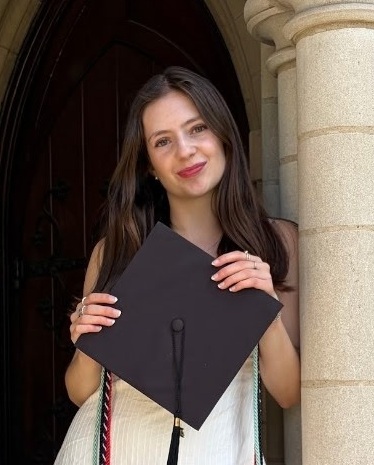
Birdie Stark ’26, a Trinity College alumna who completed a B.A. in English last spring, mentored 13 students in their fall 2025 first-year seminar, “Physics in Science Fiction.” During her undergraduate career, Stark was involved with the Trinity College Writing Center, the Sigma Tau Delta English Honors Society, and the Trinity Prison Education Project. Here, she reflects on her experience as a first-year seminar mentor:
After traveling 2,500 miles away from my home in Tucson, Arizona, I arrived on Trinity’s campus my first semester without a single familiar face in sight and only a vague idea of what I wanted to study. It was a major change for me, meaning that my fall semester was full of fear, excitement, and relative uncertainty about what lay ahead.
Birdie Stark ’26
Like all first-year students at Trinity, I was enrolled in a first-year seminar that fall. These small, discussion-based classes emphasize writing, critical thinking, and research skills while helping students navigate the transition into college life. My seminar—“Art and Artists,” part of the InterArts Gateway program—provided me a space to connect with other students, hone my writing skills, and receive consistent support as I began my journey as an undergrad. Looking back now, I believe it was one of the first spaces on campus where I felt a real sense of belonging.
Paired with each first-year seminar is an upper-year student mentor, and I found that my mentor played an essential role in my first-year seminar experience. He was candid, thoughtful, and approachable, making Trinity feel navigable when everything around me seemed entirely new. I never forgot that experience, so last year I was thrilled to take on a role as first-year seminar mentor for the Class of 2029. I worked alongside Associate Professor of Physics David Branning as a mentor for his seminar, “Physics in Science Fiction.” The course consisted of both literary and scientific investigations of various works of science fiction, including novels like Andy Weir’s Project Hail Mary and Poul Anderson’s Tau Zero.
As an English major, I was able to collaborate with Professor Branning to curate a space for academic conversation that bridged humanities and the sciences. I think this course was particularly unique in its synthesis of two disciplines, as the course often toggled between speculations about the “hard” physics of sci-fi and the underlying literary themes of those same science fiction stories. And while many of my mentees described themselves as “science-brained,” I was consistently impressed by their ability to tackle creative and literary analysis with open minds, inquisitiveness, and passion. The course culminated in a final creative writing project which allowed students to compose their own sci-fi stories, pulling inspiration from the themes and conventions of the genre we’d encountered throughout the semester.
When I tell people about my role as a first-year mentor, I find they’re often confused about how the position differs from that of a teaching assistant, or TA. I usually explain it like this: while TAs provide discipline-specific academic guidance, first-year seminar mentors serve a much broader purpose as peer advisors. We help students navigate both the academic and personal dimensions of college life, meaning our role extends far beyond the classroom.
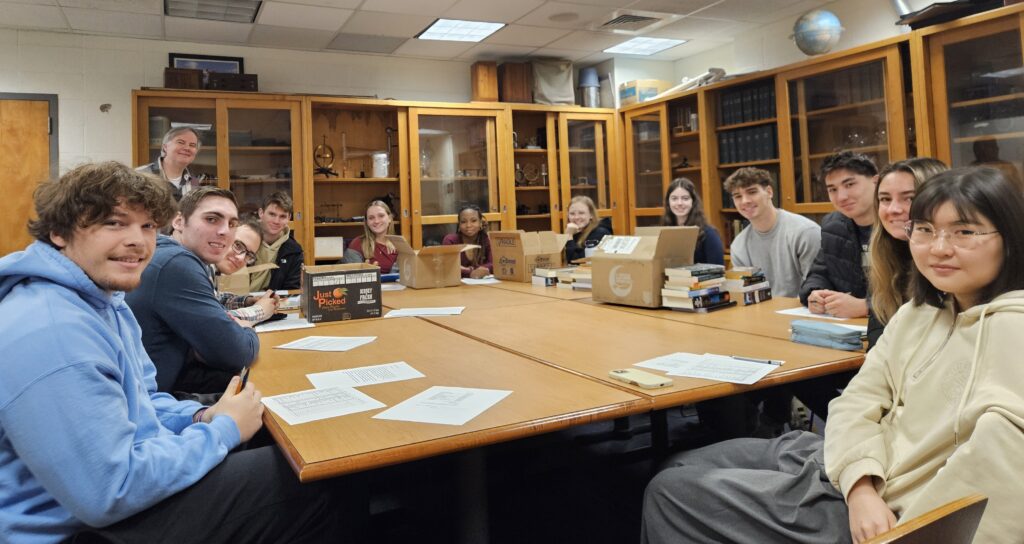
The fall 2025 first-year seminar, “Physics in Science Fiction.”
Last year, one of my priorities as a mentor was introducing my mentees to the many on-campus resources Trinity has to offer. Early in the semester, I found this helped lower the barrier to engagement for students who might otherwise hesitate to take advantage of the College’s programs. We discussed making appointments at the Writing Center, Aetna Quantitative Center (Q-Center), Blume Language and Culture Learning Center, Peer Research Center, and Subject Based Tutoring Center—all of which offer peer-to-peer academic support across a wide range of academic disciplines. I also ensured they were familiar with emotional and mental health services, like those offered at the Counseling and Wellness Center.
My absolute favorite time to connect with my mentees was during my office hours, which I held weekly at one of Trinity’s on-campus coffee shops. I got to know so many of my mentees this way, as they came by to chat about dorm life, discuss classwork, ask about course registration, and share broader concerns about college as a whole. Since many of my mentees were prospective STEM majors, we often talked about the importance of taking classes outside of their major.
Over time, those conversations gave way to something larger, and by the conclusion of our semester together I found that the community of our first-year seminar had already stretched far beyond the classroom. Thanks to the first-year seminar program’s funding, we were able to hold weekly pizza dinners where we watched and discussed quintessential science fiction films. In March of that next semester, we even organized a trip to see the film adaptation of Andy Weir’s Project Hail Mary in theaters.
That, to me, is one of the best parts of the first-year seminar program. Beyond serving as academic courses in their own right, first-year seminars provide an opportunity to build foundational relationships and skills to last the remainder of one’s undergraduate career. Even now, as an alumna, I’m still able to reflect on the ways in which my first-year seminar shaped me for a life beyond college. It was a delight to mentor my students as they began their social, academic, and emotional undergraduate journeys, and I know that—like me—they’ll carry the lessons and connections into the rest of their college careers and beyond.
Learn more about Trinity’s First-Year Seminar Program here.
Associate Professor of Classical Studies Vincent E. Tomasso, whose first-year seminar is reading Homer’s epic poem, will give a presentation as part of Odyssey Day this fall. Read more about why he says The Odyssey still resonates today.
More than 100 Trinity students spent part of the summer working with faculty members and other mentors. The fall symposium allowed these students to showcase their findings and research processes.
A page of 15th century text—hidden for more than 100 years in an uncatalogued scrapbook in the Watkinson’s archives—has connections to famed printer Johannes Gutenberg and may represent one of the earliest generations of European printing.
The digital humanities website Public Art CT—sponsored in part by Trinity College and created by a Trinity faculty member—has received a 2026 Award of Excellence from the American Association for State and Local History (AASLH).