‘A Dream Come True:’ Trinity Students Conduct Archaeological Research in Greece this Summer
Content
Story
Posted
By
Andrew J. Concatelli
Category
Academics
Two Trinity College students spent a month conducting archaeological research in Greece this summer alongside Associate Professor of Classical Studies Martha K. Risser.
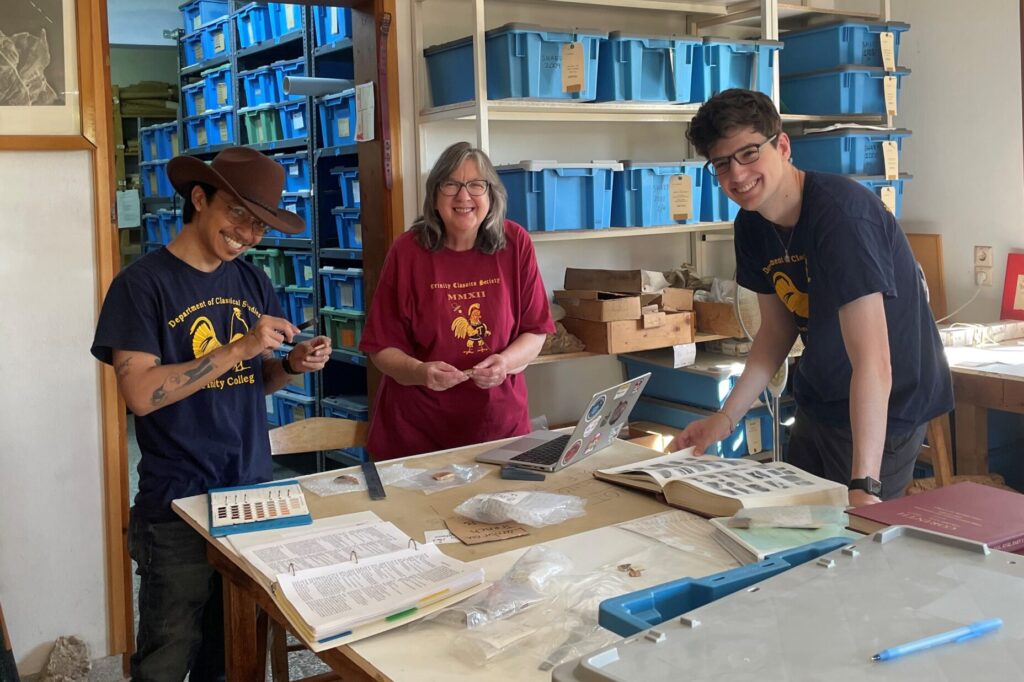
Trinity students Augustin Millet ’28 (left) and Noah R. Turner ’27 (right) with Associate Professor of Classical Studies Martha K. Risser in Greece.
Augustin Millet ’28 of Plano, Texas, and Noah R. Turner ’27 of Kirkland, Washington, each received funding from the James Goodwin Prizes in Ancient Greek Culture, which they won at Honors Day this spring. Both students are classical studies majors; Turner is additionally completing a minor in English.
Risser and the student researchers are part of a team working to analyze pieces of pottery from the sixth to fourth centuries BCE that were excavated from the West Cemetery at Isthmia between 1967 and 1970. They dated the pottery from the Ancient Corinthian graveyard by taking measurements, photographing, and analyzing the art and structure of the pieces, called sherds. Risser also worked on this project in summer 2025 with Trinity students Eleanor Raspa ’27 and Madison Schofield ’27.
This year’s fieldwork was conducted in June at the “Dig House,” a storage and research facility at Isthmia. “I am staying in Greece,” Risser said, “but the students will go home and work with me remotely for the rest of the summer. July and August work includes labeling and organizing the hundreds of photographs they have been taking of all of the pottery; checking and proofreading spreadsheets; converting the data we have been collecting into charts and tables; and similar tasks.”
Noah R. Turner ’27 and Augustin Millet ’28 worked for a month on an archaeological research project in Greece.
Risser recently was awarded an ASCSA Senior Fellowship for Advanced Research in the Humanities from the American School of Classical Studies at Athens. The fellowship will extend her scheduled one-semester quadrennial leave to the entire 2026-27 academic year, which she will spend at the American School of Classical Studies at Athens. “Building on the research I am doing this summer with my students, I will take a holistic, person-centered approach to presenting the material in a book, merging the analyses of pottery and other grave goods, skeletal remains, and individual grave contexts into a cohesive examination of the people, their community, their customs, and their beliefs,” Risser said. “This will help to develop a broader understanding of ancient pottery and its funerary use during the Greek Archaic and Classical periods.”
Read more from Risser, Millet, and Turner below:
Why were you interested in being a part of this research team?
Associate Professor of Classical Studies Martha K. Risser: Isthmia’s West Cemetery was discovered in 1967 by construction workers. The late Paul Clement, a UCLA professor, was called upon to conduct an archaeological excavation. Clement’s team did an admirable job of recovering material and documenting the process, but little further work was done. Now I’m part of a team led by Jon Frey (Michigan State University) and Lita Tzortzopoulou-Gregory (Australian Archaeological Institute) working to resolve the curation crisis that resulted from the outdated practice of excavating without fully publishing the cemetery. My responsibility is a study of the pottery from the cemetery, and my main goal is to understand aspects of the ancient Isthmian community through the items people selected to bury with the deceased. What do these pots tell us about the people who selected them?
Augustin Millet ’28: I accepted the offer from Professor Risser because I knew I would be walking in the footsteps of Alexander the Great. He is the reason why I’m majoring in classical studies. It feels like a real dream come true, since I was just daydreaming about all of this three years ago while working at PetSmart in Plano, Texas. I couldn’t be more thankful to be in Ancient Corinth, gazing upon the views that Alexander once laid his eyes on.
Noah R. Turner ’27: I am planning on getting a Ph.D. and have been dying to do some field research at Trinity. Professor Risser is the best there is with ancient pottery, and we worked with so many incredibly knowledgeable people. I have loved classical studies for over a decade, and though my specialty isn’t pottery, the chance to actually touch and interact with things that were held by people two and a half millennia ago is incredible. This is a once-in-a-lifetime experience that I have literally been dreaming about since I was in elementary school. I wanted to be a paleontologist when I was 5 years old, and even though the subject matter has changed slightly, I think I’m making 5-year-old Noah proud.
When doing this fieldwork in Greece this summer, what was a typical day like?
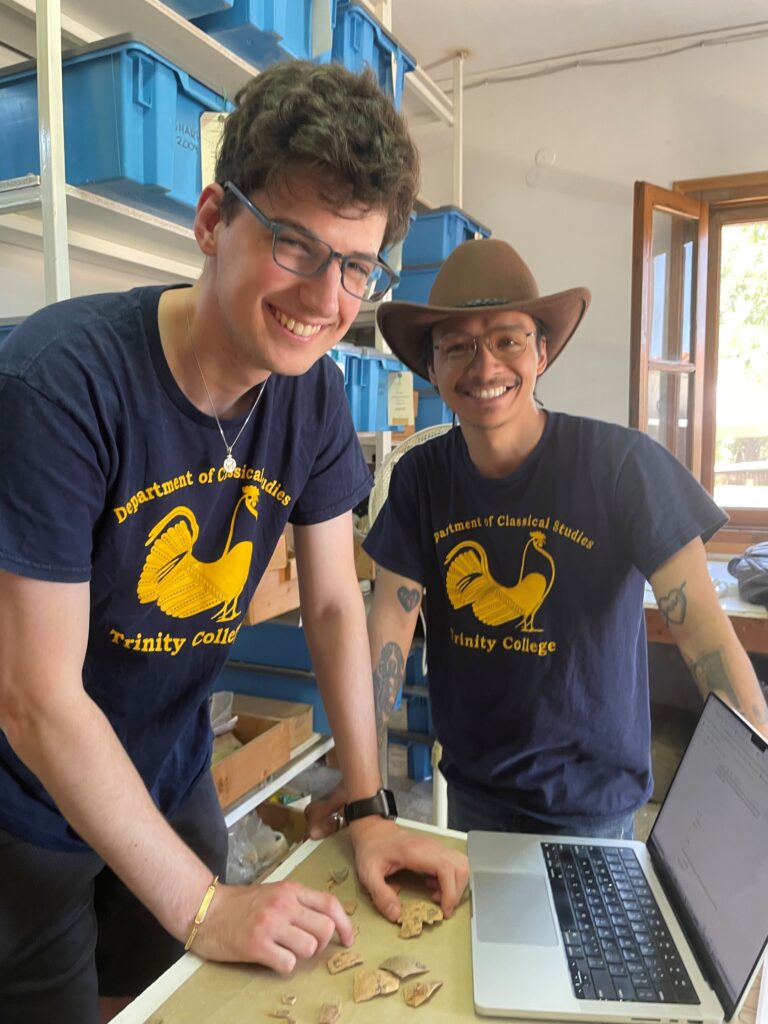
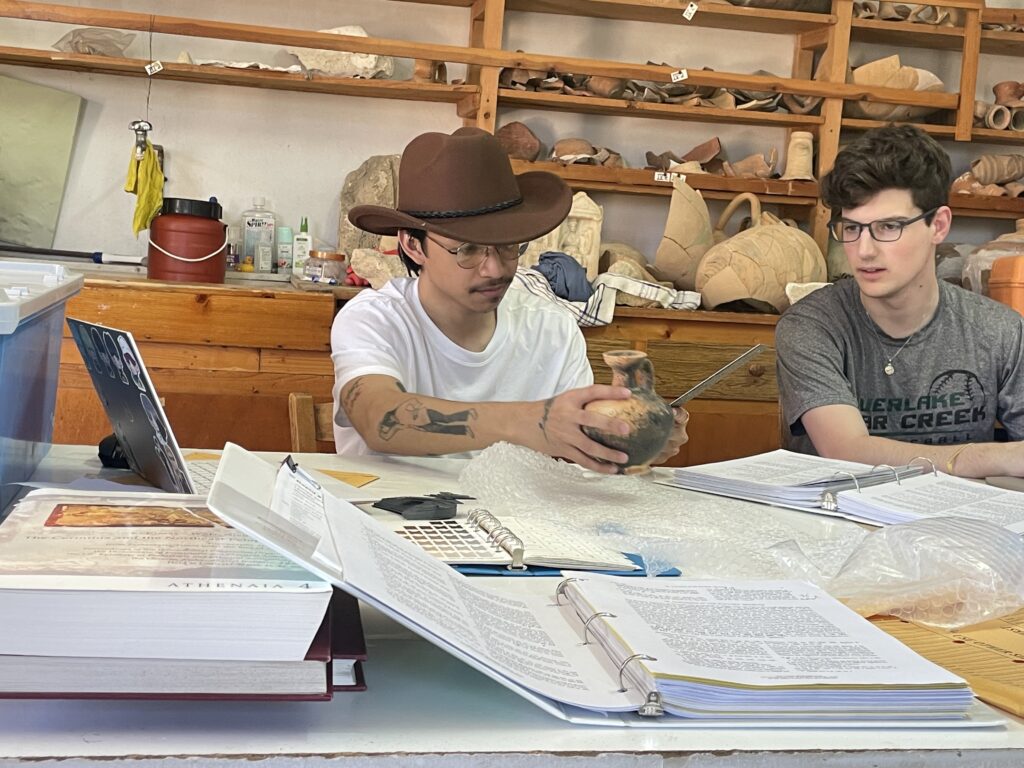
Noah R. Turner ’27 helped to date pottery from an Ancient Corinthian graveyard by taking measurements, photographing, and analyzing the art and structure of the pieces.
Turner: We would have a beautiful breakfast of fruit, eggs, and pastries at our hotel, and then head to the site at 8:30. We spent most of our day going through boxes and analyzing pottery sherds, cross-referencing with spreadsheets, and writing down all of the information for future use.
Risser: Augustin, Noah, and I went through pottery the excavators saved, but could not assign with certainty to a grave. Sherds from many different pots are grouped and organized by find-spot and stored in plastic bags. The students carefully measured and described each item; we use alphanumeric Munsell codes in place of subjective color descriptions, and then a pot’s shape and decoration must be described according to very specific, standardized formulas.
Millet: We were essentially helping to reconstruct the world that the people of Ancient Corinth lived in, bit by bit.
How did this experience build on the learning that happens in Trinity’s classrooms?
Turner: Trinity has many amazing professors and classes in classical studies, but you can’t beat actually being at a site and working hands-on with the materials. The fact that there were only two students working with Professor Risser and another professor also adds to the personalized experience.
Millet: Having this hands-on experience greatly boosts my confidence in learning and sharing what we study, both in and out of the classroom. Actually getting to not only see the pottery but touch it, examine it, and get a true sense of the different sizes it comes in—instead of just looking at pictures in textbooks and guessing the dimensions—definitely paints a clearer picture.
Risser: Field research is one of my favorite forms of teaching because the work is tangible. In the classroom, I show students how to look at and analyze ancient art. At Isthmia, my students put that into practice with materials no one else has yet seen, handling artifacts that are more than 2,600 years old, examining them closely and from all angles.
What kind of skills or knowledge are gained from this work?
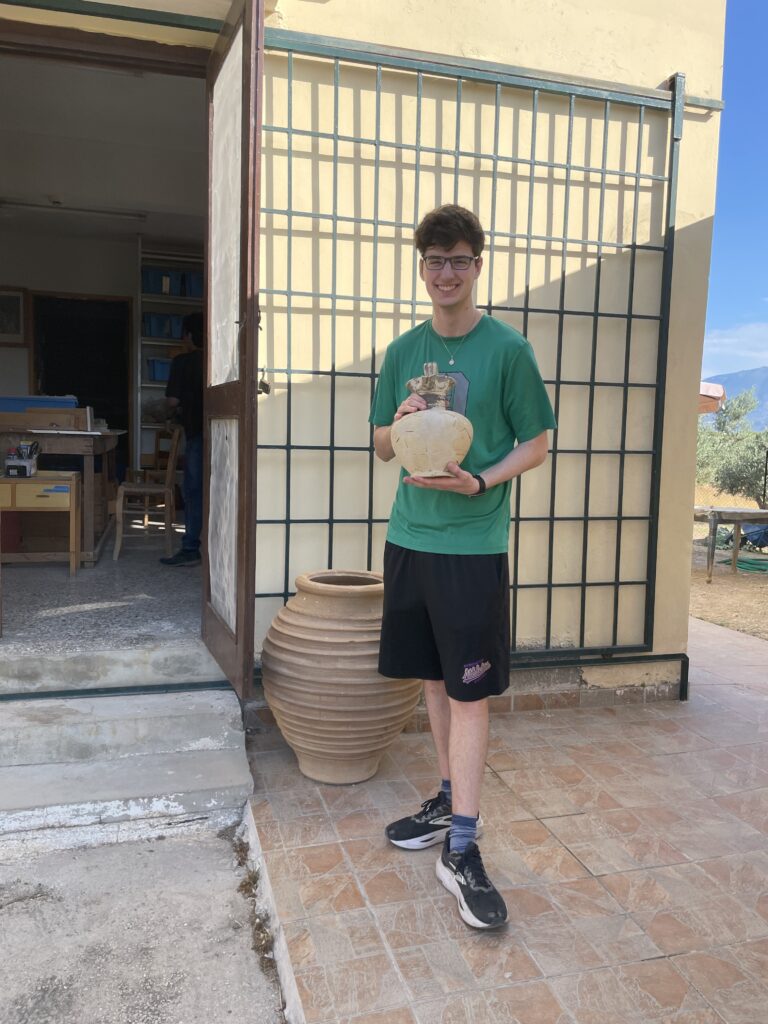
Augustin Millet ’28 and Noah R. Turner ’27 conducted research in June 2026 at the “Dig House” in Isthmia, Greece.
Millet: Since we were working with pottery, I wanted to learn as much as I could about identifying different types. Working with Professor Risser, who is absolutely the best at her job, made learning a lot easier because we could just ask her about a piece and she immediately knew the answer. On day one, I felt the pressure since I couldn’t identify anything on my own, but now, I can confidently identify a trefoil oinochoe from a few inches of a rim sherd. I’ve also learned how to tell which sherds are Roman, Attic, and Corinthian, all from the knowledge that Professor Risser has shared.
Risser: My students are learning—through active participation—how archaeologists conduct research, how to read and interpret excavation records, and how to gain further understanding of ancient Greek people through material culture. This is an intellectual experience with broader applications. As they collect, quantify, cross-reference, and interpret data, my students are developing teamwork, critical thinking, communication, and analytical skills they can apply to anything else they do in their future lives.
Turner: I hope to be a professor one day so I can impart the same skills and memories to my students that Professor Risser has given us: not only the knowledge of the subject, but the experience of working at a site with experts from around the world, the experience of living in another country, and all of the other priceless things that doing this research brings.
The Trinity College community gathered for a documentary film screening and panel discussion with alumna Julia Hoppock ’06, an associate producer of People vs. Politics, as part of Voter Education Week.
The grant for Susan A. Masino, Paul E. Raether Distinguished Professor of Applied Science, and David N. Ruskin, research associate professor, will provide summer research opportunities for Trinity students.
Associate Professor of Classical Studies Vincent E. Tomasso, whose first-year seminar is reading Homer’s epic poem, will give a presentation as part of Odyssey Day this fall. Read more about why he says The Odyssey still resonates today.
More than 100 Trinity students spent part of the summer working with faculty members and other mentors. The fall symposium allowed these students to showcase their findings and research processes.