Neuroscience explores how the brain and nervous system shape behavior, thought, and consciousness. At Trinity, you’ll study how neurons develop and communicate, how the brain processes information, and how dysregulation of these systems can lead to neuropsychiatric disorders.
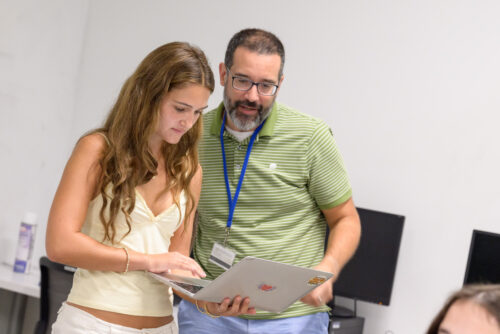
Our program brings together faculty from biology, chemistry, engineering, philosophy, and psychology to offer an integrated approach to understanding the mind and brain. You’ll build a strong foundation in the sciences, while tailoring your studies toward cellular and molecular, systems and behavioral, or cognitive and clinical neuroscience.
A neuroscience major at Trinity opens doors to careers in research, healthcare, education, business, law, or public service, while also preparing you for advanced study in graduate or medical school.
Coursework
Neuroscience majors begin with foundational courses in Brain and Behavior, Principles of Neuroscience, biology, and chemistry, and later engage in advanced lab and seminar experiences that connect research to real-world discovery. Students can explore electives such as Developmental, Behavioral, and Cognitive Neuroscience, Neurochemistry, Neuroendocrinology, Human Neuropsychology, and Nutrition and Brain Health.
Research
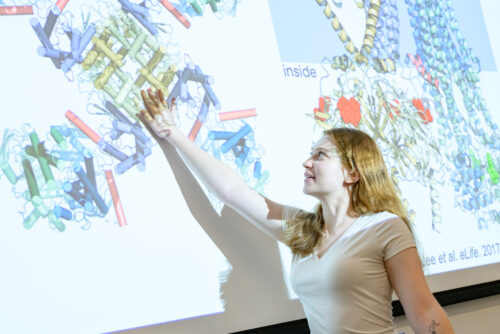
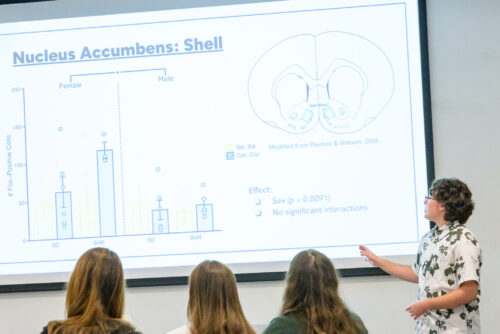
Students gain hands-on experience in Trinity’s state-of-the-art labs and through research collaborations on campus and at nearby institutions such as the Olin Neuropsychiatry Research Center. Faculty research spans topics from brain plasticity and memory to addiction, autism, and the study of attention.
Why Major in Neuroscience at Trinity?
There may be no course of study more representative of the relevance, range, and challenge of a liberal arts education at Trinity than the major in neuroscience. With its multidisciplinary approach it embodies the ideals of a liberal arts education. Neuroscience, the major, offers a unique undergraduate experience. From the enjoyment of research to the diversity of subject matter to the level of work and scholarship demanded of the program, students are encouraged to extend themselves in new challenges and new ways of thinking. The intensive program enhances their powers of perception, organization, and expression.
Outcomes
After graduating as Neuroscience majors, most students pursue graduate studies in some area related to their curriculum at Trinity, including about 40 percent of graduates who go on to attend medical school. Others pursue graduate degrees in research. Still others find their undergraduate experience has provided an exceptional foundation for careers in a broad spectrum of careers, from applied sciences to law to philosophy. Each finds that as a neuroscience major at Trinity College, they have been prepared in a truly unique manner for a rewarding and challenging post – graduate career.
Read about Pernell T. Reid, M.D., ’03, senior vice president, Department of Otolaryngology—Head and Neck Surgery, Mass Eye and Ear (member hospital of Mass General Brigham), as profiled in the Spring 2024 issue of the Trinity College Reporter.
A Trinity College faculty member will share her expertise at a screening of the Academy Award-winning documentary My Octopus Teacher in Hartford.
Associate Professor of Psychology Elizabeth D. Casserly will present ...
Research by a Trinity College faculty member will be featured this weekend on the big screen.
Susan A. Masino, Paul E. Raether Distinguished Professor of Applied Science, is set to deliver ...
Trinity College students, faculty, and alumni gathered recently at the 54th Annual North American Meeting of the International Neuropsychological Society. The conference, “Neuropsychology in the Age of Innovation,” was held ...
Laboratory Work to Wilderness
Trinity College Vernon D. Roosa Professor of Applied Science Susan A. Masino is blazing a trail in neuroscience and conservation. She insists that applied science be pursued with an approach of “fearless kindness.” To do so, she asks, “How can science make ourselves better, make our lives better, and make our planet better?”
GET IN TOUCH
Neuroscience Program
Luis A. Martinez, Associate Professor and Director of the Neuroscience ProgramLife Sciences Center
Second Floor
300 Summit Street
Hartford, CT 06106