Faculty Voices
With this new website section, the Center for Caribbean Studies (CCS) plans to begin to highlight members of our campus community who advance the study of the Caribbean in their research and teaching.
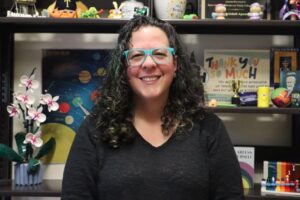 We start this series with Professor Aponte Avilés, Senior Lecturer and Language Coordinator in Language and Culture Studies, who has worked at Trinity College since 2014. This blog is a summary of an interview conducted with Professor Aponte Avilés in spring 2024 by CCS student research assistant, Jackeline García Alvarado (Class of 2027).
Photograph by Paola Evangelista (Class of 2026)
Professor Aponte Avilés’s academic journey began in Puerto Rico, where she earned her undergraduate degree in Biology and pursued graduate studies in Microbiology. However, her passion for literature and comics significantly shifted her academic focus. She transitioned to Hispanic Studies at the University of Puerto Rico, Mayagüez Campus, and later completed her PhD at the University of Connecticut in 2018.
At Trinity, Professor Aponte Avilés has sought to enhance language learning by incorporating cultural connections, games, and community awareness into her teaching methods. Her role has expanded beyond classroom teaching to serving as the co-director of the Blume Language and Culture Learning Center.
Aponte Avilés’s personal connections to the Caribbean significantly influence her academic and professional trajectory. Born and raised in Puerto Rico, she brings a rich, firsthand perspective to her work. She had the opportunity to teach a course on Latinos in the US at the University of Connecticut which allowed her to build her understanding of the broader cultural and historical contexts of Caribbean culture within diaspora contexts.
Professor Aponte Avilés currenly teaches “Hispanic Hartford”, a course that delves into the understanding of Hartford’s large and diverse set of Spanish-speaking communities. As she explained in our interview, “When you think of Hispanic Hartford, you have to think of the Caribbean community and the Latin American community in general”.
One of her notable campus projects is “Voces de la Migración” (Voices of Migration), an oral history initiative documenting the experiences of the Latin American community in Hartford. The archival project represents a collaboration with Christina Bleyer from the Watkinson Library, Erica M. Crowley from the Center for Hartford Engagement and Research, and the staff at the Hartford Public Library.
Professor Aponte-Avilés asserted that, “We created it in such a way that anybody from the community or anybody around the world can just go in, check it out, listen to their conversations…it could be a way for people to understand how Hartford has evolved, how Hartford has changed, how the Latin-American community has reshaped the city”. When asked about her advice to students interested in Caribbean and Latin American studies, Professor Aponte Avilés encourages students to move beyond textbooks and classroom lessons with travel. She emphasized that “You cannot learn about Latin America without having the experience of being in Latin America. So, dare to, if you have the chance, and there’s a possibility, go to Cuba, go to Dominican Republic, Puerto Rico, Venezuela, Colombia, Mexico, Nicaragua, Costa Rica, Chile, Ecuador…Go beyond what you learn in class. What you learn in class is just the beginning. The rest is out there.”
Looking forward, Professor Aponte Avilés is excited about her ongoing and upcoming projects, including further expansion of the “Voces de la Migración” project to additional languages and in partnership with other migrant communities in the city. Collaborations with other Trinity faculty members, and connections with similar oral history projects at institutions like the University of Texas at Austin, continue to enrich her work and support the development of Caribbean studies at our institution.
– Jackeline García Alvarado
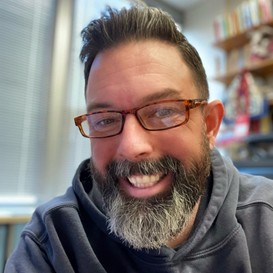
As part of the Center for Caribbean Studies’ ongoing effort to highlight Caribbean scholarship across disciplines, we are honored to feature Professor Tim Landry, Associate Professor of Anthropology and Religious Studies at Trinity College, in this edition of the Faculty Voices series. His work invites us to reflect on the spiritual, political, and ethical dimensions of the study of Afro-Caribbean and West African religions and practices, and how these travel, transform, and resist across oceans and generations.
Photograph by Tim Landry
We had the privilege of speaking with Professor Landry in spring 2025 about the unexpected journey that led him to find the centrality of his studies, and the responsibilities that come with working alongside communities whose traditions are often misrepresented or misunderstood.
Landry’s interest in West African and Afro-Caribbean religions can be traced back to his childhood in Houston, Texas, shaped by familial roots in Louisiana. He recalls that one of his earliest encounters with these traditions came through reading as a child a book titled Gumbo Ya-Ya, a collection of Louisiana folktales that sparked his curiosity. He still recalls the depictions of tales, remedies, and spells for attracting blessings. His academic focus sharpened at the University of Houston, where he trained as an archaeologist and worked at the Levi Jordan Plantation in South Texas. There, he encountered objects deliberately buried beneath floorboards, those objects were evidence of spiritual practices that enslaved Africans actively created and incorporated into their daily lives. These material traces, unearthed as part of efforts to reconstruct the lived experiences and cultural knowledge of enslaved communities, marked a turning point in his journey and led him to engage more deeply with African religious traditions.
A formative trip to Haiti soon after shifted his path entirely, leading him away from archaeology and toward cultural anthropology and the study of living religious traditions. Landry’s shares that his academic trajectory has been shaped not only by his fieldwork in Haiti and Benin, but also by the mentorship he received as a student. Those approaches to anthropology continue to inform his practice. Today, his work is firmly rooted in West-Africa and the Caribbean, he developed a working in Haitian Creole and Fongbe allowing him to engage with spiritual communities across both regions with care and cultural sensitivity. By tracing how rituals, language, and sacred objects move across time and space, Professor Landry sees West African and Afro-Caribbean religions not as remote and isolated traditions, but as deeply interconnected systems of meaning shaped by histories of survival, resistance, and transformation.
A key point in Professor Landry’s work came when he made the decision to be initiated into both Haitian Vodou and later West African Vodun. This decision, he explained, was not made lightly. With initiation came not only deeper understanding, but also new ethical boundaries. “It opened doors, but it also closed them,” he reflected. “There are things I know that I will never write about.” Professor Landry made a commitment to the communities who welcomed him. A commitment not just to protect sacred knowledge, but to honor the trust and relationality at the heart of these traditions.
Rather than centering “secrets,” Professor Landry encourages us to look at what secrecy does: how it produces power, trust, and social bonds within spiritual communities. This approach reflects the commitment to de-centering academic authority and recognizing that the knowledge produced within these religious systems does not exist for extraction or display. “Secrecy isn’t just about what’s hidden,” he explained, “it’s about who has the power to teach, to speak, and to share.”
Professor Landry’s research has evolved over time. Initially drawn to questions of modernity and tradition, his fieldwork in Benin proposed a different reality, one where secrecy and the questioning of expectations is central. “If you leave the field studying the same thing you went in with,” he said, echoing his mentor Alma Gottlieb, “you weren’t listening.” This willingness to be transformed by the field (rather than imposing expectations onto it) is what defines his approach.
Currently, Professor Landry is working on a book about consciousness, magic, and the sentience of ritual objects. Moving beyond a symbolic analysis, he is exploring how objects in Vodou and Vodun do more than represent, they act. “These aren’t just pretty things,” he told us. “They hold memory. They carry agency” This insistence on the liveliness of matter, on the animacy of the sacred, challenges Western ontologies and invites us to consider other ways of being in the world.
Teaching is central to how Landry engages with these ideas. At Trinity, he sees the classroom as a space for undoing harmful narratives and cultivating intellectual humility. “We’re taught to see Haiti and Africa through the lens of catastrophe,” he said. “But these are places of immense cultural, intellectual, and spiritual wealth.” He finds it especially rewarding to challenge students’ assumptions and to encourage critical reflection on privilege, whether racial, national, or economic. He sees his role not as speaking for communities, but as amplifying their complexity and refusing simplistic representations. “Whiteness and colonialism still shape the way these religions are viewed,” he noted. “It’s important to use whatever privilege I have to push back against that.”
We discussed the role of art and material culture in the transmission of spiritual knowledge. Whether through ritual objects, Haitian paintings, or performance, Landry views art as a form of resistance, a way for communities to assert sovereignty over their narratives. “Art is political,” he said. “It holds power. It does things.” In both West Africa and the Caribbean, materiality is not inert, it is divine. And in times of crisis, people turn to these sacred forms for protection and continuity.
Looking ahead, Professor Landry is developing a visual ethnography project that examines how Afro-Caribbean religions have been represented in academic photography. He is particularly interested in how imagery can either reinforce or challenge stereotypes. “We need to be mindful,” he said. “Too much sensationalism becomes exoticism. But erasure—censoring the blood, the messiness—whitewashes the truth.” His work proposes the question, how do we represent these traditions responsibly, with nuance but also with care?
When we asked what advice, he would give to students interested in Caribbean studies, religious studies, or anthropology, his response was clear: “Decolonize yourself,” he said. “That means doing the hard work of examining your assumptions, your privileges, and your frameworks. It doesn’t mean abandoning what you believe. It means recognizing that your lens is not universal.” He encourages students to prioritize the voices of practitioners, to move beyond media distortions. “These religions aren’t just about the concept of spirits” he reminded us. “They’re about family. They’re about survival. They’re about power and love. And they have so much to teach us, if we’re willing to listen.”
– Paola Evangelista (Class of 2026)