‘My Place on Campus:’ One Trinity Student Finds a Community in Model UN
Content
Story
Posted
By
Cate Griffin ’27
Category
Students
Cate Griffin ’27 is a comparative literature major and English minor from Pennsylvania. On campus, she is an executive editor at the Trinity Tripod, Trinity’s student newspaper; the vice president of Trinity’s Model United Nations Club; and a reader for The Vernacular, Trinity’s student-run literary magazine. This semester, she is the writing intern for Trinity’s Office of Communications and Marketing.
Here, she shares how she found her place on campus:
Cate Griffin ’27
I came to Trinity from a small school in Pennsylvania that I attended since Kindergarten. Thirteen years is a long time to spend in one place, and in my school of only 400 students, I knew everyone in my class year. Some of my friends felt stifled by this environment, but I knew that I was looking for the same kind of familiar, tight-knit community in my future college.
It’s no surprise, then, that I ended up at Trinity: with just over 2,000 students and an 8:1 student-faculty ratio, Trinity certainly had the same small-school feel that I wanted for my undergraduate experience. However, going from a senior class of 100 to a first-year class of around 600 was still a big change for me.
I was lucky early in my first year to find a great group of friends—who are now my roommates—but like most new college students, I was also searching for somewhere that felt like my place on campus outside of my immediate friend group. The place I found was within Trinity’s Model United Nations Club.
Model United Nations (MUN) is an extracurricular club in which student delegates represent United Nations countries in a simulated UN committee and debate real-world issues. MUN clubs from schools all over the country (and the world) attend intercollegiate conferences and compete for awards, given on the basis of the delegates’ knowledge of the committee’s subject and their public speaking skills.
I joined MUN for the first time in my senior year of high school, when I went to a meeting with a friend who was in the club. I was surprised by how fun it was, and how it also caused me to become friends with many people I hadn’t really spoken to before. Still, although I enjoyed doing it in high school, I didn’t necessarily think I would continue doing MUN at Trinity.
That changed when I first went to a meeting, again going with a friend. Just like with my past MUN experience, Trinity Model UN was a small group of people who I wasn’t familiar with, but we quickly became close. In the spring semester of my first year, six other club members and I went to the Harvard National MUN conference in Boston, and then to the New York University conference in New York City. Through my time in club meetings and traveling with the team, I was able to form a real sense of community and long-lasting friendships with people I’m sure I wouldn’t have met otherwise.
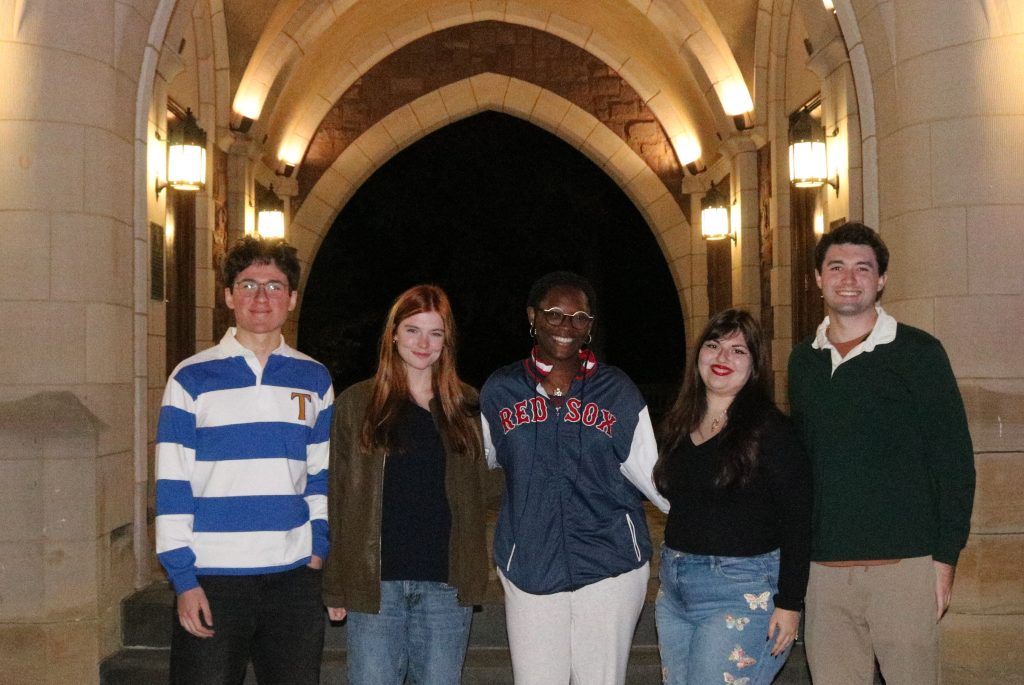
(Left-right) Trinity College Model United Nations Club members Carlos Fonseca ’30, Cate Griffin ’27, Yulissa Gerard ’30, Charlotte DeSimone ’27, and Max Ryan ’28 attended the University of Pennsylvania Model UN Conference in October 2026, along with Irene Crespo ’29 (not pictured).
Although many people would assume that Model UN is a club intended for political science or human rights majors, I believe that joining extracurricular activities that seem unrelated to your major can greatly enrich your academic experience. (As my mom would say, “That’s the benefit of a liberal arts education!”) I’m majoring in comparative literature and minoring in English, but through Model UN, I was able to greatly improve my public speaking, gain in-depth knowledge about international policy, and meet incredibly smart and driven students outside of my social bubble.
This semester, Trinity MUN was able to go to the University of Pennsylvania Model UN Conference for the first time (which was also our first conference in a fall semester since the club’s founding four years ago). Although the conference was hard work, it was incredibly rewarding. As the current vice president of the club, I was excited to see the three newer club members we brought to UPenn finding the same community in MUN that I found when I was a first-year.
When I was a New Student Orientation leader this summer, the biggest piece of advice that I gave to the incoming students was to join clubs and extracurricular activities. Although Trinity is a small college, trying to find a group of people you connect with can still feel overwhelming. However, what I’ve discovered is that there’s a place for everyone here—you just need to find it.
A senior thesis project by political science and human rights double-major Chloe Libby ’27 aims to increase voter turnout in Hartford during this election season. “Civic engagement is so important,” Libby said of the motivation behind her work.
Film studies major Emma Baskin ’27 recently organized a program that welcomed Trinity alumna, casting director, and producer Joanna Colbert ’87 back to campus to talk about her career in the entertainment industry. Read more from Baskin in her own words.
This year’s cohort of President’s Fellows includes some of Trinity’s most accomplished seniors. These 32 student scholars from the Class of 2027 have compiled exemplary academic records in their years at the College.
More than 100 Trinity students spent part of the summer working with faculty members and other mentors. The fall symposium allowed these students to showcase their findings and research processes.