‘Monumental Training’: Trinity Political Science Alumnus, Faculty Members Co-Author Paper
Content
Story
Posted
By
Andrew J. Concatelli
Category
Academics
For one Trinity College alumnus, the work of conducting research with faculty-scholars didn’t stop at graduation. Jacob Loor ’25—now a second-year law student at Yale Law School—recently had an article that he co-wrote with Associate Professor of Political Science Reo Matsuzaki and Senior Lecturer in Political Science Hernan Flom published in the peer-reviewed journal Politics & Society.
“The opportunity that I had to write this paper with two professors who are both leading in their respective fields is unique to Trinity College,” said Loor, a political science major from Houston, Texas. “I don’t think it would happen at 99 percent of other schools.”
After Loor completed a paper for Matsuzaki’s “Statebuilding” course comparing policing in New York City and Tokyo, Matsuzaki was intrigued by the connections to his own research on fictive politics in Japan, and encouraged Loor to continue studying stop-and-frisk.
“We had great flexibility at Trinity to basically devise an independent study class where I was getting credit to do this research,” Loor said. “I also was able to receive funding from Trinity through a CUGS [Center for Urban and Global Studies] grant to go down to New York and conduct interviews with lawyers, academics, and community members that were vital to our understanding of the case study we were looking at.”
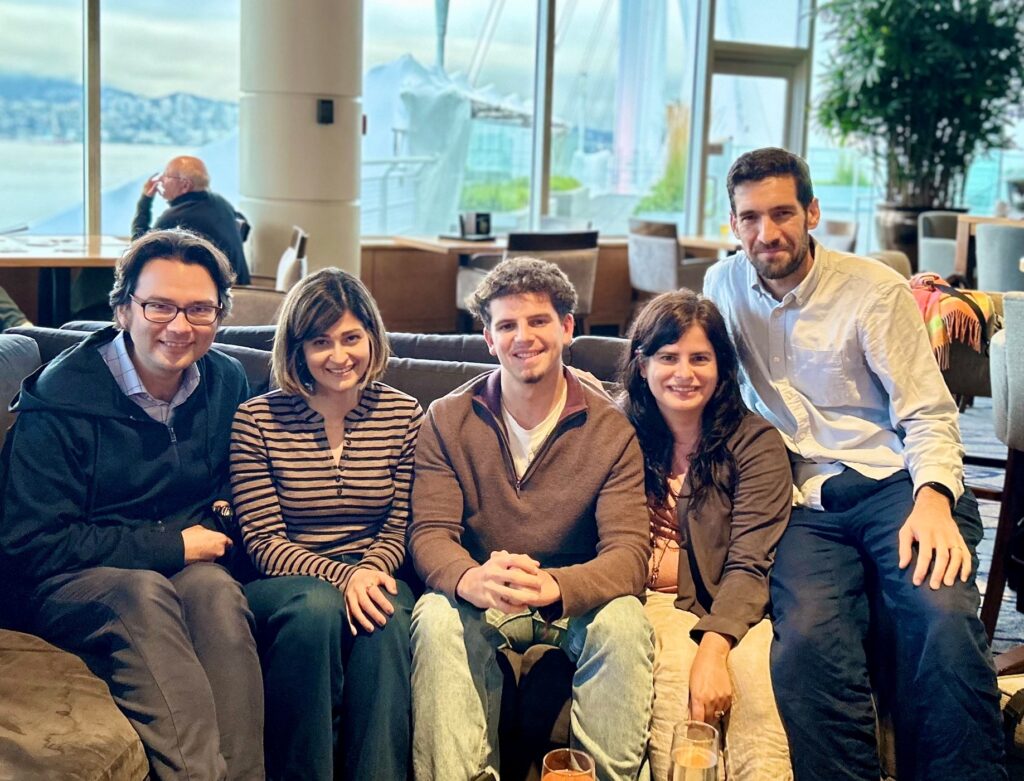
Left-right: Reo Matsuzaki, associate professor of political science; Sidra Hamidi, assistant professor of political science; Jake Loor ’25; Belén Fernández Milmanda, associate professor of political science and international studies; and Hernan Flom, senior lecturer in political science, at the American Political Science Association’s 121st Annual Meeting and Exhibition.
By the spring of Loor’s senior year at Trinity, after researching the subject for more than a year, Loor and Matsuzaki began to meet with Flom, who teaches “Policing and Human Rights,” which Loor had also taken. Loor said, “It was an amazing opportunity throughout the whole process to learn from and work with professors as colleagues, rather than only as a student.”
Loor and the faculty members wrote the bulk of the paper during the summer after Loor graduated, then had the chance to present it at the fall 2025 American Political Science Association conference. “That was our first testing grounds, where all the three of us were in Vancouver together, alongside some other Trinity professors presenting other works,” Loor said. “We got feedback from other scholars, and then we really refined the paper over the next six months or so, submitted it to one journal, and it got accepted on the first try, which was super exciting.”
Matsuzaki said that the paper was published just eight months after it was originally submitted—“a turnaround I have never seen for anything I or my colleagues have published,” he said. “It is not just that Jake, working with us, wrote a paper worthy of publication in a top journal in comparative politics—he wrote an exceptionally good one.”
The paper’s abstract says that recorded stop-and-frisks fell from a peak of nearly 700,000 in 2011 to fewer than 10,000 by 2020. “We demonstrate that this portrayal of the program’s demise is more fiction than reality—a simulation sustained through underreporting and reclassification of pedestrian stops into categories that draw less attention,” the authors say. The research analysis suggests that “mechanisms designed to ensure government accountability can become instruments that enable highly scrutinized agencies and programs to evade reform.”
Loor added that he and his co-authors looked at both the data produced around stop-and-frisk and the political messages conveyed through the statistics. “The idea—on paper—is that this policing in New York City has been transformed, but there’s a lot of evidence from surveys and some interviews we did with people in New York City that there really has not been—on the ground—this transformative change that people talk about.”
“It’s a cautionary tale, because in some ways it shows how data designed to keep the government transparent and accountable can, in fact, serve the opposite purpose, and make what the government is doing harder to understand, harder to oversee, and harder to hold them accountable on,” Loor said.
While at Trinity, Loor completed Trinity’s Legislative Internship Program and played on the men’s soccer team. He served as a head tutor at The Writing Center and also was a tutor at local schools and at the Hartford Correctional Center.
Now studying at Yale Law, Loor is interested in working in civil rights impact litigation. “I want to help shrink the carceral system and reduce racialized mass incarceration,” he said. Publishing this peer-reviewed research paper with Trinity professors gave him experience in his chosen field. “I’ve learned about the limits and impacts of the type of work that I want to do,” Loor added. “It’s monumental training for that sort of work.”
Flom said that Loor’s extraordinary research, writing, and presentation skills were evident throughout the publication process. “His example shows how students can develop a research project on something that matters dearly to them, so that it can reach a broader audience beyond the classroom and impact real-world issues,” Flom said. “Achievements like this show the quality of both the students and faculty we have at Trinity.”
Matsuzaki added that it is rare for an undergraduate student’s work to be published in a top academic journal. “This speaks both to Jake’s tremendous intellectual capacity and work ethic and to the environment that made the achievement possible,” he said. “Trinity College’s commitment to the scholar-teacher model for our faculty, and to supporting student research, is exceptional. Without the underlying infrastructure and support from the College, this collaboration would not have been possible.”
Learn more about the many student research opportunities at Trinity College here.
The Trinity College community gathered for a documentary film screening and panel discussion with alumna Julia Hoppock ’06, an associate producer of People vs. Politics, as part of Voter Education Week.
The grant for Susan A. Masino, Paul E. Raether Distinguished Professor of Applied Science, and David N. Ruskin, research associate professor, will provide summer research opportunities for Trinity students.
Associate Professor of Classical Studies Vincent E. Tomasso, whose first-year seminar is reading Homer’s epic poem, will give a presentation as part of Odyssey Day this fall. Read more about why he says The Odyssey still resonates today.
More than 100 Trinity students spent part of the summer working with faculty members and other mentors. The fall symposium allowed these students to showcase their findings and research processes.