Trinity’s Applied AI Innovation Sandbox Pilot Program Delivers AI-Based Solutions to Local Community
Content
Story
Posted
By
Andrew J. Concatelli
Category
Academics
Eight senior computer science majors at Trinity College spent the spring 2026 semester working with business and community partners to develop new uses of artificial intelligence. The teams presented demonstrations of these capstone projects as part of the computer science senior seminar final conference on April 30.
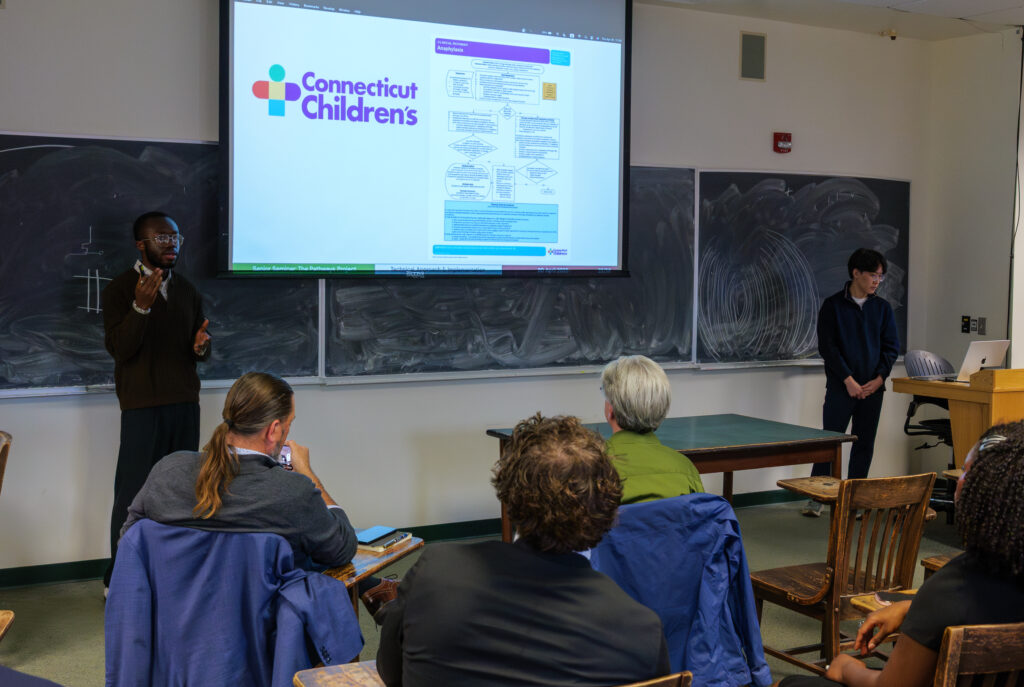
Kwaku A. Agyapong ’26 and Ki Hwang ’26 present their project, developed in partnership with Connecticut Children’s. Photo by Helder Mira.
The students who participated in the Applied AI Innovation Sandbox pilot program from Trinity’s Elting Center for Innovation and Entrepreneurship received training in the fall semester from the Project Management Institute and Sandbox vendor partners. In partnership with ENTEVATE AI and Quantum Innovation (AIQUI) Sandbox, the inaugural cohort worked this spring with clients, faculty, third-party AI professionals, rapid proto-typers, and vendors to find creative, AI-based solutions to real-world problems.
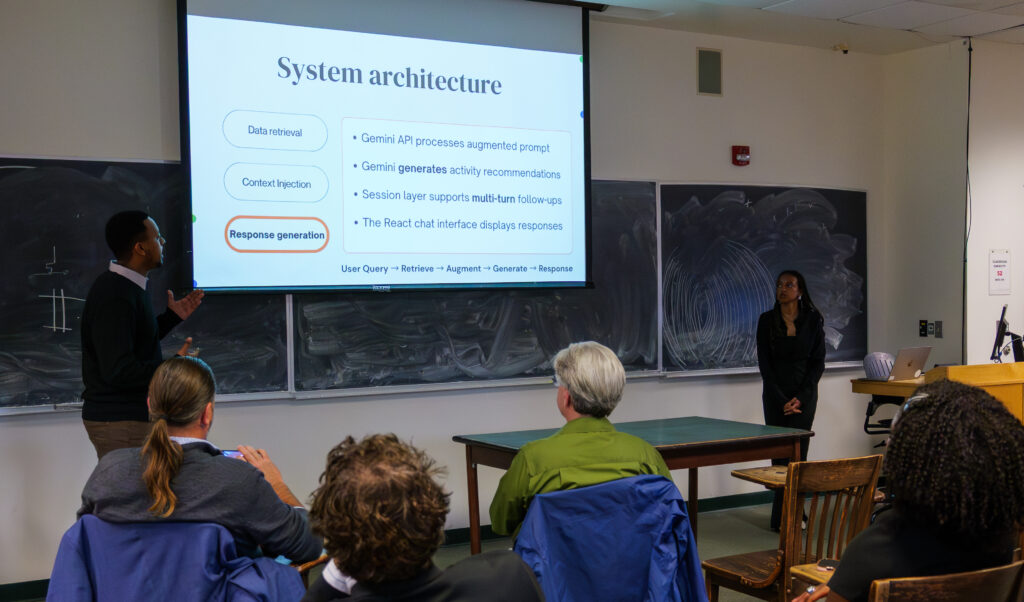
One senior project is already being tested by its client. Kwaku A. Agyapong ’26 and Ki Hwang ’26 partnered with Connecticut Children’s to develop “Pathways,” an interactive Retrieval Augmented Generation (RAG) system that allows pediatricians to quickly query emergency medical treatment guidelines. Agyapong and Hwang interviewed personnel from other children’s hospitals and improved upon a system implemented by Seattle Children’s Hospital. A period of beta testing for “Pathways” by approximately 20 pediatricians at Connecticut Children’s began on April 30.
“We’re hoping to see a lot of feedback regarding the quality of responses being generated, the specificity of recommendations regarding what clinicians should do next, and the accuracy of those answers themselves,” Agyapong said. “The feedback will be in line with TrAAIT, which is a recognized framework for validating the trust of AI tools.” The students plan to evaluate the feedback and make improvements to their system before handing it off to Connecticut Children’s for possible implementation in the future. A team in next year’s Sandbox cohort expects to pick up where these students leave off and continue to develop and enhance AI apps for Connecticut Children’s.
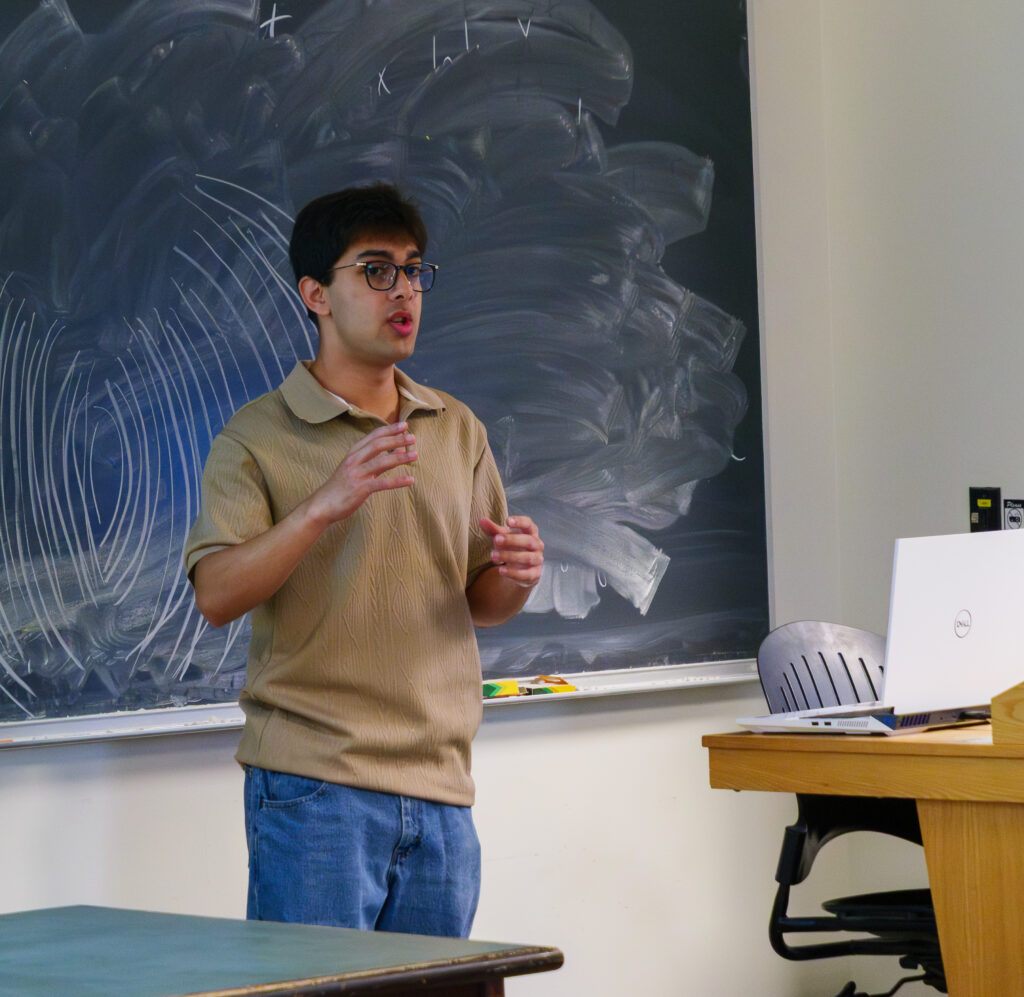
Saqlain Anjum ’26 worked with ENTEVATE to develop a content management system for data related to the Applied AI Innovation Sandbox at Trinity. Photo by Helder Mira.
Hwang said that the project went well beyond an academic exercise by providing students the opportunity to build something with real clinical impact. “Working with messy, real-world data was meaningful. It exposed gaps that classroom environments cannot replicate,” he said. “But the most formative experience was the iterative process of engaging with stakeholders: learning what they actually needed, communicating across technical and medical domains, and refining the system accordingly. That cycle of listening, building, and adjusting is something I’ll carry directly into my work in technology and software development.”
Agyapong agreed that working with partners and clients was a valuable part of the experience. “Though it would have been easier to bury our heads in the more technical aspects, it wasn’t long until we realized that our weekly meetings with stakeholders were critical in making sure what we were making was what they needed,” Agyapong said. “By assigning tasks, tests, and deadlines around these meetings, we were able to stay focused on refining the functionality that our clients needed most. This experience offered a rare glimpse into development beyond the classroom—one that will serve us well as we move on from Trinity.”
Saqlain Anjum ’26 worked closely with ENTEVATE to develop a content management system for data related to the Applied AI Innovation Sandbox at Trinity. “The ultimate goal is to organize all business operations associated with managing the Innovation Sandbox in one central platform that ENTEVATE can utilize,” Anjum said.
Ibsa Tassew Geleta ’26 and Yeabsira G. Bizualem ’26 worked on their project with the NextMinds/Connecticut Invention Convention program. Photo by Helder Mira.
The cohort spent the fall semester going through training to earn Certified Associate in Project Management (CAPM) certification. “The CAPM certification helped me understand how to work effectively with various stakeholders to ensure that a project may be delivered successfully to a client,” Anjum said. In addition, Anjum was the first Trinity student to participate in the National Science Foundation I-Corps program, an immersive, entrepreneurial training program. “This program provided me with invaluable experience on managing early-stage startups/venture development,” he added. Anjum plans to use the skills he honed during the past year in a technology job with client- or customer-facing components.
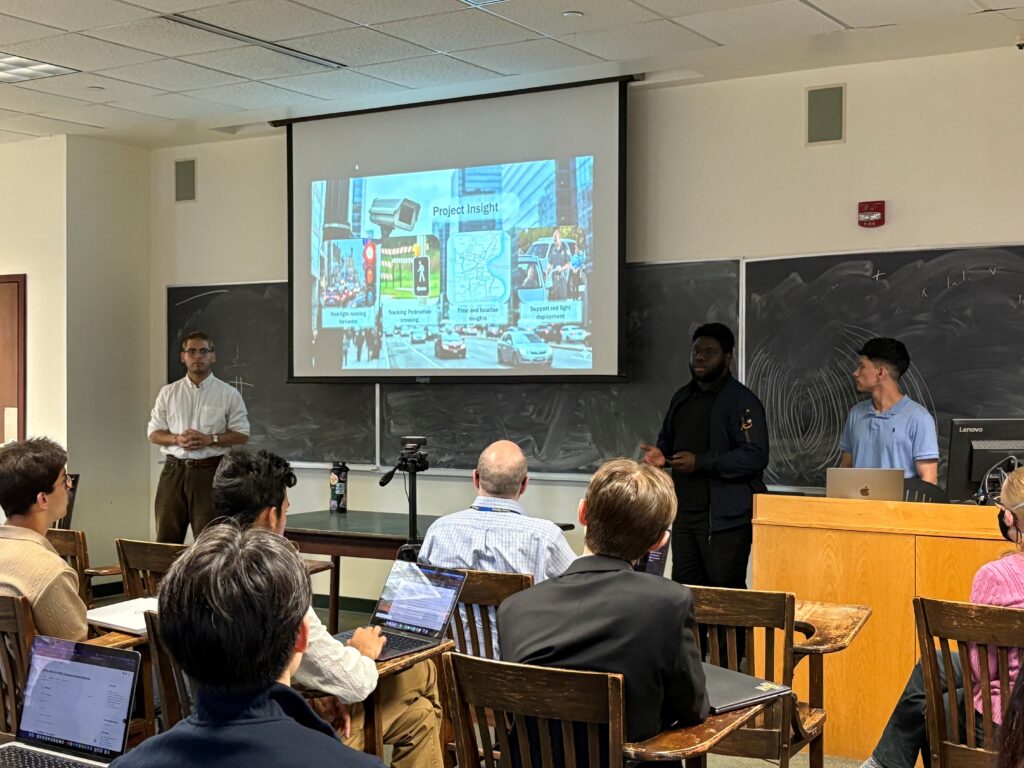
In other student projects, Ibsa Tassew Geleta ’26 and Yeabsira G. Bizualem ’26 worked with the NextMinds/Connecticut Invention Convention program to develop a Google Classroom AI-enabled curriculum access tool for teachers in K-12 schools to build custom curriculum for their classrooms. Meanwhile, Kwadwo Osarfo-Akoto ’26, Alex Sanchez ’26, and Francois Carpe Elias ’26 partnered with the City of Hartford and Trinity College on a project to review and digest local CCTV video to advise on vehicular and pedestrian safety around campus.
Kenneth A. Kousen, visiting professor of the practice in computer science and associate director for STEM initiatives in Trinity’s Elting Center for Innovation and Entrepreneurship, met with the students weekly to advise on this pilot program, which was designed to prepare students for the workforce and to help them discover the many possible uses of AI.
Francois Carpe Elias ’26, Kwadwo Osarfo-Akoto ’26, and Alex Sanchez ’26 partnered with the City of Hartford and Trinity College.
“We don’t know what impact AI will have on our lives, but any student who can work with these tools will have an advantage,” Kousen said. “These students have the opportunity to work with companies that are well established in the field, try out all the AI tools, apply them to real problems, and learn for themselves what they can and can’t do.”
Danny Briere, Ruane Family Executive Director of the Elting Center for Innovation and Entrepreneurship, worked with ENTEVATE to bring the AIQUI Innovation Sandbox Fellowship to Trinity. “Our success is that the students completed their real-world projects to client satisfaction and worked successfully alongside platform, vendor, and client partners as peers in scrum teams,” Briere said. “Going through this process helped them gain skills that will set them up for successful experiences in the future and make them stand out in a rapidly changing job market. Another added value is what the students brought to the pilot clients well beyond just coding and solutions—they helped the clients themselves gain confidence and skills so that they can prove to their own organizations that real change with AI is not only possible, but real.”
Briere added that the Applied AI Sandbox will return next year. “The Elting Center intends to expand on the breadth of experiences by adding, for instance, AI hardware to the mix in the form of XR glass-based projects,” he said. “It’s such an awesome moment in time to explore and experiment—we intend to maximize that experience where we can.”
For more information about Trinity’s Elting Center for Innovation and Entrepreneurship and how to get involved, click here.
Trinity’s Summer Research Program supports intensive student involvement in ongoing faculty research. More than 100 Trinity students spent part of summer 2026 engaged in research projects with faculty mentors.
Anthony M. Messina, John R. Reitemeyer Professor of Political Science, Emeritus, has received a 2026 Career Achievement Award from the American Political Science Association’s Section on Migration and Citizenship.
For one Trinity College alumnus, the work of conducting research with faculty-scholars didn’t stop at graduation. Jacob Loor ’25—now a second-year law student at Yale Law School—recently had an article that he co-wrote with two Trinity faculty members published in a peer-reviewed journal.
Hundreds of Trinity College students spent the summer exploring potential careers as they gained practical skills through wide-ranging internships. Read about the highlights and lessons that six Trinity students took from their experiences.