Q&A: Trinity Student and Faculty Research Collaboration Leads to Published Paper
Content
Story
Posted
By
Eh Wah Wah ’28
Category
Academics
Following a yearlong collaboration, a Trinity College student and faculty member recently published their research in a peer-reviewed scientific journal. The project by Shivanshu Dwivedi ’26 and Senior Lecturer in Physics Kalum Palandage applies machine learning to streamline complex many-body calculations.
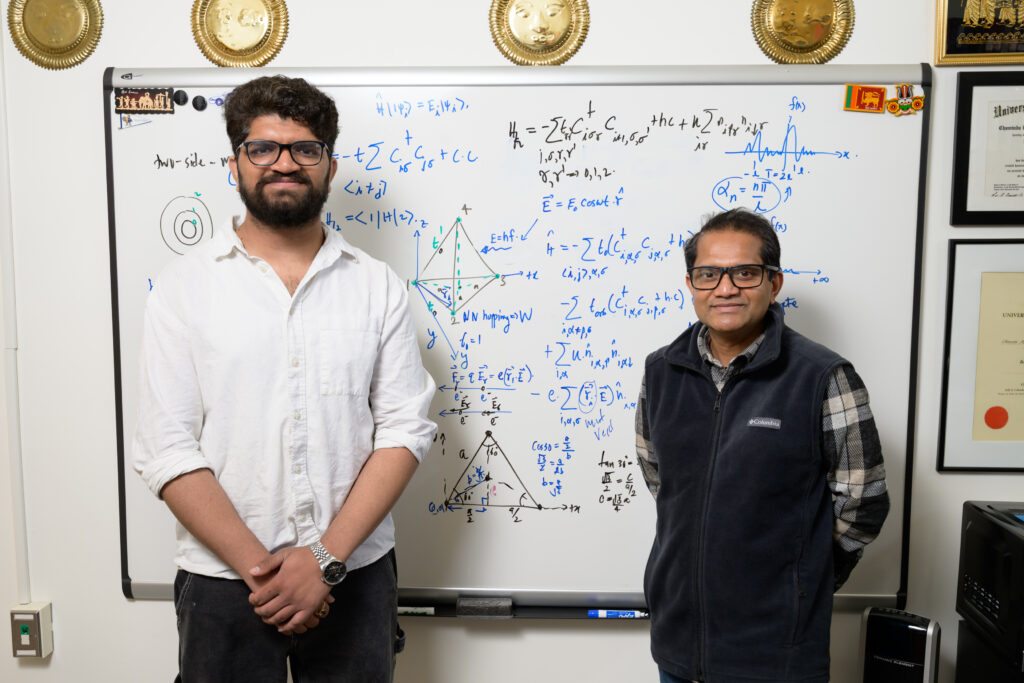
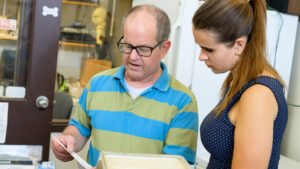
Shivanshu Dwivedi ’26 and Senior Lecturer in Physics Kalum Palandage. Photos by Nick Caito.
The student and mentor met when Dwivedi was in his first year at Trinity, but they first began discussing this project prior to the summer of 2025. The project was made possible through the support of the Trinity College Summer Research Program.
Below, Dwivedi and Palandage reflect on the process of conducting research and writing a paper together.
What is this research about?
Dwivedi: I’ll give you a simple analogy: Let’s suppose you wanted to buy a specific ice cream and there are 1,000 stores in front of you. And let’s say you want to buy the ice cream wherever it’s cheapest. So what we were doing initially was going to every store and trying to note the price of ice cream at each one. Professor Palandage and I came up with a new method in order to address this problem because our computers weren’t able to handle all these heavy calculations. We used machine learning, which will try to make predictions of which store will have the cheapest price. So instead of visiting 1,000 stores, we just have to analyze 10 stores in which the price could be cheapest. Then, we just visit those 10 stores and try to find three stores where it’s cheapest, and then find the cheapest one. This reduces the competition from 1,000 to four of five.
Palandage: Our goal is to control interacting electrons using external energy inputs, such as an applied electric field. In the Hubbard model, the standard approach involves calculating energy levels for every possible configuration, which quickly becomes extremely complex. With this new method, we can avoid that exhaustive process while still capturing the system’s behavior efficiently.
What did the process of working together on this research look like, and how did the project evolve into a paper?
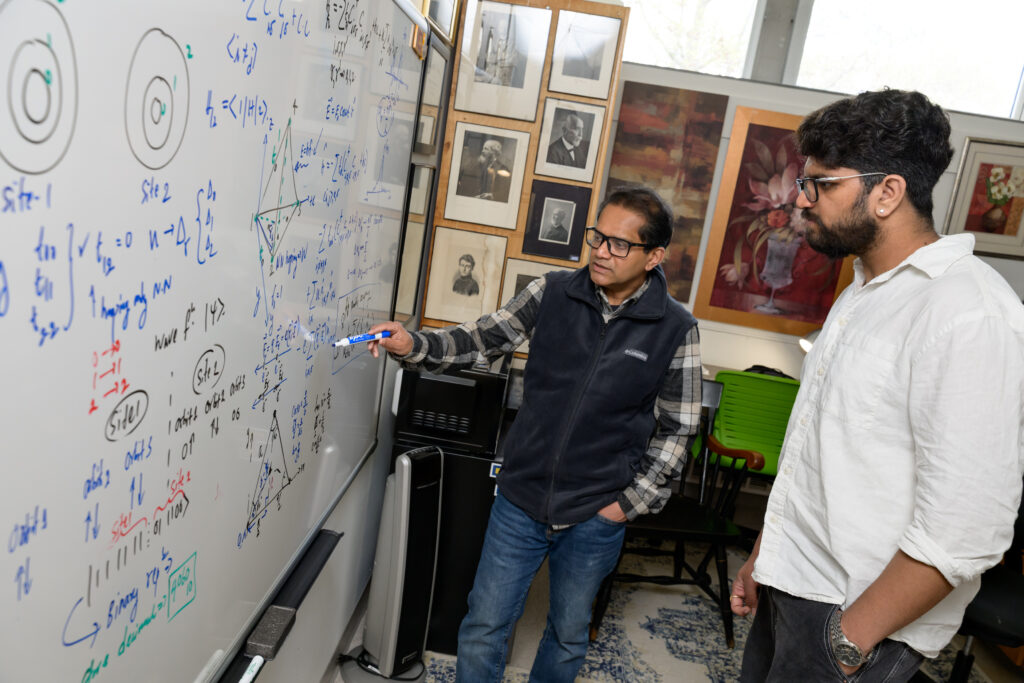
Senior Lecturer in Physics Kalum Palandage and Shivanshu Dwivedi ’26.
Palandage: Shivanshu is kind of an expert in machine learning. We had weekly meetings that initially started by making sure Shivanshu understood the model, addressing what our limitations were at that point, and then setting our goals. As we continued working, our meetings were meant to assess our progress and, sometimes, to cut down on goals by deciding what we wanted to focus on.
Dwivedi: From the student side, those weekly meetings were essential. We sat and discussed the way we should approach a specific problem, or maybe to not do this and try this new thing. I might have gotten lost if Professor Palandage didn’t guide me in the right direction. But in addition to that, Professor Palandage gave me a lot of liberty to try new approaches and experiment to see what might give us better results.
Palandage: After collecting a strong set of results, we worked through multiple revisions to determine the most effective way to tell the story of our findings. In the following weeks, we searched for an appropriate journal and ultimately decided to submit our work to Applied Physics Letters.
Why is undergraduate research at Trinity important?
Palandage: Even if you do not publish a paper, getting the experience of undergraduate research is very important. You learn how to manage your time with your coursework and your research, and I think that’s a valuable experience for undergraduate students. There are many ways to take advantage of it: You can spend the summer on campus for that experience and work with other students, or you can go to research conferences to present your work and get some experience on presenting.
Dwivedi: I completely agree. Being able to do research as an undergraduate is a huge privilege that you get at colleges like Trinity, where you can work directly with the professor and where your ideas are really valued. That’s not something you get everywhere. At a lot of other institutions, that might not happen because there are so many other people.
What made this experience most meaningful and valuable to you?
Dwivedi: I’m really grateful to have such a helpful mentor, not just in research but also for advice about how I should pursue my grad school application or how I should plan for my future in the industry as a software engineer. The experience of working with Professor Palandage and other professors in the Physics Department exposed me to how beautiful the actual science part of physics is.
Palandage: I was really very lucky to have Shivanshu as my research student. He’s very talented and has a great future ahead of him.
This year’s cohort of President’s Fellows includes some of Trinity’s most accomplished seniors. These 32 student scholars from the Class of 2027 have compiled exemplary academic records in their years at the College.
The Trinity College community gathered for a documentary film screening and panel discussion with alumna Julia Hoppock ’06, an associate producer of People vs. Politics, as part of Voter Education Week.
The grant for Susan A. Masino, Paul E. Raether Distinguished Professor of Applied Science, and David N. Ruskin, research associate professor, will provide summer research opportunities for Trinity students.
Associate Professor of Classical Studies Vincent E. Tomasso, whose first-year seminar is reading Homer’s epic poem, will give a presentation as part of Odyssey Day this fall. Read more about why he says The Odyssey still resonates today.