Trinity Professor Brings Research to the Big Screen with Talk and Film at Connecticut Science Center
Content
Story
Posted
By
Andrew J. Concatelli
Category
Faculty
Research by a Trinity College faculty member will be featured this weekend on the big screen.
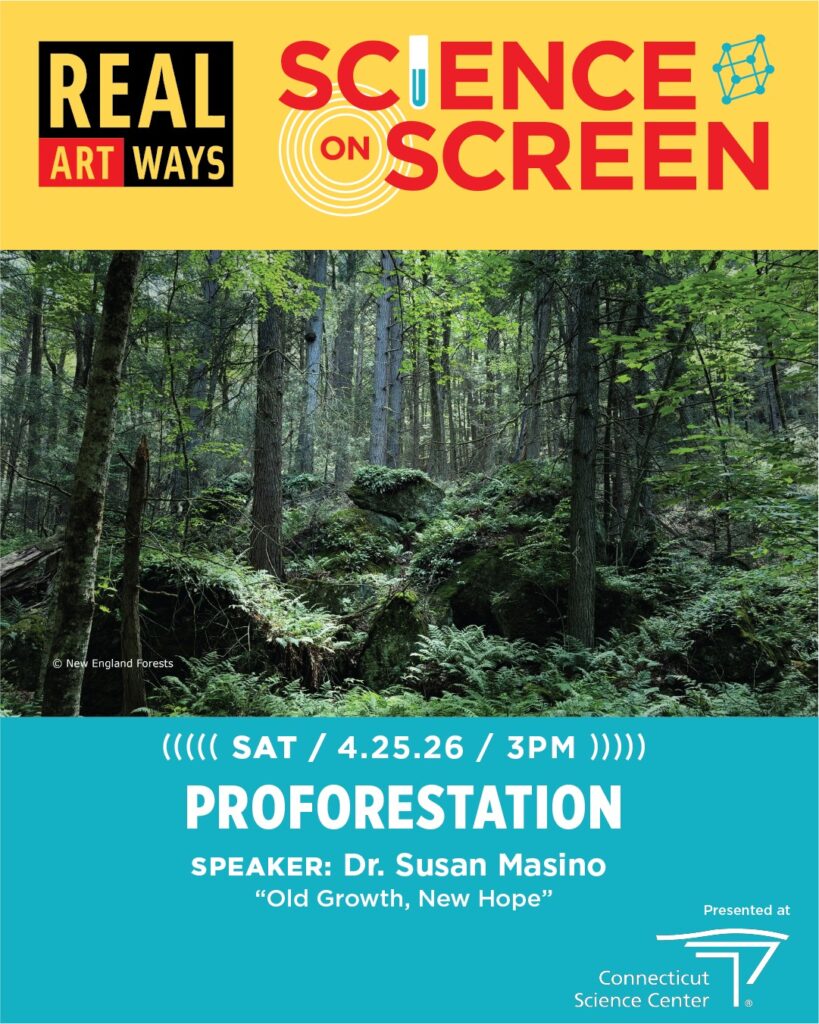
Susan A. Masino, Paul E. Raether Distinguished Professor of Applied Science, is set to deliver a talk titled “Old Growth, New Hope” at the Connecticut Science Center on Saturday, April 25, before a screening of the documentary film, Proforestation: Letting Forests Grow Old (2026). Masino is featured in the film, and the talk and film are part of the latest season of Real Art Ways’ “Science on Screen” series.
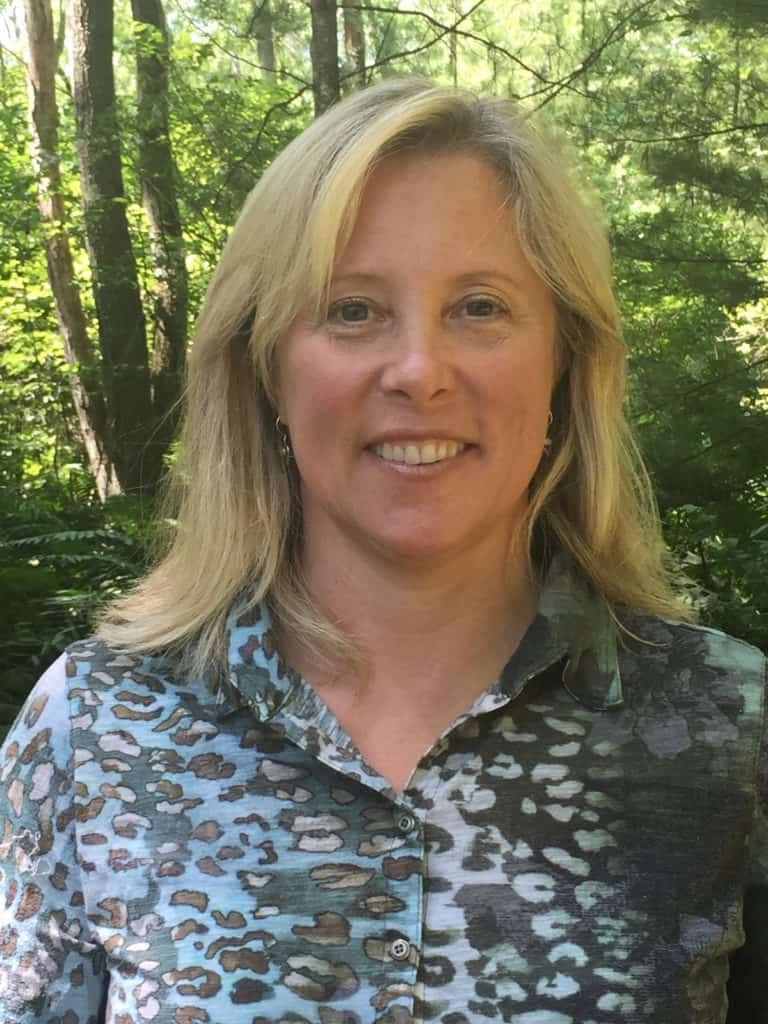
Susan A. Masino, Paul E. Raether Distinguished Professor of Applied Science
“Proforestation is simply letting some existing forests grow, adapt, and evolve,” Masino said. “Nature is powerful and amazing, and there is so much we do not know. One thing I want people to understand from this film is that natural processes have irreplaceable benefits for climate stability, ecology, and public health. Our current policies are not focused on that.”
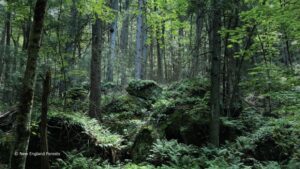
Directed by naturalist and filmmaker Ray Asselin of New England Forests, the 63-minute Proforestation discusses the value of proforestation for watersheds, carbon storage, and ecosystem function. Masino and her co-authors—William R. Moomaw and Edward K. Faison—published the seminal paper on proforestation in 2019, and it has since been widely cited in policy reports and scientific journal articles.
At Trinity, Masino holds a joint appointment in neuroscience and psychology. With a Ph.D. in biology, she conducts research in the fields of ecology and neuroscience, including forest ecosystems, brain health, and the relationship among metabolism, brain activity, and behavior. This spring she previewed Proforestation for Trinity students in her senior seminar, “Embracing Nature’s Complexity, Inside and Out.”
Masino met Asselin after seeing the premiere of his film The Lost Forests of New England at Harvard, where Masino was a Charles Bullard Fellow in Forest Research. Since then, Masino appeared in Asselin’s film, Eastern White Pine: The Tree Rooted in American History, before the filmmaker pursued his project on proforestation.
“Without an ongoing plan for nature, what are ‘nature-based’ solutions based on?” Masino said. “Natural processes are the baseline and the long-term support system for the farms and forests that we are asking to provide us with resources.” Masino added that the vast majority of conserved forestland remains open for “multiple uses.” She said, “We also need places intended for the full web of life—the operating system that brought us here, regulates water and weather, and enables life on land to thrive.”
Masino added, “Proforestation is not intended for everywhere, obviously. But it is for everyone, and I want everyone to be able to engage in critical thinking about these vital issues. We have a tremendous window of opportunity in this region to protect and connect key pieces of the beautiful ecological lifelines of land and water that we and other species need.”
Masino is an author on a recent report, “Wildlands in New England: Past, Present, and Future,” where Wildlands are defined as land that is protected from development and has an explicit intent to prioritize natural processes. The findings were shocking, she said. “In New England more than 20 percent of the land is protected from development, but so far less that 4 percent is documented as Wildlands. It is only about 1 percent in Connecticut, even though we have some of the oldest and most beautiful forests in the region,” she said.
To increase those numbers, Masino is working with RESTORE: The North Woods and others to “stitch together a network of nature.” RESTORE has identified places in New England and around the country, especially public land, that they say should be national parks or have a similar level of long-term protection. Masino also wrote an op-ed about the need for Connecticut to include Wildlands as part of the Department of Energy and Environmental Protection’s Green Plan.
Masino believes it would be very easy to make initial decisions on conserved land and avoid tragic accidents. “At the very least our headwaters, critical habitats, and core forests on public land should have stronger protection,” she said. “This is a unity issue. We need long-term data across disciplines and safeguards on where and why we allow manipulation and extraction.”
Masino’s April 25 talk at the Connecticut Science Center begins at 3:00 p.m., followed by the film screening at 3:30 p.m. Tickets and more information are available through Real Art Ways here.
Pablo Delano’s installation, The Museum of the Old Colony, opens this fall at the Museu de Arte de São Paulo Assis Chateaubriand (MASP). It brings together around 300 photographs and objects that invite reflection on the history of Puerto Rico.
The Trinity College community gathered for a documentary film screening and panel discussion with alumna Julia Hoppock ’06, an associate producer of People vs. Politics, as part of Voter Education Week.
The grant for Susan A. Masino, Paul E. Raether Distinguished Professor of Applied Science, and David N. Ruskin, research associate professor, will provide summer research opportunities for Trinity students.
Associate Professor of Classical Studies Vincent E. Tomasso, whose first-year seminar is reading Homer’s epic poem, will give a presentation as part of Odyssey Day this fall. Read more about why he says The Odyssey still resonates today.
 “Without an ongoing plan for nature, what are ‘nature-based’ solutions based on?” Masino said. “Natural processes are the baseline and the long-term support system for the farms and forests that we are asking to provide us with resources.” Masino added that the vast majority of conserved forestland remains open for “multiple uses.” She said, “We also need places intended for the full web of life—the operating system that brought us here, regulates water and weather, and enables life on land to thrive.”