CT Data Collaborative and Liberal Arts Action Lab Awarded 500 Cities Grant
Content
Story
Posted
Category
Academics
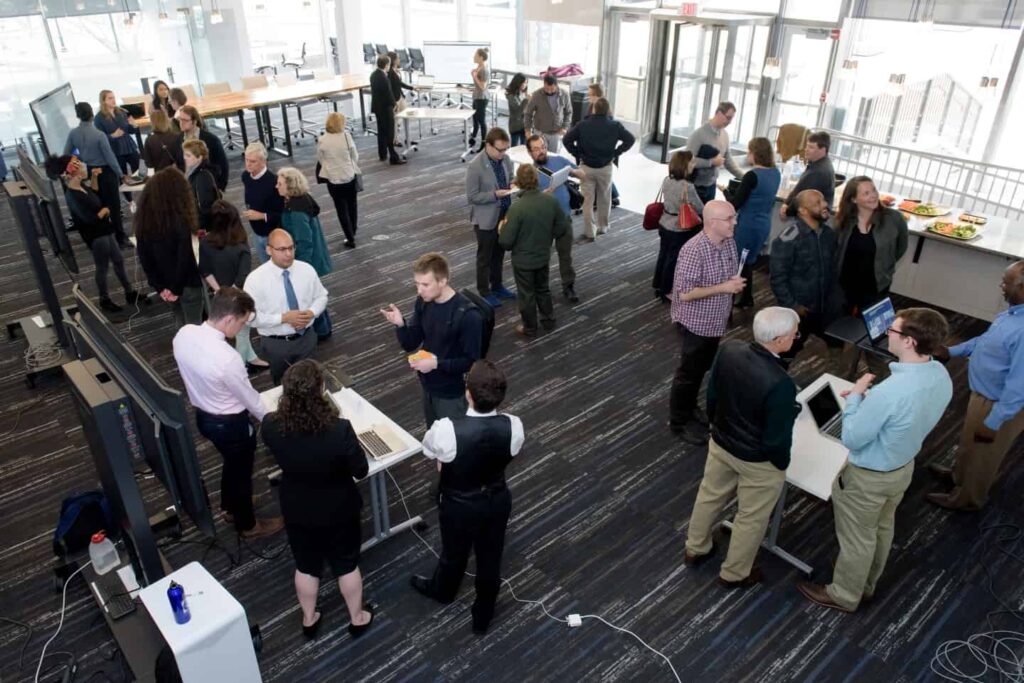
Liberal Arts Action Lab teams share their research projects at a Digital Poster Fair on April 30. Photo: Nick Caito
Hartford, Connecticut, May 22, 2018 – The Connecticut Data Collaborative and the Liberal Arts Action Lab have been awarded a 500 Cities Data Challenge grant by the Urban Institute and the Robert Wood Johnson Foundation. The joint proposal was one of 10 selected from a large competitive pool of applications submitted by organizations from cities across the United States.
This one-year $148,000 grant will support local research and educational outreach on housing conditions, health outcomes, and neighborhood disparities in the capital city of Hartford. The Connecticut Data Collaborative is a nonprofit organization focused on providing public access to data, creating an ecosystem of data users, and increasing data literacy. The Liberal Arts Action Lab, launched in early 2018 by Trinity College and Capital Community College, investigates problems posed by Hartford community partners, with teams of undergraduate students and faculty fellows who conduct semester-long research projects to strengthen the city.
The Urban Institute and the Robert Wood Johnson Foundation designed this challenge grant to encourage communities to delve into the 500 Cities open-access dataset, to design innovative solutions on social factors that influence health, and to guide local organizations on how to effectively use neighborhood-level data. The broader goal is to promote more comprehensive cross-collaborative approaches to foster a broader “Culture of Health” in urban areas.
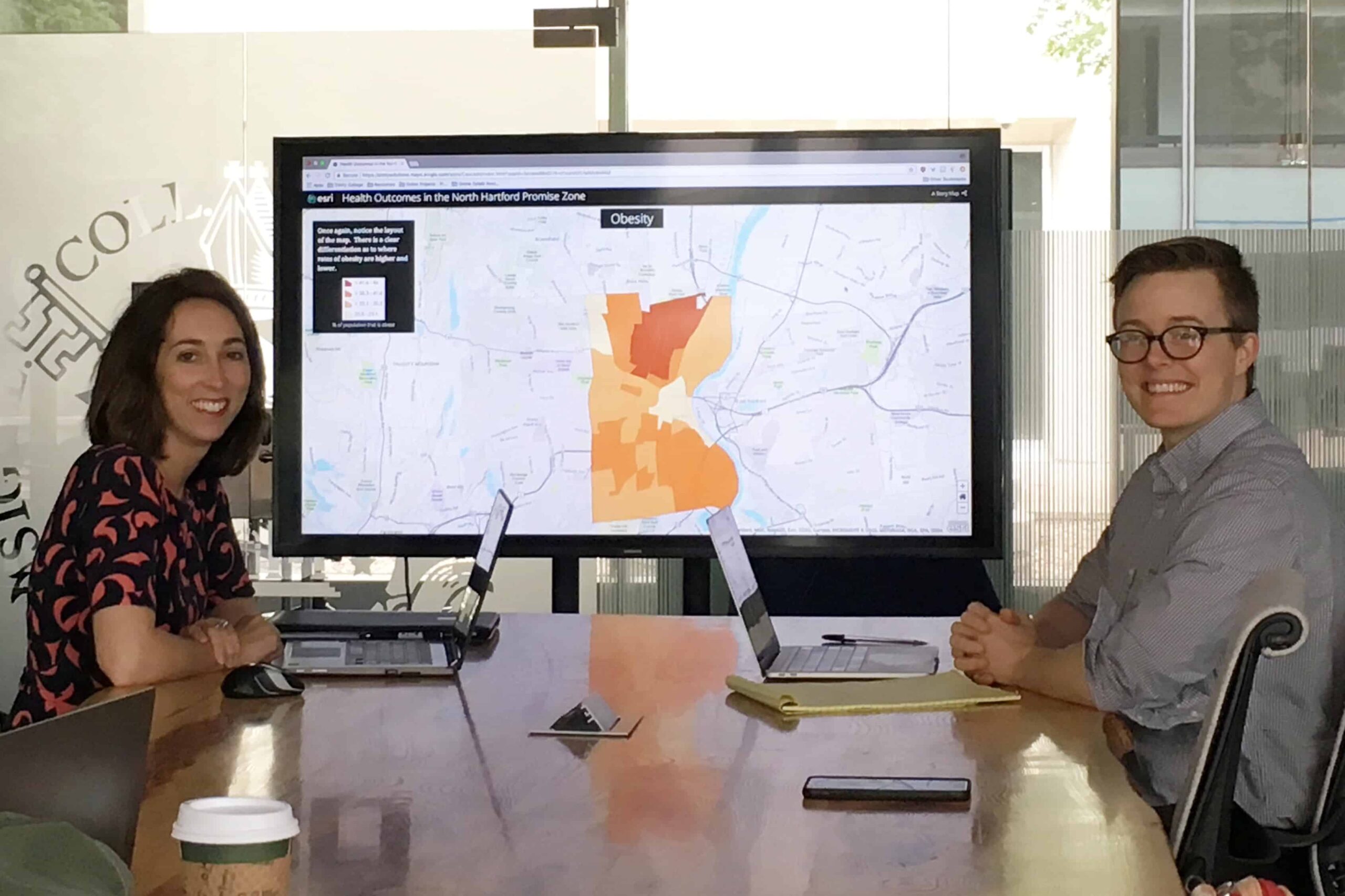
(L-R) Michelle Riordan-Nold, executive director of the Connecticut Data Collaborative, and Megan Brown, director of the Liberal Arts Action Lab.
“We seek to understand the social determinants of health contributing to disparate health outcomes across neighborhoods in Hartford,” said Michelle Riordan-Nold, executive director of the Connecticut Data Collaborative. “By partnering with the Action Lab, we will enhance our community engagement efforts and help elevate information to inspire action.”
As a statewide organization, the Connecticut Data Collaborative reaches and serves state agencies, municipalities, and nonprofit and philanthropic organizations. This grant builds on the recent announcement that the Connecticut Data Collaborative will move into office space in Trinity College’s downtown Hartford location at 10 Constitution Plaza.
“Involving students in applied research projects like this helps to connect the liberal arts skills and techniques they learn in class to the practical applications in Hartford and the broader world,” said Megan Brown, director of the Liberal Arts Action Lab. The 500 Cities grant will fund research stipends this summer for students to extend research done during the spring 2018 semester.
By sharing resources and expertise, the Connecticut Data Collaborative and the Action Lab will conduct a geospatial analysis that maps Hartford housing conditions with the new 500 Cities dataset, to better understand which neighborhood conditions could be improved to promote a “Culture of Health.” Moreover, the grant will help identify concentrated pockets of disinvestment where more resources could be targeted to improve health conditions of city residents. Also, the Connecticut Data Collaborative’s public education initiative, the CT Data Academy, will provide foundational data literacy skills to empower local organizations on using health and housing data to promote meaningful change.
A striking and colorful piece of art in the Cornelia Center created by conceptual artist Sol LeWitt underwent a thorough restoration this summer, nearly three decades after its installation.
Trinity College students Augustin Millet ’28 and Noah R. Turner ’27 spent a month conducting archaeological research in Greece this summer alongside Associate Professor of Classical Studies Martha K. Risser.
A new data science major will equip Trinity College students with the knowledge, tools, and problem-solving skills to work with data across all industries and applications. Students may declare data science as a major starting in the fall 2026 semester.