When collections talk back
Watkinson Library staff share their favorites
Christina Bleyer
College Librarian and Director of Special Collections and Archives, Watkinson Library
At the Watkinson Library, our collection favorites are not objects so much as commitments. They are the moments when curiosity sparks, when students handle history with care, and when collections stop being quiet and start talking back. As stewards of Trinity College’s Special Collections and Archives, the Trinity College Art Collection, and the Hartford Medical Society Collection, our work spans disciplines, formats, and centuries. This story shares our staff’s favorites—from beloved books and moments of discovery to programs and projects—that remind us why we do this work in the first place. Consider this a snapshot of what energizes our work.
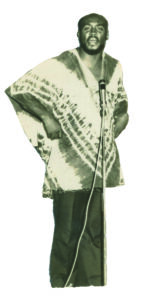
My own favorite collection and project is the Lloyd Best Archive Digitization Project. This ongoing initiative focuses on digitizing the papers of Lloyd Best, a leading Caribbean economist and public intellectual, while ensuring that the physical materials remain in Trinidad and Tobago. Working in close partnership with Best’s family and local collaborators, the project supports community-led digitization, description, and stewardship, with the Watkinson Library providing technical guidance and digital infrastructure.
The work prioritizes collaboration, shared authority, and respect for the intellectual and cultural contexts in which the materials were created. It demonstrates how digital projects can expand access while remaining grounded in ethical practice and long-term relationships.
The staff favorites featured on these pages echo that same spirit. Together, they reflect curiosity, care, humor, and a shared belief that libraries are living ecosystems shaped by people as much as by collections.
Eric Stoykovich
College Archivist and Manuscript Librarian
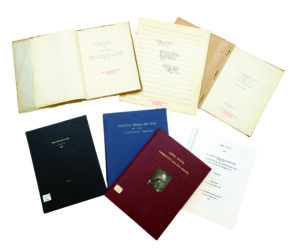
A favorite collection of mine that typifies two important characteristics of the Trinity College Archives—distinction within uniformity—is the collection of more than 1,000 master’s theses. Between the early 20th century and the early 21st century, the College offered master’s degrees to older members of the Hartford community who took courses alongside the undergraduates. Many were women receiving degrees from Trinity—long before undergraduate education became coeducational in 1969—while teaching in the local public schools, including Hartford teachers Anne L. Gilligan and Dorothy M. McVay, who in 1930 were Trinity’s first female master’s degree recipients. During most of that era, each recipient of a Trinity master’s degree had to complete a written thesis or perform a capstone work of dance or theater. Each thesis is a body of unpublished work specific to discipline and the person who produced it. As a result, each is a unique window into the scholarship, creativity, and education of the master’s candidate. The copy in the archives may be the only one still in existence. The completion of a master’s thesis often led to important personal discoveries or intellectual achievements later in one’s life or possibly career. Several examples of Trinity master’s theses remain today as readable, valuable, and well-researched pieces of writing or works of art.
Amanda Matava
Digital Archivist
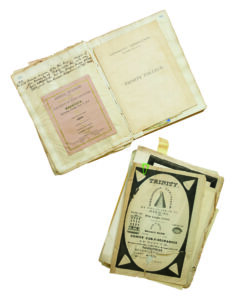
One of my favorite collections in the Watkinson Library is our student scrapbook and diary collection (particularly those created before 1879) in the College Archives. I don’t love them because they’re neat or tidy (they absolutely are not) but because they are delightfully tactile and intimate. You can’t leaf through these. You must pause, unfold, lift up, turn sideways. Students saved what they chose to remember, what was important to them in the moment: programs from performances and events, school assignments and schedules, pressed flowers, dance cards, pranks, grievances, friendships. They didn’t think they were “documenting history.” They were simply paying attention—collecting ephemera to evoke memories once their time at Trinity had passed.
Pre-1879 examples are particularly compelling because they document a Trinity that no longer physically exists. The downtown campus consisted of different buildings, streets, and daily rhythms but also the same anxieties, questions, and joys of today. Students struggled with exams, joined clubs and teams, studied in the library, and found corners to have a little fun. These pages collapse time, allowing us to meet past students not as abstractions but as peers in the present tense, even if they lived more than 150 years before we did.
Barbara Sternal
Art Collection Manager

One of my favorite pieces in the art collection is an untitled painting by Haitian artist Paul Nemours depicting various animals surrounded by leafy plants, all on a black background. This work is one of 336 pieces in the Edith A. Graham Collection of Haitian Art. The artwork in this collection encompasses an assortment of styles, media, and subject matter. Some works depict village scenes, while others feature fantastical landscapes or historical figures. I like the painting by Nemours in particular because it is characterized by vibrant colors and a precise graphic style, and although the subject matter is seemingly straightforward, Haitian art depicts deep and complex meanings and viewpoints from a vibrant and resilient culture. As analyzing art can be subjective, I invite the reader to examine the painting and to develop their own interpretation.
The Edith A. Graham Collection of Haitian Art is part of Trinity’s art collection, which numbers several thousand pieces. The College’s collection consists of a variety of artworks, including paintings, prints, sculptures, and decorative objects from a wide range of time periods and cultures. Several pieces are displayed in spaces on campus where students, faculty, and staff, as well as members of the public, can enjoy them.
Casey Machenheimer
Special Collections and Archives Librarian for Public Services, Research, and Outreach

My favorite book in the Watkinson Library is Blessed are those who mourn, for they shall be comforted (an altar) by gino romero. We acquired this book in 2024 as part of our artists’ books collection. An artist’s book is a difficult thing to define, but many artists’ books challenge the concepts of books and reading through their content and design. This book by gino romero not only challenges the idea of what type of object can constitute a book but also exemplifies how books can be a personal expression of our own humanity.
The book is in the form of a box with a drawer that contains different components that can stand alone as their own individual art pieces. Each component is imbued with different meanings that are informed by the identities and experiences of the author. The artist is a queer and trans Venezuelan American, and they are an ordained minister, archivist, and educator. This particular artist’s book unflinchingly examines the author’s reality of being Venezuelan, queer, and spiritual and uses unconventional materials (such as Venezuelan money) to portray these concepts. This is a book that encourages readers to engage with it both physically and emotionally.
Eric Johnson-DeBaufre
Rare Books and Special Collections Librarian
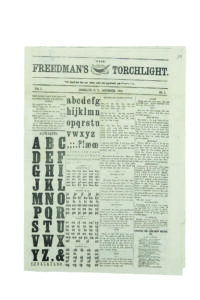
How does one choose a favorite item from a collection that includes so many remarkable materials? While our copy of Audubon’s Birds of America is, without doubt, the best known and most valuable item among our holdings, my personal favorite is the sole surviving copy of a 19th-century newspaper, The Freedman’s Torchlight, published by a free Black community in Brooklyn in 1866. Whenever I have the chance to exhibit it, I cannot help but feel deeply moved, to feel, in fact, like I am in the presence of something sacred.
The Freedman’s Torchlight was created immediately after the end of the Civil War to help teach newly freed Black men, women, and children how to read and to provide them with some necessary basic education. Perhaps more remarkably, it was produced by an organization staffed entirely by people of African descent who were committed to Black self-reliance and self-liberation. The editors and contributors make that clear within the paper, stating that they “believe, and always have believed, that the [B]lack man of education can best instruct, direct, and elevate his race.” Had this single copy not survived, we would have no printed record of this remarkable organization’s aims and achievements.