A force multiplier for the liberal arts
Elting Center for Innovation and Entrepreneurship helps students develop critical skills
By Andrew J. Concatelli
At Trinity College, having an entrepreneurial mindset isn’t just for start-up CEOs.
“Thinking like an entrepreneur means problem-solving, innovating, adapting, thinking outside the box, and taking smart risks,” says Elizabeth “Liz” Elting ’87. “These are real-world skills that help students succeed in whatever they want to do. These skills can belong to anyone, not just to people who want to start a company.”
Students will soon have a dedicated space on campus to build those universal skills. With a lead gift from Elting—a former Trinity trustee and a highly engaged alumna—the College began construction this summer on the Elting Center for Innovation and Entrepreneurship. The Vernon Street building, expected to open in fall 2027, will become a hub for students, faculty, staff, community partners, and alumni engaged together in innovative thinking and entrepreneurial work across disciplines.
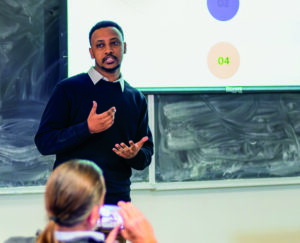
“I want every Trinity student, regardless of their major or future goals, to have access to the mentorship, hands-on learning, and community that can help them develop these critical skills and to learn how to thrive in whatever they choose to do,” Elting says. “Entrepreneurial thinking isn’t a specialty; it’s a mindset. And the earlier students develop it, the further it will take them.” (See more on Elting below.)
Graduates in Trinity’s Class of 2026 heard from Commencement speaker N. Louis “Lou” Shipley ’85 about what it means to have an entrepreneurial mindset. Shipley—a multi-time tech CEO and entrepreneur, a former Trinity trustee, and a founding supporter of the Elting Center for Innovation and Entrepreneurship—spoke of the importance of seeing opportunities where others see obstacles. “I urge you to be entrepreneurial,” he said in his address last May. “You don’t have to start a business to be entrepreneurial, but you should be adaptable and open to learning from others and be willing to get outside your comfort zone.” Those who can think like entrepreneurs, he added, “don’t see failure as the end—they see it as a chance to learn, to adapt, and to grow.”
Early start
The center that is now known as the Elting Center for Innovation and Entrepreneurship was launched in 2022, with more students taking part in its programs and events each year since, according to Danny Briere, Ruane Family Executive Director of the Elting Center for Innovation and Entrepreneurship.
“The Elting Center helps students apply liberal arts thinking to real-world problem-solving through collaboration, mentorship, and practical opportunities,” Briere says. “The programs and events reach all areas of the College, combining the co-curricular, extracurricular, and curricular.”
With input from the Elting Center for Innovation and Entrepreneurship Advisory Board (see far right), Briere is working on ways to grow and differentiate the College’s innovation and entrepreneurship offerings within the higher education landscape. “Entrepreneurship centers at many universities focus only on helping students launch businesses,” he says. “Trinity can support that, too, but our goal is to start to work with students very early on, by building innovative and entrepreneurial mindsets across as many students as we can. With these opportunities at Trinity, students can be more successful sooner.”
More than 20 percent of first-year students engage with the center in some way, according to Briere. First-year students can join the Invention, Innovation, and Entrepreneurship pre-orientation program, the Junior Analyst Training Program, or the Tyree Innovation Fellowship. (See more about the Elting Center’s offerings on page 39.)
“We’re doing a lot to help get students the skills that they can use later on,” Briere says. “The four pillars that we want to instill are creativity, invention, innovation, and entrepreneurship. To develop those, students engage with coursework, seminar speakers, internships, apprenticeships, and mentoring; they can start a business anytime, connect with alumni, and make an impact in Hartford and beyond. Above all, we’re focused on being a force multiplier for the liberal arts.”
Students
Gigi Winston ’29, a Posse scholar from Chicago, began her time at Trinity in the Tyree Innovation Fellowship program, a two-year experience that helps students build practical skills in innovation, leadership, and problem-solving through hands-on programming and mentorship. She worked with mentors from NextMinds (formerly the Connecticut Invention Convention) and was advised by Tracy Chadwell ’87 as she developed Cheri, a feminine hygiene product that fits discreetly into a phone wallet. Winston was a winner in the first-year category at Trinity’s 2026 Summit Innovation Challenge in January.
“Next year I’m going to continue to develop my product, and the Elting Center is setting me up with alumni who can help with the prototype process,” says Winston, who also has participated in the NESCAC Entrepreneurship Day and a behind-the-scenes tour at an Amazon facility through the Elting Center. “It’s really amazing how much support there is in the community. It gave me so much more confidence in myself.”

Alexander Cacciato ’26, from New York City, who graduated with a double major in history and international studies, came to Trinity with an idea for a business he had conceived with his family. Now the focus of Cacciato’s work, Flippit helps air travelers mail their TSA-prohibited items back to themselves from an airport security checkpoint rather than forfeiting the items.
“When the [Elting] Center at Trinity was announced, this was an immediately accessible resource that I could go to,” Cacciato says. “Danny was able to make a number of introductions to people who turned out to be tremendous resources, including Lou Shipley, so Flippit was one of the first companies to come out of the center.”
Cacciato won the Summit Innovation Challenge’s ready-for-market category with Flippit in 2024 and intends to continue his involvement with the Elting Center as an alumnus. “Entrepreneurship doesn’t have to be just commercial,” he says. “There are plenty of academic entrepreneurs. I think the entrepreneurial mindset is about how, instead of going through tracks already laid, a student can create a new path to blaze for themselves, bring ideas to the world, and have an impact on others.”
Academics
The Elting Center has worked with academic departments to launch an innovation experiential certificate and an entrepreneurship experiential certificate as part of the Trinity+ curriculum. Certificates appear on student transcripts and may be referenced on résumés. In addition, Trinity offers a minor track that includes entrepreneurship within formal organizations.
In a pilot program led by the center last year, senior computer science majors partnered with local companies and organizations to solve problems using applied AI. One team working with Connecticut Children’s Medical Center developed a system to quickly query emergency medical treatment guidelines, and it was beta tested by pediatricians at the hospital. As Briere says, “This is experiential learning in action.”
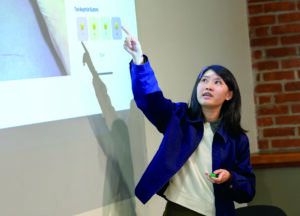
Ewa Syta, Charles A. Dana Associate Professor of Computer Science and faculty lead for the Elting Center, says, “We want students to go through the entire process of identifying a problem, defining it, designing a solution, implementing it, testing it, and ultimately deploying the solution. And that’s very much what happens in the real world. It’s an approach they will take into the careers that they will be pursuing.”
Syta says that this way of thinking can be applied not only to business and technical entrepreneurship but also to fields such as sustainability, public policy, and community engagement. “At Trinity, we develop leaders, and leaders bring about change, including social change,” she says. “The center provides support to students so they can turn their ideas into tangible outcomes and real-world impact.”
As an adviser to the center, Clayton P. Byers, Donald L. McLagan Associate Professor of Engineering, has seen students learn that they can apply entrepreneurial skills broadly. “The center provides a creative and disciplined outlet for any students who want to take their knowledge, their degree, and their learning beyond the classroom. I think it is a quintessential example of what the liberal arts is,” he says. “Yes, students can talk about an idea for a start-up, and the center can provide them with guidance. But I think everybody can benefit from innovation and entrepreneurship, including, for example, a freelance writer trying to find ways to build up their clientele.”
Alumni network
Hundreds of alumni are engaged with the center through the Entrepreneurship Corps, which offers many ways for them to share their knowledge and experience with students, including speaking at events on or off campus, mentoring student project teams, and judging a competition. “We bring about 70 to 80 alumni to campus in any given year,” Briere says. “They are instructing students, helping us to develop programming, hosting workshops, and networking with the students.”
Elting notes that the center creates new opportunities to harness Trinity’s powerful alumni network by bringing together generations of Bantams who are eager to invest in and to inspire one another. “That connection is mentorship at its best,” she says. “Mentorship opens doors that might otherwise remain closed, builds the confidence people need to navigate major career and life decisions, and helps develop the practical skills students can’t always learn in the classroom alone.
“Mentorship also does something even more critical,” Elting adds. “It builds community. When alumni, professors, administrators, and students are all actively connected and engaged with one another, Trinity becomes something more than a college that students graduate from—it becomes a network they belong to for life.”
Header image: Ruane Family Executive Director of the Elting Center for Innovation and Entrepreneurship Danny Briere, second from left, with Kwaku Agyapong ’26, Ella Geffen ’29, and Gigi Winston ’29 (Photo by Nick Caito)
More from Liz Elting ’87Elizabeth “Liz” Elting ’87—founder and CEO of the Elizabeth Elting Foundation—founded TransPerfect out of an NYU graduate school dorm room in 1992 and served as co-CEO until 2018. TransPerfect is the world’s largest language solutions company, with more than $1.3 billion in revenue and offices in more than 150 cities worldwide. Elting also is the best-selling author of Dream Big and Win: Translating Passion into Purpose and Creating a Billion-Dollar Business. At Trinity, Elting helped launch the Elizabeth Elting Foundation Venture Conference for Women’s Leadership, a pre-orientation program. She is a member of the Trinity Women’s Leadership Council and the Marjorie Butcher Circle and has been awarded the College’s Alumni Medal for Excellence. “While working with so many standout initiatives at Trinity over the years, I’ve seen firsthand the talent and motivation of our students and alumni,” Elting says, “and this new building is the natural next step by offering a permanent space to allow Trinity students to gather together to kick-start their entrepreneurial dreams.” Elting says that she graduated from Trinity not only with a B.A. in modern languages but also with the ability to think across disciplines, to engage deeply with ideas, and to connect with people from vastly different backgrounds. “Trinity gave me so much, including many of the skills I used to build my business and then start my foundation,” Elting adds. “I felt a real responsibility to pay that forward for Trinity students today. I want this center to create the kind of community where everyone has the support to thrive professionally.” |
Supporting the pillars
The Elting Center offers nearly 30 programs, events, and activities for students. Here’s a sampling:
Creativity
Idea Hackathon: A fast-paced event where students develop creative solutions to real-world challenges, pitch their ideas, and receive feedback from the audience, mentors, and judges
Invention
Summit Innovation Challenge: A campuswide pitch competition where Trinity students, HMTCA high school students, and young alumni present innovative ideas, inventions, and emerging ventures; answer questions from alumni judges; compete for awards; and share their progress with the broader Trinity community
Innovation
Innovation Academy (Tyree Innovation Fellowship): A selective first-year program that helps students develop innovation skills through individual and team-based experiential learning, mentorship, and hands-on projects
Applied AI Innovation Sandbox: A project-based program where students work with external partners to apply artificial intelligence to real-world challenges and develop deployable solutions
Entrepreneurship
Entrepreneurship Academy (Tyree Innovation Fellowship): A selective second-year program that builds on the Innovation Academy experience by introducing students to entrepreneurial thinking, opportunity recognition, venture creation, and leadership
Junior Analyst Training Program: A career-focused program that prepares students for finance, consulting, venture capital, investment banking, and related fields through intensive training and mentorship
Tuck Bridge Program: A partnership with Dartmouth’s Tuck School of Business that provides students with a foundation in business, finance, marketing, and leadership
NESCAC Entrepreneurship Day: An annual innovation challenge that brings together students from all 11 NESCAC institutions to form mixed-school teams that develop a sustainable business venture in response to a challenge introduced at the event and present solutions to a panel of judges
The Elting Center for Innovation and Entrepreneurship Advisory Board
Elizabeth “Liz” Elting ’87
Eric R. Fossum ’79, H’14
Steve Hafner P’23
John D. Howard ’74, P’27
Thomas J. Lazay ’95
William K. Luby ’81
Daniel Meyer ’80, H’24, P’20
Arthur F. Muldoon Jr. ’88
Nick Neonakis ’94
Jennifer Openshaw
Edward T. “Teddy” Schiff ’01
N. Louis “Lou” Shipley ’85
Gordon Singer P’27
Casey Tischer ’01
Kathryn George Tyree ’86