Berger-Sweeney Joins Virtual Conversation on ‘Race, Class, Higher Education, and Democracy’
Content
Story
Posted
By
Andrew J. Concatelli
Category
Trinity in the News
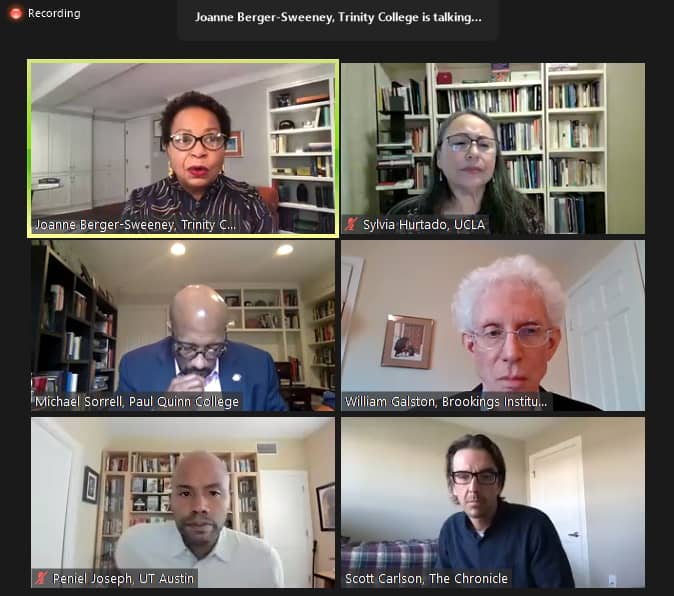
Trinity College President Joanne Berger-Sweeney took part recently in a virtual conversation called “Race, Class, Higher Education, and Democracy,” hosted by The Chronicle of Higher Education, a national leader in higher education journalism. The program explored how colleges define their roles in promoting civic engagement and what they can do to support democracy and racial equity.
A screenshot from the ‘Race, Class, Higher Education, and Democracy’ conversation, hosted by The Chronicle of Higher Education.
Berger-Sweeney was among the four panelists who were invited to discuss the ways in which educators can renew their mission to serve and advance an equitable democratic society. Joining Berger-Sweeney were: William Galston, senior fellow in governance studies at the Brookings Institution; Sylvia Hurtado, professor of education and former director of the Higher Education Research Institute at the University of California at Los Angeles; and Peniel Joseph, professor of public affairs and history and founding director of the Center for the Study of Race and Democracy at the University of Texas at Austin. The panel was co-hosted by Scott Carlson, senior writer at The Chronicle, and Michael Sorrell, president of Paul Quinn College.
Held via Zoom on October 15—just weeks ahead of the presidential election—the conversation began with a question about how higher education can turn outward to serve the public good and address the issues of the day, including race, class, and democracy.
Berger-Sweeney, who helped launch the Center for the Study of Race and Democracy at Tufts University, spoke about Trinity’s choice to become a test-optional institution as one important way to promote equal access to higher education. “We removed SAT and ACT scores as a barrier to entry,” she said.
Additionally, Trinity created a series of programming called “Bridging Divides,” which Berger-Sweeney said focused on higher education’s role in advancing understanding and promoting a just society. “Even if you have a difference of opinions, you can come together and discuss them in the academy,” she said. “An educated population is essential to democracy.”
Berger-Sweeney also talked about her decision to encourage democratic participation by giving Trinity staff members the day off on election day this year to vote, work at polls, or volunteer in other ways if they wish.
To view the entire conversation on demand, click here.
Trinity College President Daniel G. Lugo speaks with WFSB about the College’s new Hometown Hartford initiative, through which admitted students from Hartford will receive a Capital City Grant covering the full cost of tuition, room, and board.
The Hockey News follows the story of Dominique DiDia ’12 and Kim Weiss ’11, who met as Trinity teammates and now are general manager and coach of the new Professional Women’s Hockey League team in Las Vegas.
Fine Books & Collections—a quarterly magazine and daily blog about rare books, fine art, and collecting—reports on a discovery at Trinity College’s Watkinson Library of a page of previously unrecorded 15th century printing.
Trinity has announced that it will cover full tuition, housing, and meals for admitted students who live in Hartford. Trinity also is eliminating application fees and offering half-tuition grants to admitted students from Hartford County and five neighboring counties.
 Berger-Sweeney, who helped launch the Center for the Study of Race and Democracy at Tufts University, spoke about Trinity’s choice to become a test-optional institution as one important way to promote equal access to higher education. “We removed SAT and ACT scores as a barrier to entry,” she said.