From Lived Experience to Research: How Zeynep Oguzer ’26 Used the Marcuss Fellowship to Study Earthquake Preparedness in Türkiye
A double major in Human Rights and Psychology, with minors in Urban Studies and Philosophy, Zeynep Oguzer ‘26 has spent the past year investigating how people respond to disaster, and why so many remain unprepared even when the risks are well known.
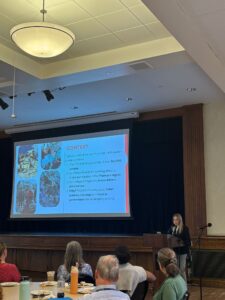
Her project grew out of both personal experience and academic curiosity. Shortly after Zeynep’s family moved to the US from Türkiye, Hurricane Harvey flooded the place they were staying. That’s when she became interested in how disasters affect people’s lives. Then, during her first year at Trinity, the devastating 2023 earthquakes in Türkiye killed more than 50,000 people. Watching the destruction from across the ocean left a lasting mark on her.
“It was devastating,” Oguzer said. “I was so affected by everything that happened that I decided to actually research why people don’t prepare.”
That question became the foundation of her Marcuss-funded psychology thesis, which examines how earthquake preparedness in Türkiye is shaped by trust in government, religiosity, fatalism, and political ideology. At the same time, her human rights thesis approaches the issue from the opposite direction, focusing on how political leaders use fatalistic language to shift responsibility away from themselves and onto fate or God. Together, the two projects form what Zeynep describes as a bottom-up and top-down way of understanding the same problem.
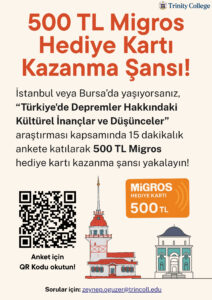
For the psychology study, Zeynep designed a detailed survey and collected responses from about 500 participants in Bursa and Istanbulregions in Türkiye. She carefully ensured the project was grounded in the local context. Wherever possible, she used scales previously developed by Turkish researchers or already used in Turkish studies. When those were unavailable, she translated and back-translated materials herself to preserve meaning.
The data revealed surprising findings. The strongest predictor of earthquake preparedness, she found, was self-efficacy: whether people believed they were actually capable of preparing. But that sense of capability did not emerge in the same way for everyone. Among more conservative and more religious participants, greater trust in government was associated with higher self-efficacy and, in turn, greater preparedness. Among more liberal and less religious participants, the opposite pattern appeared: lower trust in government was associated with higher self-efficacy and greater preparedness.
The findings suggest that people don’t all respond to preparedness messaging in the same way. For Oguzer, that has important practical implications.
“You can’t really go about it in a one-size-fits-all way,” she said. “Different demographics, people with different ideologies, react to messages differently.”
Her research also challenged assumptions about fatalism. Rather than reducing preparedness, fatalistic beliefs appeared in some cases to increase it, especially among conservatives, while also increasing fear. That complexity is part of what made the project so compelling. What began as a study of fatalism evolved into an analysis of how belief systems, political identity, and trust shape people’s responses to risk.
The project was ambitious from the start, and Zeynep said it would not have been possible without Marcuss Fellowship funding. Her faculty mentor initially warned that an international research project would be difficult to pull off as an undergraduate. The fellowship made it feasible for her to travel to Türkiye, recruit participants, and provide incentives for survey participation.
It also gave her the opportunity to grow as a researcher. She led the project design and data collection herself, relying on family networks, social media, and community outreach to build her sample. Some of that outreach was unexpectedly difficult. When sending messages to local contacts through WhatsApp, her account was flagged as spam multiple times. However, even after returning to Connecticut, she continued participant recruitment remotely and nearly doubled her sample size.
“Everything takes longer than you expect,” she said. “You’ve got to be really intentional with your time.”
That lesson is one she expects to carry into the next stage of her academic career. This fall, Zeynep will begin a Ph.D. program in social psychology at UConn, where she plans to continue research on related questions.
For her, the project’s success is not only academic. She hopes the research can eventually help shape more effective public messaging and interventions around disaster preparedness in Türkiye. Instead of proposing a universal strategy for everyone, Zeynep argues that preparedness efforts should account for the ways different communities interpret risk, authority, and responsibility.
“I would be really happy if there are some changes in the future based on my project,” she said, “if we can actually find and use interventions that work for people to take precautions for earthquakes.”
For students considering applying for the Marcuss Fellowship, Zeynep’s advice is simple: start early, expect challenges, and choose a project that genuinely matters to you.
“I think you should definitely apply if there’s a project you’re passionate about,” she said.
In Zeynep’s case, that passion turned into a project that was personal, methodologically rigorous, and far-reaching. Rooted in her life experience and motivated by understanding how people live with risk, her work shows how undergraduate research can move beyond the classroom towards questions with real human stakes.