From Classroom to Community: “Anthropology of Museums” Students Curate Environmental Justice Research into a Traveling Exhibit
This fall, students in Professor Amanda Guzmán’s “Anthropology of Museums” course turned environmental justice research into a traveling banner exhibit that invites visitors to reflect and participate in facilitated discussions about environmental and waste management issues in Greater Hartford.
The exhibit, which debuted at the Connecticut Museum of Culture and History from January 29 to February 6, includes five banners that introduce the project and the environmental justice questions at stake in Greater Hartford, share archival findings about urban planning and waste management, explain the history and impacts of a trash-burning incineration plant in Hartford, and present findings from Photo Voice and oral histories. The exhibit is a component of the Hartford Environmental Justice Research Partnership (HEJRP). *
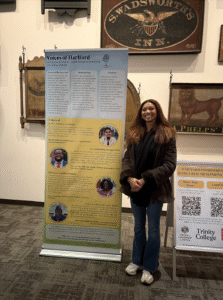
One of Guzmán’s students was Arrington Mims, a senior anthropology major at Trinity, who took the course because she is interested in museum careers and exhibit curation. Mims had previously completed engaged coursework in the archives of the Stowe Center of Literary Activism, one of the two grant community partners.
She worked with a group of class peers to translate oral histories with 14 community members into a banner for public audiences. Mims described the central challenge as accurately representing participants while condensing long interviews into short quotes, given the banners’ space limitations. “We were really trying to make sure we weren’t chopping up their words and making them say something they didn’t mean,” she shared.
Mims said it was powerful to see the work leave the classroom. “Usually, I do a project, and it’s just my professor looking over it. This is something people are going to see,” she said. “This has an impact.”
The pop-up banners are designed to be displayed in public spaces for a general audience while also inviting optional research participation through an anonymous survey. There is also an opportunity for visitors to view the banners as part of facilitated dialogues that offer a space for group discussion around visitors’ reflections and perspectives on environmental justice, waste management, and regional responsibility. An important component of the broader research project is understanding how people in Greater Hartford view environmental justice, especially as it relates to trash management. Survey responses and dialogue experiences will be analyzed to contribute to this line of inquiry.
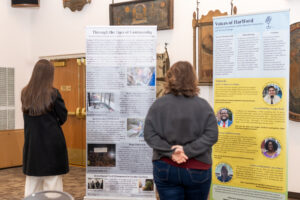
A focus on careful representation, clarity, and accessibility shaped the overall development of the traveling exhibition. Students worked through multiple rounds of feedback from faculty and project partners, revising banner language and visual design to make the information readable and impactful for a general audience. At the exhibit opening, Mims said she watched visitors stop and read closely, reacting in real time to the history and the community experiences presented.
The goal of the exhibit work was not only to share information, but to make space for reflection and conversation: how decisions about land use and waste management have been made, who has borne the health and environmental consequences, and what regional responsibility could look like going forward.
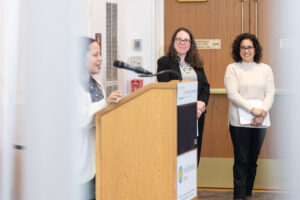
The exhibit will be on display at several more venues over the next few months. The banners will be installed as part of a dialogue event at Urban Hope Church, a Hartford congregation that plays a key role in the work of project partner, Center for Leadership and Justice. Facilitated dialogues will be led by Political Science senior majors in Prof. Stefanie Chambers’ environmental justice seminar. On March 5, the exhibit will travel to the Avon Public Library, where it will remain on display until a public dialogue led by the students at an event on March 23. The final stop on the itinerary this semester is at Mather Hall, where the Trinity and Hartford communities are invited to view and react to the banners from April 1–29.
*The Hartford Environmental Justice Research Partnership project is a 3-year grant funded by the Andrew W. Mellon Foundation and led by Professors Amanda Guzmán, Garth Myers, and Abigail Fisher Williamson. The project is a collaboration between Trinity College’s Center for Hartford Engagement & Research, Center for Caribbean Studies, and Center for Urban and Global Studies, with community partners at the Center for Leadership & Justice and the Stowe Center for Literary Activism. Collectively, the team aims to encourage informed public dialogue about how historical land-use decisions have imposed health and environmental consequences on Hartford’s predominantly Latine and Black residents and to build regional consensus to address challenges posed by that history. To learn more about the project, visit the project website.
(Header image by Sarah McCoy)