Garth Myers, Director of the Center for Urban and Global Studies and Paul E. Raether Distinguished Professor of Urban International Studies, has published his sixth book, Postcolonial Urban Studies: Édouard Glissant and the Whole-World of Cities. Myers calls it the work he is “proudest of.” The book brings together urban studies, geography, postcolonial thought, literature, and personal reflection. It closely engages with the ideas of Martinican poet, novelist, and philosopher Édouard Glissant.
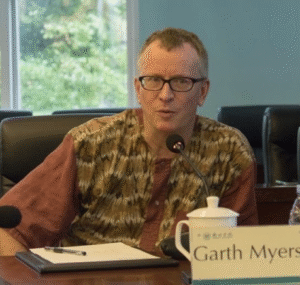
The book was recently introduced to the Trinity community through a virtual book launch hosted by CUGS. Myers talked about the inspiration behind the book, the research and writing process, and the cities, histories, and theoretical questions that shaped it.
Myers began writing Postcolonial Urban Studies during the pandemic, soon after his book Rethinking Urbanism was published in June 2020. At the same time, he was reading Glissant’s Treatise on the Whole-World, first published in French in 1997 and translated into English only in 2020. Myers had always found Glissant’s work captivating, but this book gave him new ideas for thinking about geography and urban studies.
“I have been inspired by Glissant long before that,” Myers said. “I read many times the Treatise on the Whole-World, and I thought it was really undervalued… It has a lot of material that relates very well to geography and potentially to urban studies.”
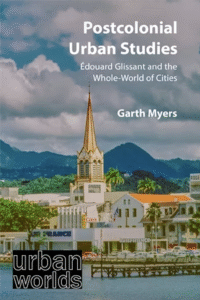 This interest became the starting point for Postcolonial Urban Studies. The book has four main chapters, each based on a different essay from Glissant’s Treatise on the Whole-World. Myers follows Glissant’s approach by comparing two cities in each chapter. He looks at what these comparisons show about colonial history, migration, city life, political identity, and daily experiences.
The first chapter compares Fort-de-France, Martinique, and Zanzibar, Tanzania. Myers describes both cities as shaped by colonial history, limited politically, and important to Creole cultures. He explores creolization through their buildings, languages, and cultural blending. He also asks if cultural mixing can help people survive but also create ongoing political tensions.
The second chapter looks at the Zambian Copperbelt and the anthracite coal region in northeastern Pennsylvania, where Myers grew up. This chapter focuses on mining, rapid growth and decline in cities, and the differences between mixed cultures and more fixed identities. Myers shows how mining towns can bring people together during good times, but economic downturns can lead to exclusion, resentment, and blame.
The third chapter focuses on Hartford, Connecticut, and Kingston, Jamaica. Myers uses literature and urban research to question common ways of describing marginalized neighborhoods. Rather than seeing places like Hartford’s North End or West Kingston only in terms of violence or poverty, he asks what new patterns and ways of living appear when we look at cities through “the time of the other.” He includes novels like Ocean Vuong’s On Earth We’re Briefly Gorgeous and Marlon James’s A Brief History of Seven Killings to bring in different urban perspectives.
The last chapter compares Los Angeles (”City of Angels”, where he earned his PhD at UCLA) and Dar es Salaam, Tanzania (”Haven of Peace”, where he has conducted much of his research). Myers looks at how cities can be places of refuge, especially for migrants, and considers issues like climate planning, infrastructure, and community support. He points out that official city plans often do not help everyday people, even when they promise sustainability. At the same time, he highlights local groups that build support networks for migrants, refugees, and others on the edges of city life.
The conclusion, based on Glissant’s essay “Waves and Backwashes,” brings back the book’s main themes of migration, displacement, and the legacy of the transatlantic slave trade. Myers links these histories to current migration across the Mediterranean and discussions about “Fortress Europe.” He finishes on a hopeful note, reflecting on African communities in Europe that show creativity, solidarity, and a sense of belonging today.
While the book deals with complex ideas, Myers wrote it for both students and scholars. He hopes it will be useful in urban studies, Caribbean studies, African studies, geography, and postcolonial theory, and that advanced undergraduates will also find it accessible.
“I started out with the idea that it would be a book that would be read by ordinary people,” Myers said. “But Glissant is really hard… He is a complicated thinker.” Even so, Myers hopes the book will be used in classes like Global Cities (URST-302 at Trinity) or advanced urban studies seminars, where students are ready to think across different regions, subjects, and historical backgrounds.
At Trinity, the launch event gave students, faculty, and colleagues the opportunity to learn about the book and Myers’s personal journey in writing it. He has also presented at Amherst College and hopes to share his work at more academic events in the near future.
Myers has always questioned narrow ideas about cities and urban theory. In Postcolonial Urban Studies, he argues that cities cannot be understood through a single lens or theory. Instead, they should be seen through relationships, movement, memory, and the “whole-world” connections that Glissant describes.