Urban Environmental Science in Practice: Avery Sands on Research, Advocacy, and the Marcuss Fellowship
For Avery Sands ’26, environmental science manifests itself in cities, public health, and the environments people interact with every day. A Marcuss Fellow, National Environmental Leadership Fellow with the Rachel Carson Council, student representative on Trinity’s Sustainability Committee, and the Presidential Fellow for the Environmental Science Program, she designed an independent senior honors thesis project investigating whether a Hartford waste incinerator that closed in 2021 might be linked to mercury concentrations in nearby ponds across Hartford County. The thesis project combined fieldwork, lab analysis, and community engagement, reflecting Avery’s broader interest in urban environmentalism and environmental justice.
Inspired by earlier undergraduate research and work in Trinity’s Liberal Arts Action Lab, Avery wanted to explore a question grounded in Hartford itself – could the city’s waste incinerator be affecting surrounding freshwater ecosystems?
“I wanted to see whether the waste incinerator was acting as a point-source polluter,” Avery said. “In Hartford, there are so many different industries that have affected the urban environment over time, and I wanted to investigate that scientifically.”
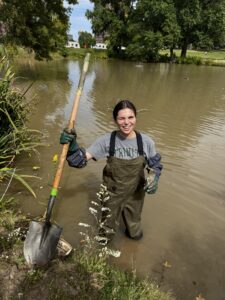
To answer that question, she collected sediment samples from ponds across Hartford County, including sites in Hartford, West Hartford, and Glastonbury. The ponds were located both upwind and downwind of the waste incinerator. After collecting the sediment, Avery processed the samples back to one of Trinity’s environmental science labs and used a mercury analyzer to measure mercury concentrations.
Her thesis results indicated that most of the study ponds met safe standards for mercury concentrations. There were some exceptions due to surrounding urban land use around the ponds, but not the waste incinerator.
Even though the project did not find a direct link, Avery sees the findings as meaningful, especially in urban environments where many different land uses and pollution sources overlap. “A lot of these ponds are also used recreationally, so it gives visibility to people who are interacting with them and helps show what is in those environments.” Avery said.
The public dimension is also something she has been involved with. Alongside her scientific research, she volunteered with the Greater Hartford Interfaith Action Alliance on their environmental justice advocacy around the redevelopment of the waste incinerator property. Through that work, Avery saw how local organizations were making sure community voices were included in redevelopment efforts.
That combination of science and advocacy became one of the most valuable parts of the Marcuss Fellowship experience. “I wasn’t only focusing on lab research,” Avery said. “I was also engaging with the community. That balance really mattered to me.”
The fellowship also helped Avery think beyond the thesis itself. She began developing the project for a broader audience and plans to submit the study to a peer-reviewed scientific journal this summer. Avery will also present the work at Trinity’s research symposium and has submitted an abstract to a Connecticut conference.
Avery describes the project as a culmination of some of the most meaningful parts of the Trinity experience: undergraduate research, environmental science training, and community-based work in Hartford.
The work was highly independent and came with challenges. Avery conducted most of the project during the fall and January term, handling field collection, lab processing, data analysis, and writing over the course of the academic year. One of the hardest parts was the fieldwork itself. Collecting sediment from ponds required careful planning, from finding access points to making sure each sample was collected in a standardized way.
At the same time, fieldwork became one of the most memorable parts of the project. Many of the ponds were in public parks, and local residents often stopped to ask questions or talk about how they used those spaces for fishing or walking. Those interactions reinforced that urban environmental science is closely tied to everyday life.
The project also gave Avery a new way of seeing Hartford County. Much of the fieldwork took place during peak fall foliage, turning data collection into a process of discovering beautiful parks and landscapes.
That experience helped clarify Avery’s future direction. After graduation, she will continue working at the intersection of environmental research, nonprofit advocacy, and urban environmental issues. This summer, Avery will intern with a conservation nonprofit, building on the combination of science and public engagement that shaped her fellowship project.
For Avery, one of the biggest lessons from the Marcuss Fellowship was that meaningful environmental work in cities requires both research and community involvement.
“Some of the most important conservation work is happening in cities,” Avery said. “It’s about urban green spaces, making sure they are equitable, making sure they are accessible, and making sure they are clean.”
Looking back, Avery encourages future applicants to choose projects they genuinely care about and to find mentors who will support them along the way.
In Avery’s case, that combination of personal investment, scientific curiosity, and community engagement produced a project that speaks to both environmental science and the value of undergraduate research rooted in place.