For Neo, Trinity became a place where she could follow what interested her and see where it led. Now an Urban Studies, Anthropology, and Arabic triple major – she describes her path as the one started out of curiosity, and shaped over time by the classes she chose, the people she met, and the places she went.
“I’ve only been a triple major since this year,” she says. “But it happened very naturally. Nothing about it felt forced.”
Neo grew up primarily in South Africa, spent part of her education in India, and has also lived in the Netherlands. That global background shaped the way she moved through Trinity, but she says she did not come in with a fixed plan. Instead, she followed the classes and professors that genuinely excited her.
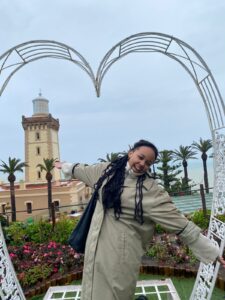
Like many Urban Studies majors, Neo traces that path back to her first-year experience in the CITIES Program – a first-year Urban Studies immersion, designed as a sequence of classes for students interested in cities. Neo still names the program’s courses as her favorite.
“I loved the assignments where we actually had to go out into Hartford,” she says. “Even now, I feel like I know the city a lot more than people who have mostly stayed on campus. That started very early for me at Trinity, being able to get off campus and actually see how cities work and move.”
That class gave her more than an introduction to Urban Studies. It also gave her a community. She remembers it as one of the most engaged classroom spaces she had at Trinity, filled with students who were excited to explore the city together.
Outside the classroom, Neo has taken full advantage of the opportunities available through CUGS and the wider college. Through the Community Learning Research Fellowship, she worked with Integrated Refugee and Immigrant Services and the Swahili Community Center on questions of social integration for African refugee youth in Hartford. Through the Public Humanities Collaborative, she helped conduct archival and object-based research for digital exhibits. More recently, through the Liberal Arts Action Lab, she worked on a project with Cinestudio focused on how the space could better serve as a true community resource in Hartford.
She credits Trinity’s faculty, especially Professor Garth Myers, with helping make those experiences possible.
“He really sees the best in his students,” she says. “He wants to help you move in whatever direction you want to go.”
Mentorship at Trinity has shaped the way she thinks about Urban Studies as a field. For Neo, the major is not only about cities in the abstract. It is about paying attention to how people move through systems, how communities experience place, and how larger structures affect daily life.
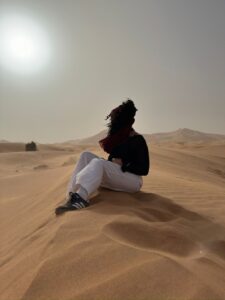
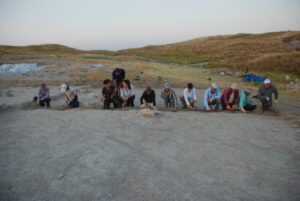
Those interests also connect closely to her work beyond Trinity. She studied abroad in Rabat, Morocco, through an intensive Arabic language and homestay program, then did a year-long exchange in Oxford, where she took courses in both Anthropology and Urban Studies. One of her favorite classes there, Urbanism and Society, explored modern cities through much older urban forms and traditions. Last summer, Neo also worked on an excavation at Beycesultan, a Late Bronze Age site in Türkiye, where she conducted archaeobotanical analysis.
|
|
|
|

Now, as a senior, Neo is bringing all those interests together in her thesis. Her project looks at youth living with both tuberculosis and HIV in South Africa, with a focus on how urban infrastructures shape treatment adherence. It draws on Urban Studies, Anthropology, and Arabic, while also reflecting her growing interest in public health and medical anthropology.
That interest is shaping her next steps, too. Neo has been accepted to graduate programs at both Oxford and Cambridge and is currently deciding between them. In either case, she plans to keep exploring the intersections of health, infrastructure, and care.
For students just beginning in Urban Studies, her advice is simple: follow what feels interesting, and do not be afraid to build from there.
“You don’t need to have everything figured out,” she says. “Sometimes it’s just, ‘this is interesting, so let me do more of that.’ And it kind of falls into place.”
Neo’s experience reflects what Urban Studies at Trinity can offer at its best. It gives students the space to explore, connect ideas, and build something that feels their own. For her, that meant following curiosity and trusting where it led.