Islamophobia and Lived Experiences in Partnership with Muslim Justice Center
In the past decades, Muslim communities across the United States have navigated a landscape shaped by discrimination and misrepresentation. How does that manifest in the daily lives of Muslim community members in the Greater Hartford area? Throughout the past semester, I had the opportunity to explore this question as a student researcher in the Liberal Arts Action Lab project Islamophobia, Lived Experiences, and Community Space in Greater Hartford. As an international student from Pakistan who moved to the United States for college, I have been drawn to the study of identity, belonging, and social justice both within my Human Rights and International Studies coursework but also as realities that I experience and witness within my communities. My identity as a visibly identifiable Muslim has traveled with me across continents, and continues to shape my experiences in both positive and negative ways. Joining this project offered an opportunity to engage with mosques in the Greater Hartford area, Muslim community leaders, and learn more about Muslim representation within policies and media.
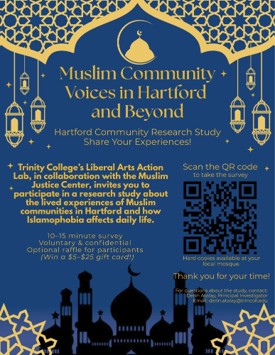
In the Action Lab, faculty and students from Trinity College and CT State Capital College partnered with Muslim Justice Center (MJC) to understand how Islamophobia or anti-Muslim racism manifests in the daily lives of residents in Greater Hartford, guided by our research question: How do policies, societal perceptions, and media narratives shape the daily experiences, opportunities, and well-being of Muslims in Hartford and surrounding towns? MJC is a Connecticut-based non-profit organization committed to defending civil rights, community enrichment, and ensuring legal assistance for Muslims and Muslim-adjacent individuals who face discrimination. With their guidance and community connections, our research aimed to center Hartford residents’ voices by highlighting recommendations built off of their lived experiences and calls for change.
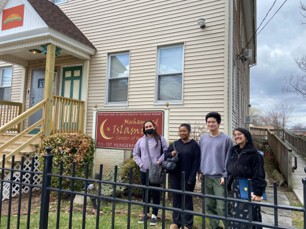
Our semester was structured around two courses: a Research Methods course and a Research Project course, which were co-instructed by Dr. Simon Hoellerbauer, Dr. Derin Atalay, and CHER Program Manager Erna Alić, where we learned qualitative and quantitative research methods, studied readings discussing the frameworks and definitions of Islamophobia, and ultimately built a public-facing website to share our findings. To answer our research question, we used a mixed-methods approach combining community surveys, semi-structured interviews, media analysis, policy review, and demographic town comparisons to better understand how belonging, representation, and political trust are shaped across different social spaces and institutions. Our partnership with MJC was essential in reaching mosques and disseminating surveys across Greater Hartford, including the Muhammad Islamic Center of Greater Hartford, the Berlin Mosque, the Farmington Valley American Muslim Center, and Masjid Al-Taqwa in New Britain. We conducted six interviews lasting between 45 and 60 minutes with prominent Muslim voices, including Imams (Muslim spiritual leaders) across various mosques and the first Muslim State Representative in Connecticut. We also analyzed 14 media articles across Connecticut outlets and reviewed policies ranging from federal surveillance programs to local zoning disputes.
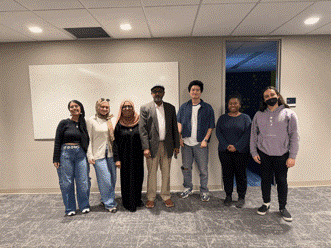
Our findings revealed that Islamophobia operates not only through interpersonal prejudice but across schools, workplaces, public institutions, media narratives, and policy systems. Interview and survey data showed that Muslim residents in Greater Hartford frequently navigate experiences of exclusion, institutional mistrust, and discrimination while simultaneously finding strength in mosque spaces and community networks. Across all of our data, one theme was clear: mosques and community spaces serve not just as sites of worship but as critical anchors of safety and identity, yet they alone cannot do the work the Muslim community needs. Our recommendations call for school-based educational programs, more inclusive public community events, interfaith dialogue spaces, and intentional efforts to uplift the diverse voices within the Muslim community itself. A more detailed explanation of our findings and recommendations can be found on our website.
A moment that stuck with me throughout this process was a statement from Omer Abdelgader, President of The Islamic Association of Central Connecticut, who reflected during our interview:
‘‘People are to me one of two things: either a brother or sister in Islam, or an equal in humanity.’’
That sentiment captures something essential about what this research is really about, not just documenting harm, but understanding what belonging and community can look like.