AI Guidelines for Faculty
A downloadable and printable version of the information below is available.
|
Trinity faculty are responsible for:
|
Setting AI Course Expectations
Consistent with the practice across higher education, and Trinity’s commitment to academic freedom, every faculty member will decide, based on the learning goals they have set for their students, whether or how AI can be used in a course to advance student learning. Students are assured that their professors are learning about AI; thinking deeply about pedagogy, or the most effective ways of teaching their students; and that student learning is their top priority. When a faculty member limits the use of AI in a course, it’s because they believe it will interfere—not advance or support—learning in that context. Use of AI that is part of an approved accommodation (e.g., note-taking) is permitted.
Communicating AI Expectations to Students
- Professors are responsible for communicating expectations about AI to students in each of their courses—always in writing; clarified verbally as needed; and framed in terms of supporting learning.
- Familiarize yourself with the academic integrity guidelines being shared with students, based on the Student Handbook. These include a one-page Academic Integrity Fact Sheet and Guidelines for Using AI Responsibly in Academic Work
- Using AI in a course is not always an all-or-nothing proposition. Usage policies can range across a spectrum and vary by assignment. Faculty should communicate with students which approach applies:
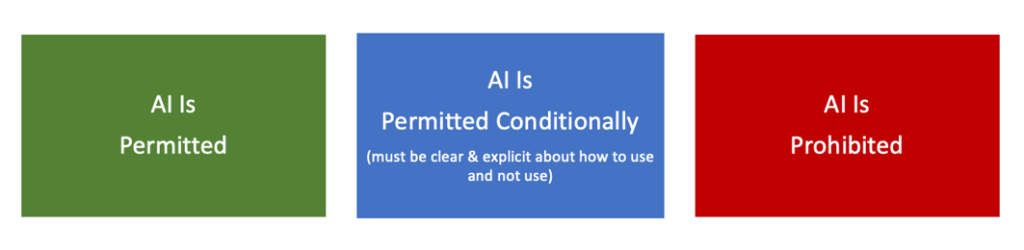
- For clear examples of language to include in syllabi, see Middlebury’s “Crafting Classroom AI Policies”.
- If AI is permitted to any degree, faculty should reinforce responsible use, including in terms of:
- Attribution and citation: see this guide from Brown University
- The need for a disclosure statement or, as appropriate, reflection statement (See academic integrity guidelines)
- The need for evidence of work or AI usage (See academic integrity guidelines)
- Ensuring that students have equitable access to AI tools (e.g., Boodlebox)
- If AI is not permitted, discuss this openly with your students, providing clarification such as:
- Examples of what constitutes inappropriate use of AI in the course (e.g., Is brainstorming or collaboration with AI permitted? Are AI features built into common tech tools excluded?)
- Your pedagogical goals for the course and the ways AI may undermine student learning
- Remember: an AI classroom policy does not override an approved accommodation.
Assessing Students Fairly and Consistently
- Faculty remain responsible for grading and other academic decisions. They should not upload identifiable student work or educational records to an AI system, which would violate FERPA or student privacy.
- Faculty, consistent with accreditation standards, assess student learning and assign grades based on expectations communicated to students, including those relating to AI; they apply course expectations consistently and fairly across all students.
- In alleging violation of academic integrity standards, faculty should:
- Not rely on AI detection tools, which can be inaccurate and biased. See this guide from MIT, “AI Detectors Don’t Work. Here’s What to Do Instead.”
- Rely instead on objective evidence (not subjective hunches), for example: verifiable evidence that sources are fabricated or nonexistent; dramatic inconsistency in a student’s work; evidence that a student is unable to demonstrate or explain their process, sources, or other key aspects of their work
- According to the Student Handbook, faculty (including members of Jury Pool) are responsible for treating all possible violations of academic integrity consistently. Failure to do so may create institutional risk.
Learning About AI for Faculty
Because AI is becoming ubiquitous in our work and lives, and students rely on it every day, it is important that faculty themselves develop AI literacy. This entails understanding what AI is and isn’t and knowing what constitutes responsible and ethical use. Indeed, many faculty are integrating AI into their teaching and research. All faculty are grappling with how to AI-proof at least some of their assignments and exams. Professional associations across disciplines are producing practical guidance about AI’s applications and challenges. Regardless of the approach, faculty members should understand AI so they’re empowered to support and advance student learning.
Trinity College AI Policies
- AI Central (SharePoint site from Technology, Data, and Innovation)
- For AI-related questions and support on campus, see these Contacts
General Resources for Faculty to Develop AI Literacy
- Artificial Intelligence Teaching Guide (Stanford University)
- AI Guide, AI Pedagogy Project (Harvard University)
- Artificial Intelligence (AI) Toolkit (Georgetown University)
- Resources, Hastings Initiative for AI and Humanity (Bowdoin College)
- AI-Based Library Research Tools (Trinity College)
- Global Resource Library for Higher Education (Digital Education Council)
Basic AI Courses (linked to higher education partnerships)
- AI Literacy for All, 4 hours, use this link for Trinity faculty and staff (Digital Education Council)
- Google AI Essentials, 5 weeks, free for all CT residents (Charter Oak State College)
- Elements of AI Course, 20-30 hours (University of Helsinki and MinnaLearn)
- 13 Foundational AI Courses, including AI 101, videos (MIT Open Learning)
Useful Resources for Course Design
- Designing Courses and Assignments in the Age of AI (Harvard University)
- Incorporating Generative AI in Course Design and Teaching Practices (Vanderbilt University)
- AI-Based Assignments and Activities and AI-Resistant Assignments (Carleton College)
- Strategies for Designing AI-Resistant Assignments (University of Chicago)