People vs. Politics Film Screening and Discussion at Trinity Promotes Voter Education
Content
Story
Posted
By
Cate Griffin ’27
Category
Alumni
The Trinity College community gathered recently for a documentary film screening and panel discussion as part of Voter Education Week, a nationwide campaign promoting voter engagement. Trinity faculty and staff members talked about issues brought up in People vs. Politicsand were joined by alumna Julia Hoppock ’06, an associate producer of the film.
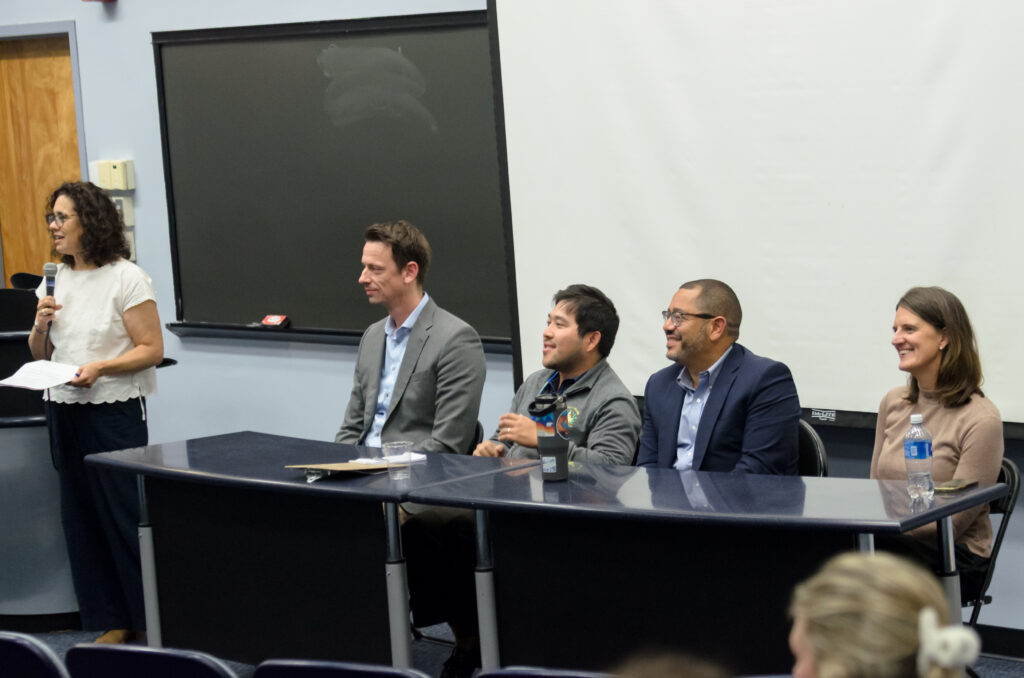
The October 7 event in McCook Auditorium was organized by Trinity’s Center for Hartford Engagement and Research (CHER) and TrinVotes!, a nonpartisan initiative to help students vote. Alongside Hoppock, the panelists were Assistant Professor of Political Science Dang Do, Visiting Assistant Professor of Political Science and Public Policy and Law Florian Gawehns, and Connecticut State Rep. Jason Rojas M’12, who serves as both the House majority leader and Trinity’s chief of staff and associate vice president for external affairs. The panel was moderated by Professor of Political Science Stefanie Chambers.
Professor of Political Science Stefanie Chambers moderates the panel discussion featuring Visiting Assistant Professor of Political Science and Public Policy and Law Florian Gawehns, Assistant Professor of Political Science Dang Do, Connecticut State Rep. Jason Rojas M’12, and Julia Hoppock ’06, associate producer of People vs. Politics. Photos by Ricardo Castanon ’30.
People vs. Politics profiles political activists around the country seeking to reform the United States’ two-party election system through ranked choice voting. Ranked choice voting allows voters to rank candidates in order of preference instead of simply choosing one candidate or the other, and is currently not widely used in the United States.
In the post-screening discussion, Gawehns called People vs. Politics a very inspiring film. “It’s great that people organize and think critically about the shortcomings of the current system,” Gawehns said. He added that he believes that although ranked choice voting will not necessarily fix political polarization, it has the benefit of not limiting election winners to just a Democrat or a Republican.
Hoppock, who graduated from Trinity with a degree in American studies, said that she was motivated to produce the film after working with the documentary crew following activists in Colorado. In addition to People vs. Politics, Hoppock also has helped produce several other documentaries, including The Dark Wizard series on HBO and the film The Social Dilemma on Netflix.
Hoppock said that her Trinity education played a role in her decision to work on People vs. Politics. “I definitely learned how to think critically at Trinity, and was taught to question the systems we have in place and who benefits from them,” she said. “I got to cut my journalistic teeth [at Trinity] with my senior thesis, where I went into the community and interviewed Korean immigrants.”
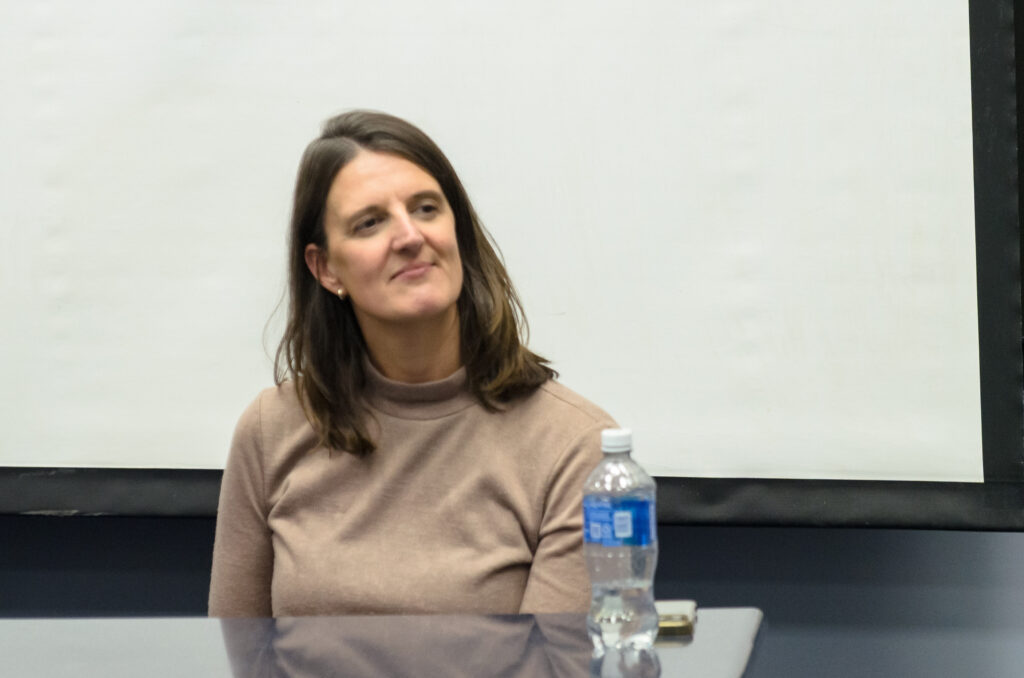
Julia Hoppock ’06, associate producer of People vs. Politics.
Regarding the voting situation in Connecticut, where the turnout in the most recent Democratic primary was just 26 percent, Rojas said that implementing ranked choice voting might change who gets elected, but the turnout may not increase significantly. He said that low voter turnout could be a result of the primary elections being held in early August, when more people are likely to be on vacation. However, he also said, “I would certainly be open to opening up the primaries to unaffiliated voters,” who typically cannot vote in primaries in the United States.
When the panel asked audience members if they thought that ranked choice voting becoming widespread would encourage more young Americans to vote, Kashmala Khan ’29 said, “I feel like a ranked choice system would allow more independence for people who want their name on a ballot and would let them hope that they can make an impact. The current system is so polarized that they, as [independent] candidates, do not have a fair fight.”
Do said that through his work with the Hartford Voter Captains’ Project, an initiative encouraging voter participation among historically underrepresented groups, he discovered, “The hardest part [about increasing election turnouts] is how we change that psychological mindset of ‘voting doesn’t matter.’”
Do added, “One thing ranked choice voting does is that it can change that psychology a little bit. It makes people think that ‘maybe I can make a difference.’ I think that this psychological aspect on the turnout is one of the benefits that ranked choice voting can give us.”
Additionally, Do said that there has been greater racial and ethnic diversity on the city council in St. Paul, Minnesota, which uses a ranked choice voting system. “There might be differences in different levels of government [due to ranked choice voting],” Do said. “Context and the level of government might matter, but change can happen.”
The digital humanities website Public Art CT—sponsored in part by Trinity College and created by a Trinity faculty member—has received a 2026 Award of Excellence from the American Association for State and Local History (AASLH).
Trinity alumna Teodora “Tea” Brnović ’24 and Associate Professor of Sociology Alyson K. Spurgas recently had a co-authored article published in the October 2026 issue of Social Science & Medicine.
Demonstrating valuable return on investment and continued alumni success, Trinity has earned recognition this fall in multiple college guides, including an elevated ranking at #31 on the 2027 U.S. News & World Report list of Best National Liberal Arts Colleges.
The exhibition opening in the Austin Arts Center on September 24 showcases recent works by Studio Arts Program Postbaccalaureate Fellowship alumni Ciara Rubí, Sydney Smith, and Trinity alumna Weixi Zhang ’18.