Harriet Beecher Stowe Symposium at Trinity Showcases Student Research
Content
Story
Posted
By
Eh Wah Wah ’28
Category
Academics
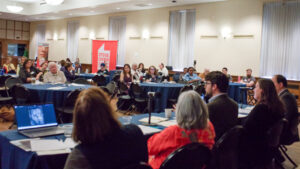
A symposium hosted by the Hartford-based Stowe Center for Literary Activism brought together scholars, students, and readers on the Trinity College campus on April 18, 2026. The daylong conference, “Stowe in Context & Conversation,” included panels and conversations about the legacy of American author and abolitionist Harriet Beecher Stowe, culminating in a keynote address by historian Tiya Miles.
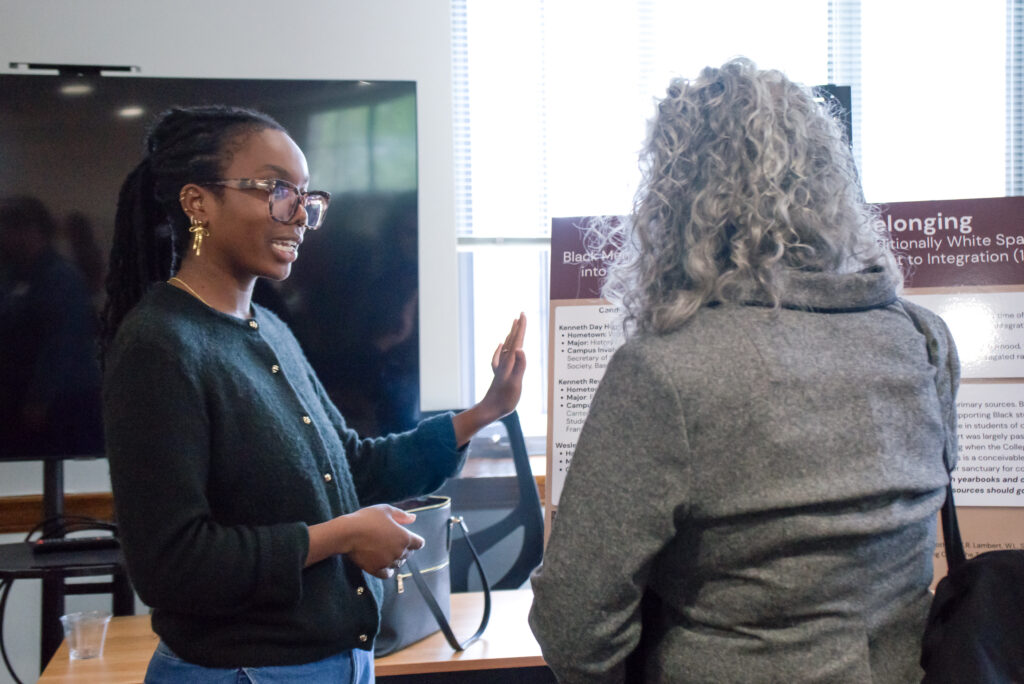
Cydney Hunt ’26 presents ‘Searching for Belonging: Black Men’s Extracurricular Involvement in Traditionally White Spaces as a Lens for Trinity College’s Commitment to Integration (1950–1958).’ Photos by Lilly Supples ’26.
During the conference, 13 Trinity students presented original research from their course, “History and Memory of Slavery on Campus.” According to the course instructor, Professor of History Scott Gac, they are part of a broader effort known as the Primus Project, which examines Trinity’s historical ties to slavery.
“The student presentations collectively recovered Black presence in Hartford and at Trinity—showing how Black workers, families, students, graduates, and activists shaped the city and the College, even when institutional records rendered them only partially visible,” Gac said. “The conference gave students an opportunity to present that work publicly, rather than only submit it in the classroom.”
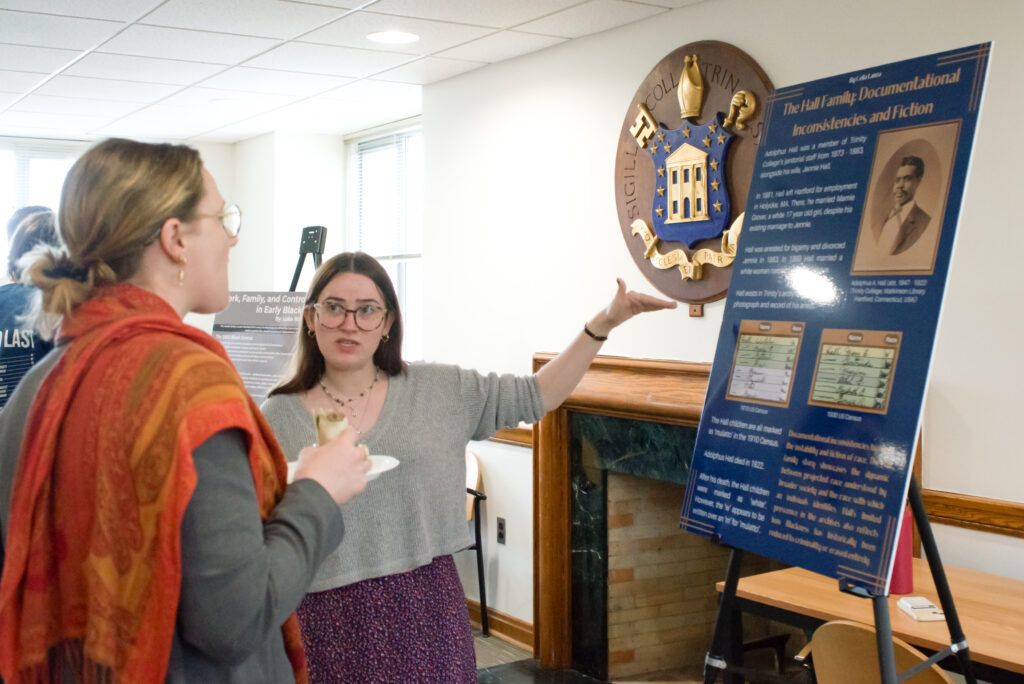
Student research revealed the complexities and limitations of the historical record. Celia Lanza ’26 said her project focused on Adolphus Hall, a Black janitor at Trinity, and explored whether his children had access to higher education through his connection to the College. While none of Hall’s children attended Trinity, Lanza’s research instead uncovered inconsistencies in archival records regarding their mixed-race ancestry.
Celia Lanza ’26 presents research at the Stowe symposium held at Trinity College.
“In class, we learned a lot about the silences of Black presence in the archives, and seeing it for myself when conducting archival research was impactful,” Lanza said. “As a senior at Trinity, I am so glad that I ended my history major career with this class.”
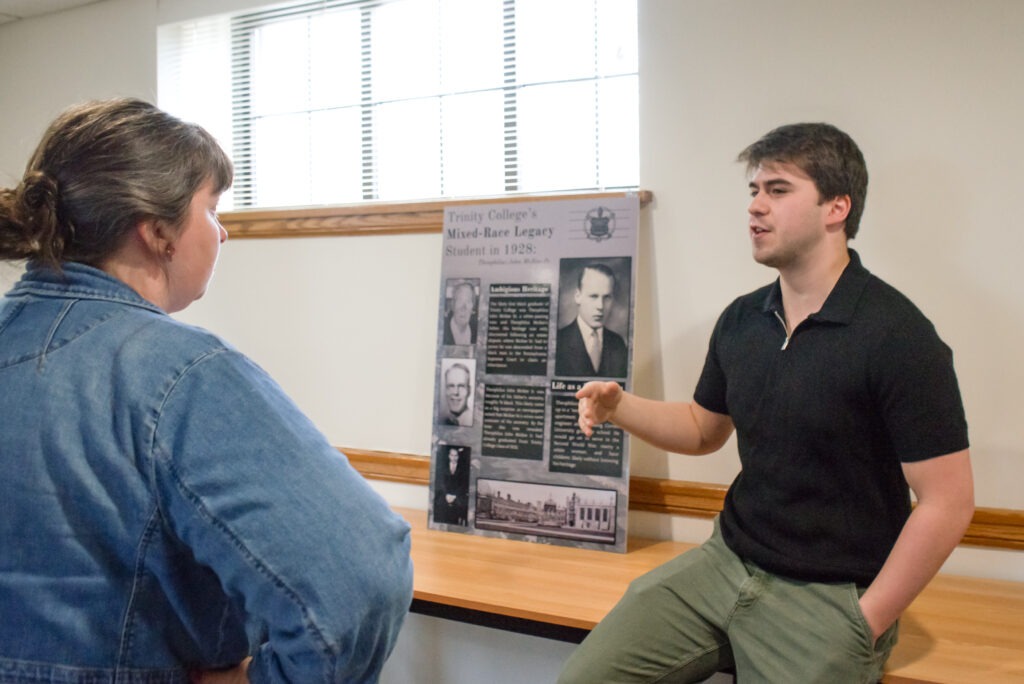
Another project, led by Matt Lane ’27 and Ted Cohen ’26, focused on trying to identify Trinity’s earliest known Black undergraduate degree recipient. Cohen’s research uncovered Theophilus John Minton Syphax, later known as Theophilus John McKee, who graduated in 1903 after entering Trinity in 1898. Cohen said, “My research and presentation focused on T. J. Syphax/McKee as the first Black graduate, while Matt’s examined his son and later grandsons, who became Trinity’s first mixed-race legacy family.”
A member of a prominent Black family, Syphax/McKee lived much of his life passing as white, a decision shaped by segregation and racism. His identity became public decades later during a legal case involving a family inheritance. “Syphax/McKee appears to have been the first admitted student of African descent at Trinity,” Cohen said. “He attended as a white-passing man, joining a nationally all-white fraternity, and graduated. He may have been admitted under the social assumption that he was white, but that should not obscure the larger point that he was a man of African descent who gained access to an institution that would have been extraordinarily difficult for most Black Americans to enter in that period. Despite his light complexion, he would have been considered Black because of his African American heritage on his paternal and maternal sides.”
Matt Lane ’27 shares research as part of the ‘Stowe in Context & Conversation’ symposium.
For Lane, presenting this research at the symposium added a layer of meaning. “It gave me an opportunity to think more deeply about Black Hartford and the history of racial exclusion,” he said.
Additional student research also uncovered Ralph Davis and Allyn Martiny as the first known Black men from Hartford to graduate from Trinity, in the Class of 1953.
Gac emphasized that the symposium was not just an academic event, but part of a larger educational experience made possible by support from the Council of Independent Colleges and the Mellon Foundation. The funding allowed students to conduct research at the Stowe Center’s archives, where they examined materials like early Black census records and account books from Black artisans in Hartford.
The keynote talk by Miles—author of All That She Carried: The Journey of Ashley’s Sack, a Black Family Keepsake—reinforced the importance of this work. Miles’s research centered on the intertwined lives of Stowe and African-American writer and abolitionist Harriet Jacobs, highlighting both their shared goals and their deep differences. Although they were working towards similar goals, which Miles described as, “a battle to sway hearts and minds against American slavery,” she emphasized that “they waged this war from distinctively gendered standpoints, shaped by their racial and caste positions… The social positions of Jacobs and Stowe bound them together and kept them apart.”
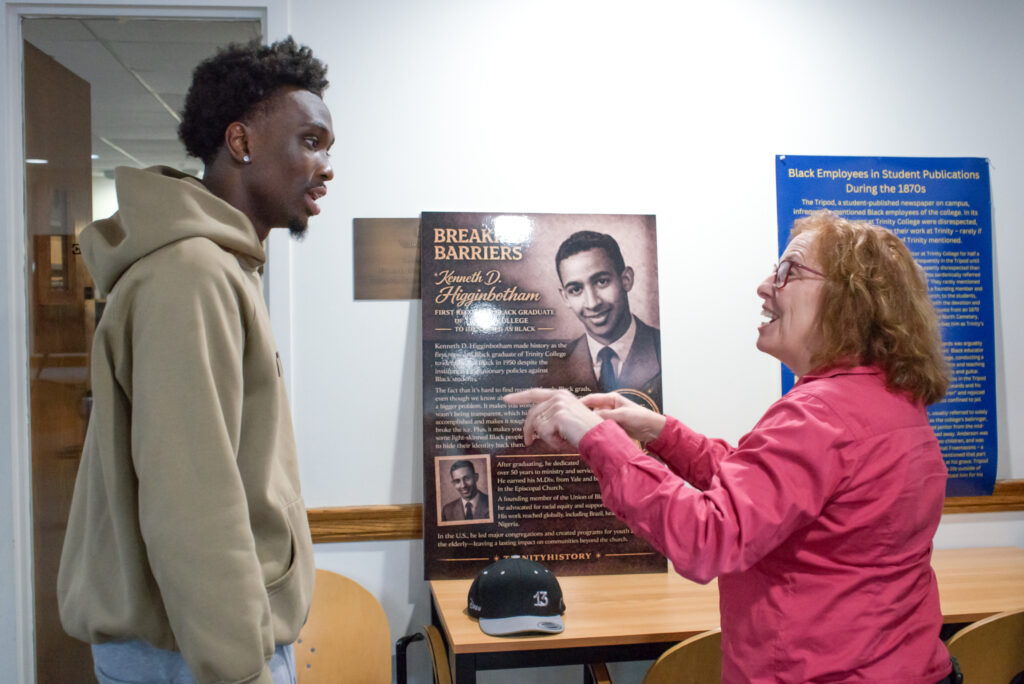
Drew Lazarre ’26 presents his research, ‘Kenneth D. Higginbotham: First Recorded Black Graduate of Trinity College to Identify as Black.’
As Gac reflected, “Tiya Miles’s keynote helped underscore… how local archival work can speak to broader questions of history, memory, and justice. In that sense, the [student] poster session was not an add-on to the conference; it was one of its clearest expressions of purpose.”
“The poster session was one of the most meaningful parts of the day because students shared original research with scholars, community members, and Stowe Center visitors,” Gac added. “The conversations around the posters showed the students stepping into the role of public historians—explaining their evidence, fielding questions, and connecting Trinity’s history to the larger history of Black Hartford.”
This year’s cohort of President’s Fellows includes some of Trinity’s most accomplished seniors. These 32 student scholars from the Class of 2027 have compiled exemplary academic records in their years at the College.
The Trinity College community gathered for a documentary film screening and panel discussion with alumna Julia Hoppock ’06, an associate producer of People vs. Politics, as part of Voter Education Week.
The grant for Susan A. Masino, Paul E. Raether Distinguished Professor of Applied Science, and David N. Ruskin, research associate professor, will provide summer research opportunities for Trinity students.
Associate Professor of Classical Studies Vincent E. Tomasso, whose first-year seminar is reading Homer’s epic poem, will give a presentation as part of Odyssey Day this fall. Read more about why he says The Odyssey still resonates today.