Faculty Focus
Belén Fernández Milmanda
Associate Professor of Political Science and International Studies
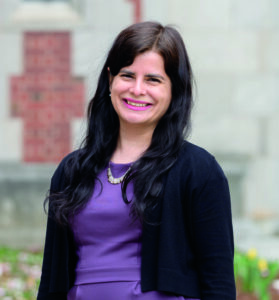
“It’s hard not to be interested in politics if you’re an Argentine,” says Belén Fernández Milmanda, who came of age in the late 1990s as the country’s economy unraveled. As protests swept the nation, her working-class family lived with the daily fear that her father would lose his job. “You could see it in the streets,” she says. “People were going through garbage to find food.”
At the University of Buenos Aires, Fernández Milmanda began studying sociology before turning to political science, drawn to questions about the relationship between economic actors and public policy. After earning a master’s degree in Argentina and receiving a Fulbright Scholarship to study in the United States, she began her doctoral work at Harvard University. When it came time to define a research direction, she looked beyond social movements and unions—subjects that traditionally dominated the field.
Instead, Fernández Milmanda focused on economic elites. “They are the ones who actually make the decisions that shape our lives,” she explains. “There was not much research being done on how they think and how they influence politics.”
In 2008, she watched as agricultural producers—one of Argentina’s wealthiest groups—led a four-month protest against a proposed tax hike. Roadblocks and strikes turned it into a national crisis, ending with the measure’s defeat in congress.
That moment stayed with her. In her first semester at Harvard, a course on Brazilian politics introduced a striking contrast: Representatives of that country’s agribusiness were not protesting from the outside but serving as lawmakers. “So the same people who have to go in the street and protest in Argentina, they are making the rules in Brazil,” she says. “I thought that needed an explanation.”
That question became the foundation of her thesis and of her award-winning book, Agrarian Elites and Democracy in Latin America (Cambridge University Press, 2024). In it, Fernández Milmanda examines Argentina, Brazil, and Chile to show how economic elites use both electoral and non-electoral strategies to bend democratic systems to their advantage.
Beyond shaping her research, the doctoral program helped Fernández Milmanda discover another passion. After her second year, coursework gave way to independent research—and long stretches of isolation.
“Academia can be very lonely sometimes because it’s just about you and your ideas, which may seem great, but it’s also really hard,” says Fernández Milmanda. Becoming a teaching assistant offered a counterpoint. “It was the one thing that grounded me and gave me structure and a sense of purpose I did not find in research,” she says.
When it came time to apply for faculty positions, Trinity College appealed to her for its balance of teaching and research. She joined the faculty in 2019 with a dual appointment to the Political Science and International Studies Departments. “I get students from all over campus in many of my classes since they fulfill different requirements,” she says.
In her “Climate Change in the Global South” course, for example, she encounters political science and environmental science students. “The class discussions are really rich because you have students who bring different expertise and different perspectives,” she says. “I really love that about Trinity.”
In some cases, that engagement leads to closer collaboration. Marlene Palma ’25 worked with Fernández Milmanda as a research assistant before asking her to advise her thesis.
“I cannot overstate how much of an impact Professor Fernández Milmanda has had on my academic and personal journey,” says Palma, who is pursuing a Ph.D. in political science. “Her presence at Trinity is invaluable, not just for the wealth of knowledge she brings to the institution but for the support, kindness, and dedication she offers to each of her students.”
Fernández Milmanda’s research has increasingly focused on environmental politics. She is working with a co-author to examine why some Latin American countries have resisted signing the Escazú Agreement, a treaty aimed at protecting environmental activists, who are killed at higher rates in the region than anywhere else in the world.
“A few years ago, I decided that the only thing that matters now is doing whatever you can to mitigate climate change,” she says. “Without the planet, nothing else is possible.”
—Eliott Grover
PHOTO: NICK CAITO