Women in STEM Event Highlights Trinity Faculty Research and Mentorship
Content
Story
Posted
By
Eh Wah Wah ’28
Category
Academics
Trinity College celebrated the International Day of Women and Girls in STEM (science, technology, engineering, and mathematics) with an event open to both the Trinity and Hartford communities. The second annual program, held on February 27, 2026, in the Albert C. Jacobs Life Sciences Center, included talks by Trinity faculty members and hands-on STEM activities for Hartford students.
Sarah A. Raskin, associate dean for faculty development and Charles A. Dana Professor of Psychology and Neuroscience, explained that the idea for this event grew out of a “Women in STEM” faculty group whose members meet to support one another professionally. “They’re great instructors in the classroom,” Raskin said, “and I thought it was also important on this day of women in STEM to recognize that they’re also really active scholars adding to our knowledge about STEM in the world.”
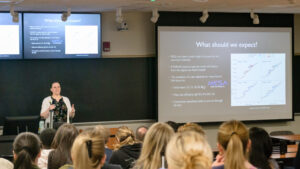
Assistant Professor of Physics Kelly M. Patton delivers the keynote talk. Photo by Fiona Cunningham ’28.
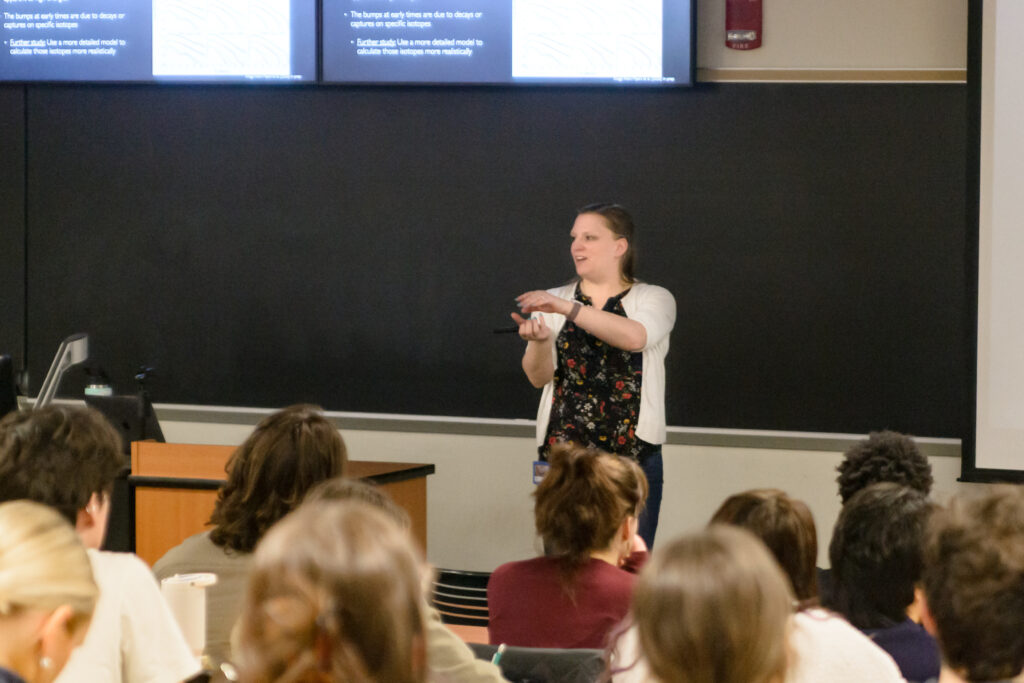
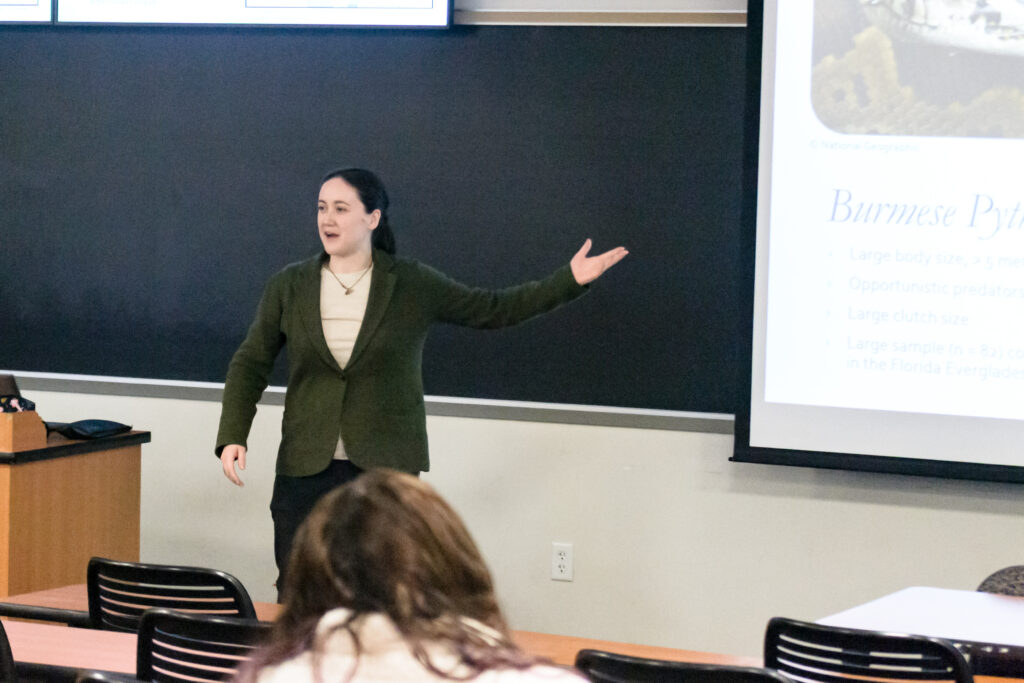
The program featured a keynote address followed by a series of brief “lightning talks” from faculty members across disciplines: Assistant Professor of Biology Rachel Keefe, Associate Professor of Environmental Science Amber L. Pitt, and Associate Professor of Chemistry Cheyenne S. Brindle.
For the keynote speaker, Assistant Professor of Physics Kelly M. Patton, the goal for the day was to highlight Trinity’s women faculty and the STEM research available to students. “We have really amazing women faculty in the STEM departments here at Trinity,” Patton said, “so I hope that people will take from this that there’s cool research being done on campus. If you want to know more, go talk to your professors about it because we all love to talk about our research, and we would all love to have students involved.”
Patton emphasized that visibility matters, especially in fields where women remain underrepresented. In her subfield of nuclear physics, she noted that women make up roughly 20 percent of researchers. Although she was fortunate to have strong female mentors throughout much of her training, she said she did not fully feel the weight of that disparity until a postdoctoral position where she was the only woman in her research group and the first woman to be hired in about 15 years. “That was the first time I really felt, at a visceral level, what it’s like to be the only woman in the room,” she said.
Assistant Professor of Biology Rachel Keefe. Photo by Fiona Cunningham ’28.
Events like this help to counter that isolation, Patton added. By showcasing successful women, younger women and girls receive a powerful message: “If you’re interested in it, you can do it and you can still be a full person,” Patton said. “You can be a scientist and be a woman and be whatever else you want to be. You don’t have to let being one of the few stop you.”
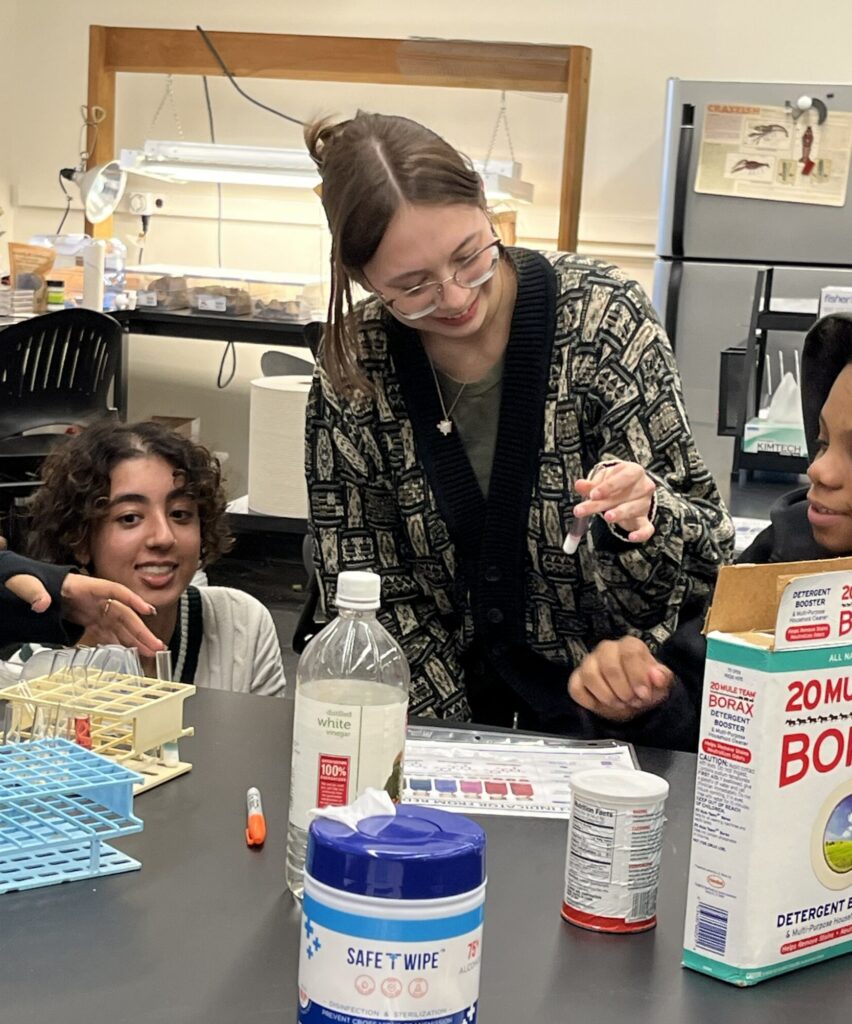
In addition to the faculty talks, the event included an outreach component for local youth. Trinity student organizations including the Trinity Women STEM Network, the Association for Women in Mathematics, the Trinity Chemical Society, and the Neuroscience Club hosted an interactive STEM workshop. Students from Hartford Magnet Trinity College Academy (HMTCA) were invited to make a clay brain model or measure their reaction times, among other activities.
Raskin said that in addition to providing an opportunity for young students to meet Trinity students and faculty members to talk about college life, she hoped that the program will “encourage young women to get excited about STEM and feel like it’s a career path they could take.”
Students from Hartford Magnet Trinity College Academy (HMTCA) took part in a STEM workshop. Photo courtesy of Sarah A. Raskin.
For Trinity students already involved in research, the event was equally meaningful. Sydney Davidson ’28 attended in part to support Patton, in whose lab she recently began conducting research. “I wanted to show up for the Physics Department and see how [Patton] presented her work in an academic setting,” Davidson said.
For Davidson, seeing women lead research at Trinity has directly influenced her academic confidence. She credited faculty mentors, including leaders of the Interdisciplinary Science Program, with helping her to navigate research opportunities and refine her interests.
“I came to Trinity thinking I wanted to study neuroscience, but part of the reason why I switched to physics and math was the research selection process,” Davidson said. “So I think having good mentors and a really thoughtful process in exploring my academic interests was what propelled me into developing academically.”
Patton reflected on the progress women have made in STEM fields: “We’re still a minority,” she said, “but we’re growing. And if more people join, then you won’t be one of the few anymore.”
Trinity students recently attended “The Future of the Environment,” a panel discussion hosted by The Connecticut Forum, a nonprofit organization that hosts thoughtful conversations on pressing social, political, and cultural issues.
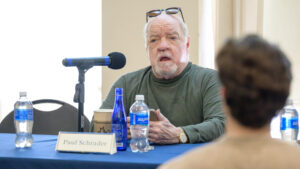
Academy Award-nominated writer and director Paul Schrader spoke at Trinity College about his filmmaking career and his creative collaborations with a close friend, the late writer Russell Banks.