Sustainability Advances at Trinity College Recognized in Independent Review
Content
Story
Posted
By
Kristen Cole
Category
Students
Trinity College recently earned its highest rating on the STARS (Sustainability Tracking, Assessment & Rating System) report, which recognizes sustainability initiatives in higher education using a common set of measurements.
Trinity’s new rating of silver by the Association for the Advancement of Sustainability in Higher Education (AASHE) reflects a host of significant achievements undertaken since the College first documented its sustainability activities for the organization in 2019, and earned a bronze rating.
“Ensuring a vibrant future requires institutional and individual sustainability commitments,” said Joanne Berger-Sweeney, Trinity College president. “I am immensely proud of the work we have accomplished together and confident that we will continue to build upon those efforts at all levels.”
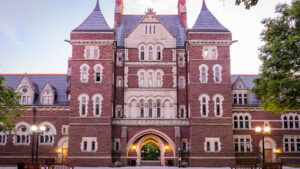
Noted among Trinity’s projects of distinction was the recent designation of the 100-acre urban campus as an arboretum.
In 2023, Trinity was designated as an arboretum by the independent accrediting agency ArbNet. Located in Hartford, Connecticut, the campus is home to more than 1,500 trees and dozens of tree species spread over about 100 acres.
Other campus-wide endeavors include the implementation of a heating and cooling system upgrade which replaced aging infrastructure. Those improvements reduce the carbon dioxide emissions by 144 metric tons annually.
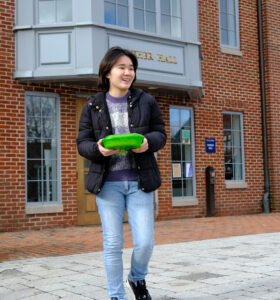
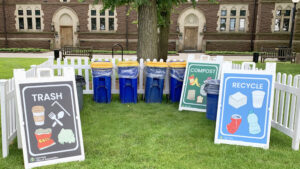
Within campus food services, Trinity implemented a number of programs encouraging use of reusable containers, as well as composting efforts for both pre- and post-consumer waste. The popular program of reusable food containers serves students who need to take meals to go from any of the three campus eateries. At the same time, new filling stations on campus support the use of reusable water bottles.
Huang Xinlei ’26 leaves Mather Hall with one of Trinity’s new reusable takeout containers. (Photo by Helder G. Mira)
Trinity is encouraging behavior change with the establishment of student eco-rep positions. These peer educators identify and pursue new ideas within the College community. Student-led initiatives include partnering with campus coffee shops to promote the use of reusable containers, and challenging sports teams to do away with single-use plastic water bottles at competitions. Pollinator gardens, a campus food pantry, and the reuse of items discarded during move-out are additional successful programs.
“Tapping into the ideas that students bring to the sustainability discussion is critical to continually expand what we do,” said Hayley Berliner. “Not only do students provide thoughtful proposals, they often serve as the best advocates for those ideas.”
With more than 1,200 participants in 52 countries, AASHE’s rating program is the most widely recognized framework for publicly reporting robust information about sustainability efforts in higher education.
Colleges and universities report achievements in five overall areas: academics, engagement, operations, planning and administration, and innovation and leadership. STARS rates initiatives with credits, allowing for comparisons at a single institution over time and between peer institutions.
“STARS was developed by the campus sustainability community to provide high standards for recognizing campus sustainability efforts,” said Meghan Fay Zahniser, executive director of AASHE.
Trinity’s silver status is a three-year designation that will expire in 2027.
This year’s cohort of President’s Fellows includes some of Trinity’s most accomplished seniors. These 32 student scholars from the Class of 2027 have compiled exemplary academic records in their years at the College.
More than 100 Trinity students spent part of the summer working with faculty members and other mentors. The fall symposium allowed these students to showcase their findings and research processes.
The first Summer Internship Showcase—presented by the Trinity+ Advising Center and the Career Center—featured the reflections of Trinity students who gained real-world experience through meaningful internships in summer 2026.
The exhibition opening in the Austin Arts Center on September 24 showcases recent works by Studio Arts Program Postbaccalaureate Fellowship alumni Ciara Rubí, Sydney Smith, and Trinity alumna Weixi Zhang ’18.
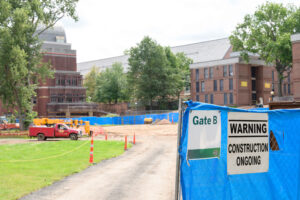 Other campus-wide endeavors include the implementation of a heating and cooling system upgrade which replaced aging infrastructure. Those improvements reduce the carbon dioxide emissions by 144 metric tons annually.