Trinity College Professor Shows How Humans and Snow Leopards Can Coexist
Content
Story
Posted
Category
Academics
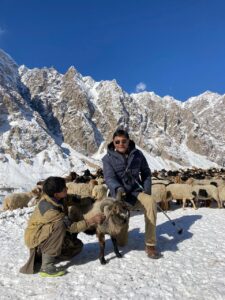
Professor Hussain, right, pictured in Northern Pakistan.
For more than 20 years, Trinity CollegeProfessor of Anthropology Shafqat Hussainhas dedicated his work to protecting the snow leopard species in Northern Pakistan. In 1999, Hussain created an insurance plan that provides economic incentives to regional farmers; the insurance safeguards snow leopards, one of the world’s most endangered species, from being killed in response to an attack on a farmer’s herd.
Project Snow Leopard, launched in Hussain’s home country, promotes the coexistence of humans and snow leopards. The project has three goals:
1. To create compensation for farmers, reducing economic loss
2. To construct predator-proof corrals for farmers
3. To monitor the snow leopard’s population through genetic analysis and camera trapping
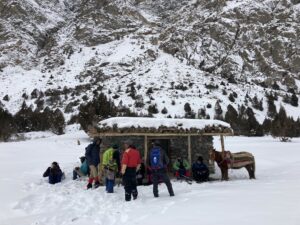
The Hushe Survey team
In 2006, with the help of a grant provided by the Rolex Awards for Enterprise, Hussain—a trained economist and environmental anthropologist—expanded the project to 10 additional valleys across Baltistan, impacting approximately 15,000 people. Today, the insurance plan has been adopted in India, Nepal, Bhutan, Afghanistan, and China. Through Hussain and his team’s work, the snow leopard population is now stable.
A new data science major will equip Trinity College students with the knowledge, tools, and problem-solving skills to work with data across all industries and applications. Students may declare data science as a major starting in the fall 2026 semester.
Julianna Boris ’26 has been awarded a Fulbright grant to serve as an English Teaching Assistant (ETA) in Taiwan, combining her academic interests with her passions for teaching and cross-cultural connection.
Eight senior computer science majors working with Trinity’s Elting Center for Innovation and Entrepreneurship spent the spring semester working with business and community partners to develop new uses of artificial intelligence.