Trinity Professors Receive Three-Year NIH Grant to Study the Impact of a Ketogenic Diet
Content
Story
Posted
Category
Faculty
Trinity College faculty members Susan A. Masino, Paul E. Raether Distinguished Professor of Applied Science, and David N. Ruskin, research associate professor, have received a three-year National Institutes of Health (NIH) R15 grant to study the impact of ketogenic metabolic therapy on behavior.
The award of $576,722 will support their research, “Metabolic therapy to modulate aggression and sociability,” and will provide summer research opportunities for two students each year of the grant.
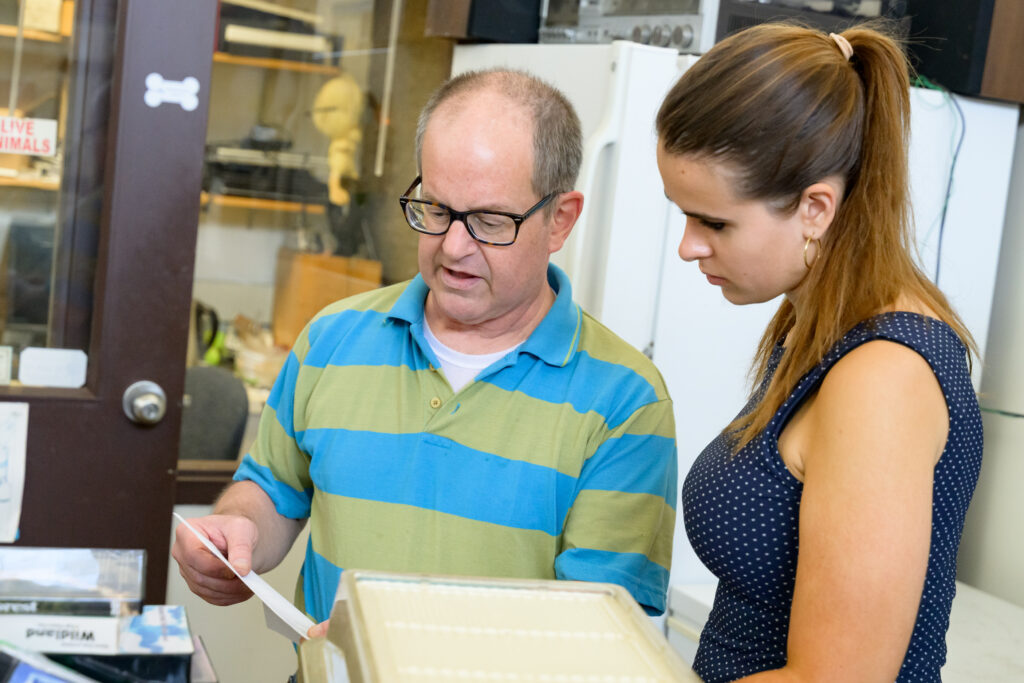
Research Associate Professor David N. Ruskin works with Zoe Kuehne ’26 on an experiment investigating how adenosine may impact behavior. Photo by Nick Caito.
According to the project summary, “The ketogenic diet is an established metabolic therapy that treats seizures and is under active investigation for its effects on many voluntary behaviors, including social behaviors.” A ketogenic diet is high in fat and low in carbohydrate, forcing a switch from glucose-based to ketone body-based metabolism.
Adenosine is a powerful antiseizure molecule underlying the ketogenic diet’s therapeutic benefits and other neurological and behavioral effects, Masino and Ruskin said. The involvement of adenosine, which is known to be anti-inflammatory, in the interaction between ketogenic diet and social behaviors remains unexplored.
“Our central hypothesis is that a ketogenic diet will reduce aggression and normalize impaired social behaviors via adenosine receptor activation,” the researchers said in the project summary. “Despite evidence for this relationship, this hypothesis has not been tested directly.” The faculty members plan to integrate Trinity students into all aspects of the project. Collaboration between students and faculty will test a novel hypothesis and “could facilitate a conceptual breakthrough for translational and clinical research.”
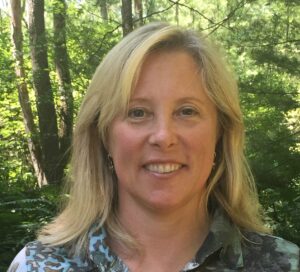
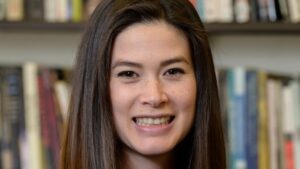
Susan A. Masino, Paul E. Raether Distinguished Professor of Applied Science.
Masino and Ruskin have a long history of research on adenosine, metabolic therapies, and the ketogenic diet. Over the last two decades they have received several grants to support this work, including a previous three-year NIH grant and a larger, multi-institutional five-year NIH grant. “Recently, the field of metabolic therapies, and in particular metabolic psychiatry, has exploded,” Masino noted. “It’s been an incredible scientific journey.”
NIH is the largest public funder of biomedical research in the world. The goals of the R15 program are to support meritorious research, expose students to research, and strengthen the research environment of the institution. The AREA grant specifically supports research at undergraduate-focused institutions.
Associate Professor of Classical Studies Vincent E. Tomasso, whose first-year seminar is reading Homer’s epic poem, will give a presentation as part of Odyssey Day this fall. Read more about why he says The Odyssey still resonates today.
More than 100 Trinity students spent part of the summer working with faculty members and other mentors. The fall symposium allowed these students to showcase their findings and research processes.
The digital humanities website Public Art CT—sponsored in part by Trinity College and created by a Trinity faculty member—has received a 2026 Award of Excellence from the American Association for State and Local History (AASLH).
A book by Associate Professor of American Studies Juliet Nebolon was named a co-winner of the 2026 Association for Asian American Studies (AAAS) History Book Award.