Trinity College Earns Carnegie Foundation’s Elective Classification for Community Engagement
In recognition of its strong institutional commitment to community engagement, Trinity College has received the prestigious 2026 Carnegie Elective Classification for Community Engagement.
 Trinity is one of 277 institutions recognized with this designation by the American Council on Education and the Carnegie Foundation for the Advancement of Teaching. Campuses must apply for the classification, which is offered every two years. The classification is valid until 2032, when Trinity will seek reclassification to retain its status. Trinity previously received the classification in 2006.
The Carnegie Foundation describes community engagement as collaboration between institutions of higher education and their larger communities—whether local, regional/state, national, or global—for the mutually beneficial exchange of knowledge and resources in a context of partnership and reciprocity. Carnegie recognizes community engagement that enriches scholarship, research, and creative activity; enhances curriculum, teaching, and learning; prepares educated, engaged citizens; strengthens democratic values and civic responsibility; addresses critical societal issues; and contributes to the public good.
Trinity College President Dan Lugo said that the future of Trinity and that of the city of Hartford are intricately linked, as they have been for more than 200 years. “Trinity holds firm to a commitment to community engagement and to participating in respectful, supportive, and collaborative work with the local community for the sake of our collective future where all can thrive,” Lugo said. “I am proud of this accomplishment, and I hope all in Trinity’s community feel the same.”
Vice President for Academic Affairs and Dean of the Faculty Sonia Cardenas added that she is deeply pleased that Trinity has again earned the Carnegie Elective Classification for Community Engagement. “The Trinity community is and has always been passionate about this work. Countless Trinity members—faculty, staff, students, and alumni—have contributed collectively by engaging and partnering with neighbors and organizations in Hartford and the surrounding areas,” Cardenas said. “I am grateful to the team that led this work, with special thanks to the Senior Director of the Grants Office, Amy Myerson, who so ably coordinated the project.”
Myerson led the yearlong self-evaluation and application process, which involved the efforts of a core team and dozens of other faculty and staff members across campus, in addition to contributions from community partners. “This is a recognition of the significant efforts that Trinity has made to ensure we are ethically engaging with the community,” Myerson said of the classification. “Not only are we engaging with the Hartford community, but with communities worldwide, and the administration has prioritized this at the institutional level.” Myerson added that President Emerita Joanne Berger-Sweeney championed community engagement during her 11-year tenure, and Lugo is continuing Trinity’s commitments to its community.
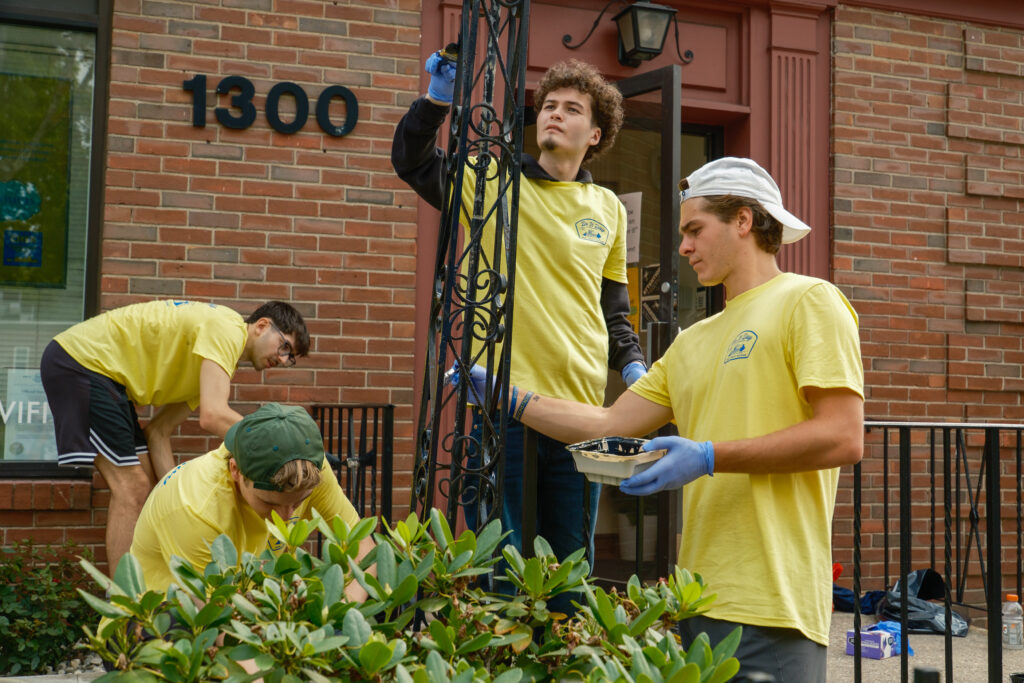
The application included 10 sections examining all aspects of Trinity’s history, culture, policies, and procedures. Myerson said that the breadth and depth of community engagement at Trinity was demonstrated through examples of faculty, staff, and students partnering with community groups and participating in civic engagement, as well as excerpts of policies and procedures. The self-study built upon the work of the Urban Engaged Learning group, which developed Trinity’s vision and principles of community engagement.
“We knew Trinity’s Center for Hartford Engagement and Research (CHER) was a very big part of this, but it wasn’t the only part. Offices, research centers, and academic departments across campus contribute to this work,” Myerson said. “Our team spoke with 16 different offices for this application, plus representatives from most academic departments. That really shows how pervasive community learning and engagement are at Trinity.”
The classification, Myerson added, provides Trinity and institutions like it with external recognition demonstrating that statements about commitment to community engagement are backed up by real-world action.
“This process offers an accountability structure through a whole-scale examination of who we are as an institution—our history, our policies, and our actions,” Myerson said. “This was not a one-point-in-time application; Carnegie wants to see continued examination and growth of community engagement efforts. This classification also recognizes Trinity’s commitment to this work moving forward.”
In addition to Myerson, the members of the core team that completed Trinity’s application were: Erica Crowley, CHER’s former senior director of academic programs; Laura Minor, former director of Trinity’s Liberal Arts Action Lab; Liliana Polley, executive director of CHER; Sarah Raskin, associate dean for faculty development and Charles A. Dana Professor of Psychology and Neuroscience; Jason Rojas, the president’s chief of staff and associate vice president for external affairs; and Hilary Wyss, Associate Dean for Curriculum and Allan K. Smith and Gwendolyn Miles Smith Professor of English.
Cammie Jones-Friedrichs, director of the Carnegie Elective Classification for Community Engagement, said in a letter announcing Trinity’s achievement that it is heartening to witness a strong and growing commitment to community engagement. “Applications in this cycle demonstrated how campuses nationwide are deepening partnerships, leveraging community assets, and addressing urgent societal challenges—work your institution has advanced with clarity and distinction,” Jones-Friedrichs said. “Your institution’s application documented excellent alignment among campus mission, culture, leadership, resources, and practices that support dynamic and noteworthy community engagement.”