Pediatrician and Geneticist to Receive 2026 Trinity College President’s Medal for Science and Innovation
Pediatrician and geneticist D. Holmes Morton, M.D., IDP’79, H’90 will receive the 2026 Trinity College President’s Medal for Science and Innovation, which recognizes individuals who have made significant contributions to the STEM fields. Morton has dedicated his career to treating Amish and Mennonite children of Pennsylvania afflicted with genetic illnesses.
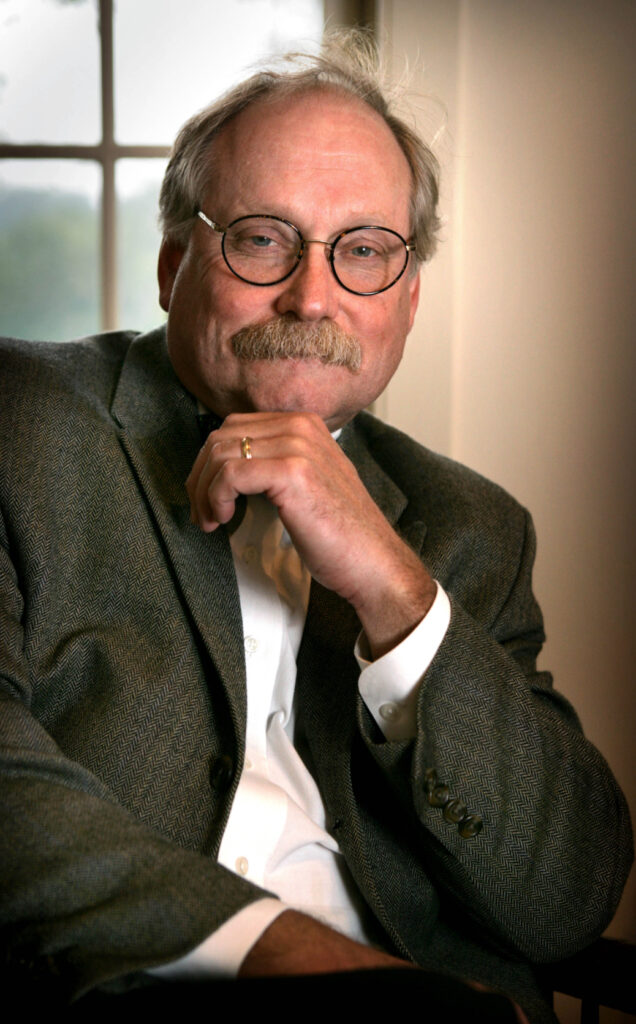
Trinity College President Dan Lugo will present Morton with the award at a ceremony on Wednesday, February 11, 2026, in the Washington Room of Mather Hall beginning at 4:30 p.m. Morton will deliver the Presidential Distinguished Lecture, “Roads Taken—In Search of Meaningful Work.” The lecture and ceremony are open to the public.
The following day, February 12, Morton will join Lugo for a fireside chat and lunch in the Washington Room at 12:15 p.m. At 1:30 p.m., Morton will take part in casual conversations with students from selected classes and clubs in the Underground Coffeehouse.
The alumnus was featured in a 2020 profile story in The Trinity Reporter alumni magazine and was a guest on Trinity’s “Beyond the Summit” podcast hosted by New York Times columnist Paul Sullivan ’95 in 2021. In The Reporter, Morton spoke about his extensive work treating Amish and Mennonite children with genetic illnesses. “The Amish called them ‘God’s special children’ and said they had been sent by God to teach us how to love. That idea deeply affected me,” he said. “These are not just curious diseases of the Amish; they affect people all over the world.”
After completing the Individualized Degree Program at Trinity in 1979, Morton went on to graduate from Harvard Medical School in 1983. He completed his residency in pediatrics at Boston Children’s Hospital and was then awarded a research fellowship in biochemical genetics at Children’s Hospital of Philadelphia, where he first encountered an Amish boy with a rare metabolic disorder—Glutaric Aciduria Type 1. His interest in this patient and others like him with “Amish Cerebral Palsy” led Morton and his wife Caroline to establish in 1989 the Clinic for Special Children, in Strasburg, Pennsylvania, as a combination pediatric-care clinic and cutting-edge research facility for rare genetic conditions.
In 2012 during a John D. and Catherine T. MacArthur Foundation Fellowship (2007-2012), Morton founded a second clinic with his brother Paul, the Central Pennsylvania Clinic—A Medical Home for Special Children and Adults, in Belleville, Pennsylvania. Similar clinics modeled after the Mortons’ ideas are found in Ohio, Kentucky, Wisconsin, and Indiana, with more in development. The clinics are non-profit, Plain Community-supported medical centers that provide care for children and adults with complex medical problems arising from inherited predispositions to disease—a form of medical practice that Victor McKusick, M.D., physician in chief at Johns Hopkins and chair of the Human Genome Project, called “genomic medicine.”
Morton has published dozens of peer-reviewed research papers in journals including Pediatrics, Current Treatment Options in Neurology, Molecular Genetics and Metabolism, Brain, Journal of Pediatrics, Pediatric Transplant, Nature, and Gene Reviews.
In recognition of his work, Morton received 10 honorary degrees—the first from Trinity College in 1990 and most recently from Juniata College in 2024—and the Albert Schweitzer Prize for Humanitarianism in 1993. He was named one of Time magazine’s “Heroes of Medicine” in 1997. In 2006 he was awarded a John D. and Catherine T. MacArthur Fellowship “genius grant” for helping rural communities to revolutionize service, research, prescriptions, and outcomes for clinical treatment of rare genetic diseases. He has been featured in The Wall Street Journal, The New York Times, and a PBS-documentary by Jean Snedegar, Inspiring West Virginians: In Search of Meaningful Work. CNN reported on the COVID-19 testing laboratory he co-founded with Dr. Regina Lamendella, professor of molecular biology at Juniata College, and her students that provided 4,000 CLIA-certified tests per week for regional schools and nursing homes, and featured tests for the virus that accommodated horse and buggy drive-through.
Trinity College President, Emerita, Joanne Berger-Sweeney—a neuroscientist herself—created the President’s Medal for Science and Innovation to highlight the significance of the sciences at Trinity during the College’s Bicentennial year. The medal recognizes a prominent, internationally renowned individual in science, technology, engineering, or mathematics who has influenced STEM with marked success and who represents the liberal arts ideal of empowering humanity through the sciences.
The President’s Medal for Science and Innovation Advisory Committee, made up mostly of prominent STEM faculty members at Trinity, leads the selection process and ultimately recommends a small pool of highly qualified candidates to the president of the College. Recipients are not necessarily graduates of Trinity but have made lasting contributions to their field.
The previous recipients of the President’s Medal for Science and Innovation were: Eric Fossum ’79, H’14, the John H. Krehbiel Sr. Professor for Emerging Technologies in the Thayer School of Engineering at Dartmouth College, where he also serves as director of Thayer’s Ph.D. Innovation Program and vice provost for entrepreneurship and technology transfer; and Kaja LeWinn ’98, professor of psychiatry and behavioral sciences at the University of California, San Francisco.