‘He saved my life’
Physician David Weinstein ’90, Alyssa Temkin ’27 share special bond
By Kathy Andrews
Above Collage: Master1305/Shutterstock
David Weinstein, M.D., ’90 has so many Trinity College connections—both on and off campus and through the mentoring and professional opportunities he has provided—that he might be considered the perfect example of the Trinity network in action.
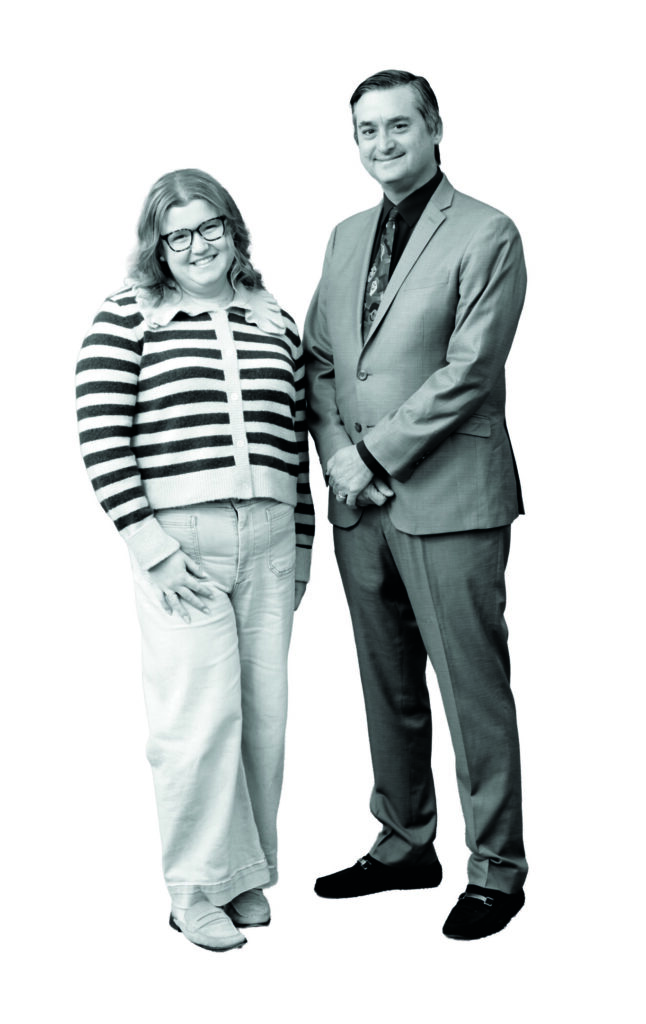
Alyssa Temkin ’27 grew up knowing Weinstein as a brilliant, dedicated pediatric endocrinologist and world-renowned authority on glycogen storage disease (GSD), a rare genetic condition affecting one in 100,000 children, Temkin among them. “When I was a baby, he saved my life,” says the psychology major, whose goal is to attend medical school after Trinity.
Gayle Temkin P’27, Alyssa’s mother, says, “He’s an unbelievable practitioner; he’d give you every second of his day if he could.” After learning so much from Weinstein about GSD and about families with limited access to lifesaving care, she and her husband, Steve Temkin P’27, created the Global Center for Glycogen Storage Disease, whose goal is to find a cure for GSD, and Alyssa’s Angel Fund, to provide financial support to families who can’t afford aspects of GSD care.
Following his graduation from Trinity, Weinstein attended Harvard Medical School before practicing at Boston Children’s Hospital. While at Harvard, he observed how few undergraduates there had opportunities to do the kind of research he had done at Trinity. Subsequently, over the course of 20 consecutive years, he hired numerous Trinity students and graduates to assist with his GSD research.
Tayoot “Todd” Chengsupanimit ’13, a biology major, says the opportunity to work in Weinstein’s GSD lab after graduation, including publishing papers with him, was life-changing. Today a Cleveland-based physician specializing in infectious diseases, Chengsupanimit says, “There is no other person like David Weinstein, and there never will be. He role modeled the type of doctor I aspired to be, and it was not the norm for a recent college graduate to be able to co-author five papers in the span of a few years, as I did in David’s lab. That spoke to his generosity as a mentor.”
Vivien Doan ’21, a double major in biochemistry and neuroscience and now a Ph.D. candidate at the University of North Carolina at Chapel Hill, considers herself fortunate for having landed both a summer internship and an academic-year fellowship with Weinstein while she was a Trinity student. Says Doan, “He inspired me by seeing each patient as a whole person, fighting for their future, and giving them hope. One day I hope to create the kind of ripple effect David Weinstein has.”
How does it happen that one Trinity alumnus creates such an extensive “ripple effect”? Part of the answer may be found in what Weinstein and Alyssa Temkin identify as some differentiators between Trinity and other colleges they might have attended.
A Personal Touch
When setting out to visit colleges, Weinstein had not considered Trinity or even heard of it. Nor had his twin brother, Steven R. Weinstein ’90, now managing partner of the Miami office of global law firm K&L Gates.
Ranked first and second in their high school class, they had racked up a host of achievements, such as David assisting in Alzheimer’s pharmacology research at the University of Miami’s Miller School of Medicine. They headed north from their home state of Florida with appointments to tour and interview at several Ivy League schools; they anticipated each would end up at a different college as they didn’t want to attend the same one. But their trajectory was interrupted by a random suggestion someone made along the way: Why not stop in Hartford on the way to Harvard and check out Trinity, just for comparison’s sake?
What they found at Trinity, says David, was a personal touch that stood out from other schools. They felt it upon arriving in Admissions, where they had no appointment and no one knew in advance about their high school accomplishments, yet a tour was customized on the spot. When David’s interest in medical school led them to a biology lab in the Albert C. Jacobs Life Sciences Center, he learned that undergraduate students were engaged in research with their professor. He knew it was highly unusual for undergraduates to have such an opportunity, and he was keen to join them.
“The problem,” says David, “was both my brother and I fell in love with Trinity, and neither wanted to give up the school.” They resolved that both would apply Early Decision and figured whoever got in, well, that would solve the dilemma. As fate would have it, both were accepted to Trinity, and they decided attending different colleges wasn’t so important after all.
Mentors Matter
Alyssa Temkin also didn’t intend to consider Trinity. But she lived in West Hartford and, with Trinity’s proximity, agreed to a visit. After a campus tour, she concluded Trinity might be a good fit. But what truly impressed her was when she asked Weinstein about it and found his enthusiasm for his alma mater was boundless. “He definitely helped influence my decision. I feel like Trinity’s a hidden gem of Hartford.”
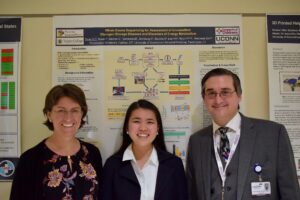
He told her about his mentor of 40 years, John E. Simmons H’08, professor of biology, emeritus, the educator whose lab with undergraduate researchers made such an impression during Weinstein’s first visit to Trinity. Weinstein worked in Simmons’s research lab throughout college and, during his senior year, conducted independent research on Alzheimer’s pharmacology—resuming work that fascinated him as a teenager—mentored by Simmons, who passed away in 2023. “At a large university, often the faculty want the credit, but Dr. Simmons wanted none. He was just happy supporting me,” says Weinstein.
Temkin says, “My professors are passionate about what they do and also care so much about their students,” citing Alisha Holland, lecturer and coordinator of introductory psychology, and Alison Draper, director of the Center for Interdisciplinary Science, as two key mentors. Another is Joanna Gell, M.D., a pediatric hematologist/oncologist at nearby Connecticut Children’s Medical Center, about whose research Temkin had read. After she contacted Gell to say how interesting she found her work, Temkin says, they immediately clicked. By the end of her first year at Trinity, Temkin had a weekly job-shadowing appointment with Gell, which has continued ever since. Recently, Gell invited her to assist on an upcoming research project, which Temkin says she can’t wait to start.
More than a Major
Weinstein’s favorite class at Trinity was on High Renaissance art history. He also raves about political science courses taught by Adrienne “Renny” Fulco, associate professor of legal and policy studies, emerita, and former director of the Public Policy and Law Program. “I’m fortunate to have had great professors like Alden Gordon [’69, Paul E. Raether Distinguished Professor of Fine Arts, Emeritus] and Renny Fulco. I’m glad I didn’t go to a school where it was always science,” he says. “I don’t think that makes for a worldly, educated person.”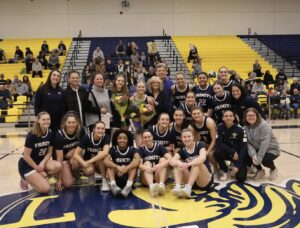
For Temkin, serving as manager of the women’s basketball team is a big highlight outside of studies. “I love being part of the team,” she says, including its involvement with Team Impact, an organization through which teams are matched with children facing serious illness. The children attend games and become honorary teammates, providing memorable experiences for them and for the team.
Because of her own experience with GSD, Temkin says, she understands what involving Team Impact kids means for them and their families. “My parents never wanted me to hide in a corner or be ashamed when I was getting tube fed or feel like I didn’t belong.”
Effecting Change
When Temkin was 6, she provided testimony to the Connecticut General Assembly’s Public Health Committee, advocating for improved support during the school day for children with life-threatening health conditions. Along with her parents, she helped amplify the case to make it possible for trained caregivers to assist with care needed at specific intervals, such as blood testing and feeding. Previously, only a registered nurse was authorized to do this. “The passing of this law really helped me feel like I wasn’t different,” Temkin says, explaining that it enabled her nanny, who felt like a member of the family, to come into her classroom every 90 minutes to assist her.
While Temkin’s poise and her determination not to be defined by GSD’s limitations are evident, Weinstein says, “What she has had to live through was incredibly difficult, and for most of her life she has had to live 90 minutes at a time. If she was even five minutes late for a treatment, Alyssa could develop severe hypoglycemia and become unresponsive.”
Asked about the attainability of a cure for GSD, Weinstein says raising awareness and philanthropic support, as the Temkin family has done, has been critical in progressing toward that goal. He notes that it was with the support of the Temkins that he and his GSD team were able to move to Connecticut in 2017 and create a gene therapy unit at UConn Health. “I had the honor of treating the first GSD patient in the world with gene therapy there in 2018,” says Weinstein, adding, “Currently, there are three trials in humans, using new technologies that our team worked on. I’m also optimistic that a new gene editing trial taking place now may finally offer hope of a cure.”
Since 2020, Weinstein has collaborated with biotechnology companies focused on gene therapy, gene editing, and other technologies to improve the lives of patients with a variety of rare or neurodegenerative diseases. He has led seven different gene therapy programs for various diseases and is working on several more.
In his prior roles leading GSD centers at hospitals in Massachusetts, Florida, and Connecticut, Weinstein has served patients from 49 states and 54 countries. “It has been remarkable to see the disease go from one where people were almost universally dying to one where 10 of my patients have become physicians,” he says.
Temkin plans to join that growing number of patients becoming doctors. “I’m really looking forward to being able to take care of patients the same way I’ve been taken care of,” she says.
Vitals—David Weinstein ’90
Degrees:
B.S. in biology
M.D., Harvard University
M.M.Sc., Harvard University and Massachusetts Institute of Technology
Current Title:
Consultant, Weinstein Rare Disease and Clinical Development Consulting
Previous Roles:
Interim Chief Medical Officer, Grace Science LLC, 2023
Senior Vice President, Clinical Development, Passage Bio, 2022
Vice President, Clinical Development, Passage Bio, 2020–21
Professor and Director, Glycogen Storage Disease (GSD) Program, UConn Health, 2017–20
Professor and Director, GSD Program, University of Florida College of Medicine, 2011–17
Associate Professor, University of Florida College of Medicine, 2005–11
Director, GSD Program, Boston Children’s Hospital, 1994–05 (also completed residency, chief residency, and fellowship in pediatric endocrinology at Boston Children’s Hospital)
Assistant Professor, Harvard Medical School, 1994–05
Recognition Highlights:
University of Florida College of Medicine Clinical Research Award, 2014
Order of the Smile international humanitarian award, 2012
Jan Albrecht Award, American Association for the Study of Liver Diseases, 2001
George Sacher Award, Gerontological Society of America, 1991
Barry Goldwater Scholarship, 1989
Personal:
Wife, Geraldine Munsayac Weinstein ’90
One adult son, Justin