Steven Bauer ’70
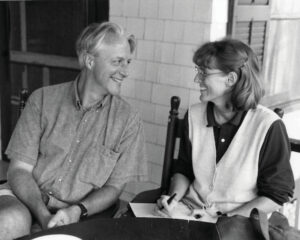
Degrees: B.A. in English; M.F.A. in creative writing, University of Massachusetts Amherst
Job titles: Writer; former professor, Colby College, Miami University [Ohio]); editor, Hollow Tree Literary Services; publisher, Hollow Tree Press
Favorite Trinity memory: The tumult, excitement, and camaraderie of May 1970, the last weeks of my senior year. After the Kent State shootings, in the midst of the national student strike, there was a euphoric sense of passionate commitment, intimacy, and purpose that has not been duplicated for me in the 55 years since.
What have been the highlights of your professional path?
I started writing poems in high school under the indulgent eye of an English teacher who put an A+ in the upper right-hand corner of each one. I was a genius! But when I got to Trinity and enrolled in Stephen Minot’s wonderful creative writing classes, he gently informed me otherwise. Under his tutelage, I also began to write stories. Senior year, I sent the best one to The Atlantic and got back a detailed rejection from legendary editor C. Michael Curtis. I was almost famous!
After graduation and two years out west in California, I came back east to the M.F.A. program at UMass Amherst. Along the way, I began to understand that writing wasn’t going to pay any bills, so I was delighted when I discovered, as a graduate student, that I loved teaching. After three years at Colby teaching writing and literature, I accepted a tenure-track job at Miami University, where I directed the creative writing programs.
While I dreamed of writing a great American novel, I instead married Elizabeth Arthur, who went ahead and wrote one. Along the way, I published a young adult novel, a book of poems, a middle-grade chapter book, and a picture book, and after I retired from Miami in 2009, I started an online editing business.
What is your most recent project?
Liz’s father, Robert Arthur, created the iconic middle-grade children’s mystery series The Three Investigators in 1964. It became a worldwide phenomenon and turned many young boys into avid readers. In 2018, Liz and I were talking about the dire state of adolescent boys—the culture’s denigration of masculinity, the indiscriminate use of the word “toxic,” the substitution of screens for pages.
We’d been thinking of finding a writer who might bring the Three Investigators series into the 21st century, hoping it might do now what it had done then, when it suddenly occurred to us that—ahem—we were writers. Liz put her own work on hold, I put my editing business on hiatus, and we began.
We wanted to create books that would appeal to all children, with heroes who were ambitious free-range kids, intrepid, inquisitive, and honorable. What if a mystery series could do more than entertain? What if, behind every puzzle, every villain, every twist and turn, there lay a deeper structure—one that not only trained the mind in the habits of logic, observation, and deduction but also quietly, inexorably, formed the heart?
On March 3, 2025, we published the first three books in the New Three Investigators series, and three more on June 3. Since September, we’ve been publishing one a month. There are 26 of them, all finished, from The Mystery of the Abecedarian Academy to The Mystery of the Zoroastrian Zodiac. The final two will be published on March 3, 2027. They follow the four main characters from the summer before high school to the summer after graduation, and while each book is a self-contained mystery, the 26 together tell an overarching story.
They’re not only funny, exciting adventures but also steeped in history, philosophy, science, and ethics. I don’t think there’s anything else like them available for young readers today.
What challenges do you face?
Because we wanted to maintain editorial control and to have the books appear on an accelerated schedule, we chose to publish them ourselves. This has meant not only having to do the writing and editing but also all the minutiae of publishing and marketing.
How did your time at Trinity prepare you for what you do now?
Trinity opened the world to me, not only through the classes I took but also through the people I met. I began to see things through a wider and wider lens. And my English classes in general and creative writing courses in particular turned me into a better writer. What I learned about the English language—about the sentence, about diction and syntax and rhythm, about subordination—was the foundation for everything that followed, in graduate school and in the classroom. To say my Trinity years were formative is a vast understatement; they changed everything—my sense of myself, my values, my goals. I’m extraordinarily grateful.