Faculty Focus
Sarah Bilston
Paul E. Raether Distinguished Professor of English
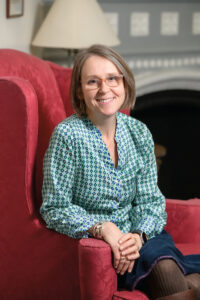 Growing up as the only child of two academic parents in rural Suffolk, England, the rhythm of academic life always felt familiar to Sarah Bilston, Paul E. Raether Distinguished Professor of English. When she left to study English at University College London, she discovered a fascination with theater and counted Christopher Nolan as one of her drama society contemporaries. Though she considered pursuing a career as a theater director, Bilston instead chose the academic route and went on to earn an M.St. and D.Phil. in English literature from Somerville College, University of Oxford. Bilston settled in Connecticut when her husband was hired at Yale Law School and describes joining the Trinity faculty in 2005 as “a dream come true.” Bilston says, “When the position was advertised at Trinity, I jumped at it. I was hopeful, but I had applied for so many jobs before and not gotten them. I still remember the day that Sheila Fisher, a wonderful Chaucer scholar, called me to tell me that I got the job.” Bilston, who was awarded the Thomas Church Brownell Prize for Teaching Excellence in 2017, teaches a range of courses on Victorian literature and completes a stint as chair of the English Department in June 2026. When asked why Victorian literature continues to resonate with students, Bilston compares the seismic shifts of the period—the industrial revolution, rapid urbanization, the expanding boundaries of empire—to the issues that students confront in their own lives.
“The 19th century is this moment of dramatic transformation. A lot happens incredibly quickly, such that one generation would be living a very different life to the ones that their parents had led,” she says. “The industrial revolution really changed the way that people encountered the machine, something we’re confronting more than ever right now as we think about artificial intelligence.”
In addition to her teaching responsibilities, Bilston also has published numerous peer-reviewed articles and five books. In 2023, she received a National Endowment for the Humanities fellowship to work on her most recent book, The Lost Orchid: A Story of Victorian Plunder & Obsession (Harvard University Press, 2025), which earned a Kirkus starred review upon release.
“My most recent book was an interesting turning point in my career,” Bilston says. “My first two scholarly books were aimed at an academic audience, and I’ve also written two novels. What I wanted to do with this book was figure out how I could convey my research and my knowledge of the period in a way that a broader readership could find engaging.”
Bilston’s influence as a teacher and mentor has left a lasting impression on her former students. “Today, I am an educator. Without even knowing, Professor Bilston guided me to this path when I needed it most as a younger person,” says Trevor Stern ’11, dean of students at Avon Old Farms School. “I will always remember Professor Bilston’s kindness, authenticity, and humanity. Whenever I spoke in class or went to her office for help, it felt as if I was the only voice in the world that mattered at that moment. Very few people have this gift.”
Reflecting on her two decades at Trinity, Bilston mentions her gratitude for her colleagues in the English Department, the beautiful campus, and the opportunities to interact with students in a small liberal arts environment. She adds that her three children are now college-age, which has given her a fresh perspective on relating to her students.
Never one to rest on her laurels, Bilston is working on forthcoming journal articles and looking ahead to her next book exploring early environmentalist consciousness in Britain. “By the end of the 19th century, Britain was continuing its imperialist agenda, but with a growing fear of
species loss and extinction,” Bilston says. “Something about that moment, that shift, really interests me as we are facing our own environmental catastrophe.”
Bilston emphasizes that the main purpose of her teaching and scholarship is all about recovering lost voices and reframing the material that her students are reading. “I want to push back against the misconception that Victorians were this weird bunch of prudish people,” she says. “Through their literature, we can make contact with them and see the ways in which their problems were similar to the ones that we deal with today.”
By Ian Rothenberg
Photo by Nick Caito