Elizabeth Devaney ’98
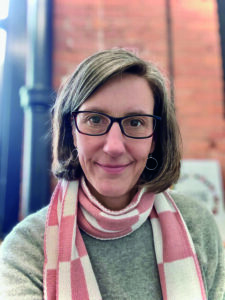 DEGREES: B.A. in American studies; master’s in management with a concentration in youth and family programs, The Heller School for Social Policy and Management, Brandeis University; Ph.D. candidate in human development, Warner School of Education, University of Rochester (expected graduation 2027)
JOB TITLE: Director, Whole Child Connection at Children’s Institute in Rochester, New York
FAVORITE TRINITY MEMORY: There are so many, but what stands out are the weekly all-nighters we pulled to finalize The Trinity Tripod. I was editor-in-chief my senior year, and that was also when I started dating Tom Devaney ’98. He worked the overnight shift as dispatcher at Campus Safety, so when I was fading around 3:00 a.m., I’d call him, and we’d talk for hours while we each did our late-night jobs. That ability to talk about anything and everything started then—and it’s still the most important part of our relationship.
What was your path to your current position? When I graduated from Trinity, I thought I was headed for a career in publishing. I had spent four years working on the Tripod and imagined myself continuing down that path. But publishing jobs were hard to come by, and thankfully, I didn’t get one! Instead, I landed a role as a publications assistant at a nonprofit focused on research and development in education and health. It didn’t take long for me to realize that publishing wasn’t my passion, but the organization’s mission sparked something deeper. I transitioned into a research assistant role and found myself drawn to the idea of using research to inform policy and practice. That led me to pursue a master’s degree focusing on social policy. From there, my career has consistently placed me at the intersection of research and practice. My husband, Tom ’98, is a history professor, and his early career required us to move around quite a bit. That gave me the opportunity to explore different roles, each one adding a layer to my understanding of systems change and youth development. Eventually, we settled in Rochester, New York, where Tom is senior associate dean of arts and sciences at the University of Rochester, and I serve as director of the Whole Child Connection at Children’s Institute, a nonprofit focused on advancing children’s social and emotional development through research, evidence-based programs, and practical support for educators and caregivers.
What do you do in your role? I lead a team that provides professional learning, coaching, consultation, and research-based tools to school districts, early childhood programs, out-of-school-time providers, families, and youth across the state of New York. One of our most impactful initiatives has been helping seven school districts revise their codes of conduct to be more student centered, restorative, and strengths based. These changes aim to flip discipline from a focus on punishment and blame to a focus on accountability and support. We’re also developing and testing a new coaching tool that helps educators integrate social and emotional skill building into everyday instruction so students build essential life skills without losing academic time.
What do you enjoy most about your work? I get to work with people who care deeply about equitable education and creating learning spaces that truly meet the needs of young people. We work directly with youth and families to co-create solutions to pressing problems in education. Also, as a mom of three teenagers, the work feels personal. I see firsthand how important it is to support young people’s social development—not just for academic success but for life.
What are the biggest challenges you face? Right now, schools are highly politicized. There’s a lot of pressure from both sides of the political spectrum to turn education into a battleground. That creates a tough environment for educators and does a real disservice to kids. Our work is not political; it’s about centering children’s needs, and that can be hard to do when the system is pulled in so many directions.
How did your time at Trinity help prepare you for your career? Trinity gave me the foundation I use every day—critical thinking and strong writing skills. Working on the Tripod and at the Writing Center helped me grow as a communicator and as a leader. My senior thesis, which focused on the Frog Hollow Revitalization Project, was my first deep dive into community-based research. It opened my eyes to the lived experiences of people in communities very different from my own and sparked a lifelong interest in understanding and addressing inequity, particularly for children.
Was there a professor at Trinity who was particularly influential? Several actually. Cheryl Greenberg and Jerry Watts introduced me to social justice concepts that lit a fire in me. But my senior thesis adviser, Stephen Valocchi, had the most lasting impact. He taught me the value of community-informed work—something that’s now the foundation of my career.