Robert Afzal ’84
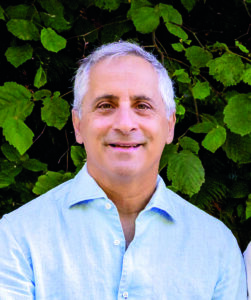 DEGREES: B.S. in physics; M.S., Ph.D. in physics, Brown University
JOB TITLE: Senior fellow at Lockheed Martin in Seattle
FAVORITE TRINITY MEMORY: First, I still have enduring friendships from my time at Trinity, and that by far is most important. I just got together with two of my friends from Trinity; we had gone on to be housemates in grad school, so we lived with each other for another five years. We hadn’t seen each other in ages, but we had a fabulous time—we didn’t miss a beat. Second is something unique at Trinity: Cinestudio, the movie theater. Almost every weekend, we would go to the movies before starting a night out. I saw so many great films, and it was such a great place. I don’t think other schools have that jewel of a theater. To this day, I’m very good at film analysis; my wife is always commenting on how I can take a film apart!
What was your path to your current position? My interest in lasers was sparked at Trinity through a freshman [first-year] seminar where Professor Harvey Picker had crafted a course in lasers. While at Trinity, I conducted an independent research project in learning more about lasers and was able to construct a laser in a Trinity lab. After graduating, I went to Brown to earn a Ph.D. in the specialty of laser physics and then to a postdoctoral position at the Naval Research Laboratory in Washington, D.C. I later took a position at a small laser company in Boston that did some defense work and also was developing lasers for medical applications; my first project there was to help develop a laser for tattoo removal. I was there for almost two years when a position finally opened at NASA-Goddard Space Flight Center. We used to say that Goddard is responsible for everything in Earth’s orbit that doesn’t have an astronaut in it. In my roughly 10 years there, I worked on three space flight programs: I was the lead for development of lasers for one of the first return-to-Mars missions, the Mars Global Surveyor; I was the lead laser developer on an Earth-observing satellite called ICESat; and I helped design the laser for the mission to Mercury called MESSENGER. I then went back into the private sector, and I ended up going back to Providence at a small start-up with my grad school cohort of a Brown professor and some of the grad students. We started a company that had its typical small company ups and downs. After five years, I took a position in Seattle at a laser R&D (research and development) company. Two years later, that company was acquired by Lockheed Martin, and I’ve been here ever since.
What do you do in your role? As the senior technical person for the development of high-power lasers, I work with corporate leadership and with our customers to help them understand what capabilities we can develop and deliver. I communicate the vision of what our advanced technology will provide them. I’m also called on to lead teams to solve technical problems in our programs.
What do you enjoy most about your work? I feel like we are working to solve very important problems that our nation faces, and that’s motivating from a personal satisfaction standpoint. I tend to work on the early stages of technology demonstrations, so I’m typically not involved in production. I’m involved in the art of the possible.
What are the biggest challenges you face? Unlike pure science, we have to do science on a schedule and within a budget. The challenge of balancing thorough work with cost and time is always the major challenge.
How did Trinity prepare you for your career? Along with academics and learning the basics, Trinity gave me the freedom to pursue my interests. I wanted to try to build a laser, and they helped me do it. I had easy access to all the professors. I had an office in McCook; I did my homework there, and I could walk down the hallway and talk to the professors. It was a really friendly environment. I also took courses in history and English literature. My liberal arts education didn’t help me with my early technical career, other than, say, being able to write proposals, but it helped me as I grew in seniority. I am able to communicate complex ideas in understandable ways so that non-technical people know what we’re trying to accomplish. I brief senior people at the Pentagon, on Capitol Hill, and in our own corporation, and not all of them are physicists. I need to be able to communicate what and why we do what we do and what benefit arises from that.