Ann McNichol ’78
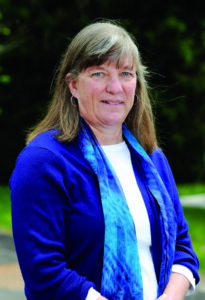
DEGREES: B.S. in chemistry; Ph.D. in chemical oceanography, Massachusetts Institute of Technology/Woods Hole Oceanographic Institution
JOB TITLE: Senior research specialist/staff chemist (recently retired), National Ocean Sciences Accelerator Mass Spectrometry Facility
FAVORITE TRINITY MEMORY: I find it impossible to come up with just one memory that is my favorite, though hanging out on the quad in the fall and spring is pretty far up there. I lived on the Long Walk for three of my four years at Trinity; those drafty dorms couldn’t dampen the fun of living there.
What was your path to your most recent position? After college, I worked as a lab assistant for two years, mostly at The Rockefeller University in New York City. After that, I attended graduate school and then worked at an ocean consulting firm for a few years before I started the job that would become my career.
What did you do in your role? I was responsible for establishing and operating a laboratory for the preparation of ocean samples for radiocarbon analysis. It was an exciting time as the analysis technique, accelerator mass spectrometry, was in its infancy, and I was able to develop techniques to extract the carbon from many different types of samples for analysis. The results increased our understanding of global climate change, paleoceanography, atmospheric chemistry, and limnology, to name a few fields. Many people think of radiocarbon solely as a dating tool, but it is so much more than that. Tracing its uptake in the environment provides important information about the transfer of carbon between different reservoirs, e.g. transport of terrestrial carbon to the ocean, understanding the local and global ocean circulation, studying the impact of climate change on the carbon cycle in the ocean, and determining where the carbon from fossil-fuel burning is going.
What did you enjoy most about your work? My favorite part of the job was working with graduate students as well as training and developing staff members. The insights that new perspectives brought to my laboratory were fascinating and provided many opportunities for advancing the field. Radiocarbon can add important information to ongoing studies, and being able to show students how their research will benefit from the analyses and help them develop the analysis techniques was very rewarding.
What challenges did you face? One obvious challenge that continues is obtaining funding to keep the laboratory and research going. Most of our funding is from the National Science Foundation. Access to funding got worse every year and is now in a crisis state. Sadly, another major challenge has been advancing in geological sciences as a woman. It wasn’t until I got to graduate school that I started feeling like a fish out of water. Some of the challenges were tangible and easy to deal with, but others were far less so. Things are better now, but there is still a lot of work to be done. My struggles made me an advocate for the underrepresented in science, and my position as a leader of a lab afforded me opportunities to advise, coach, and support junior women in science.
How did your time at Trinity prepare you for your career? Trinity was a great place to get a solid background in chemistry, which started me on the path to my career.
What was the most memorable course you took at Trinity? Oddly enough, it was not a chemistry course. The science and math courses I took were well taught and intellectually stimulating but didn’t necessarily provide the opportunity to think broadly. I took a lot of political science classes, and my favorite was a political philosophy class taught by Dr. Clyde McKee. It made me use my mind in a very different way than my science classes did. I do think that the writing I needed to do for all the political science classes I took made me a better writer than the majority of the graduate students I went to school with.
Did you have a professor who was particularly influential? Early on, Dr. Henry DePhillips encouraged me to take classes outside the sciences. He said that it was one of the last times I would have the luxury to do this and that when (not if) I went to graduate school, my studies would be much more focused. It is possible that I took his advice too much to heart and might have benefited from some more advanced chem classes and fewer political science ones, but, in the end, things have worked out pretty well for me.
PHOTO: TOM KLEINDINST