Hartford’s Black History Connects to College Experience
Content
Story
Posted
Category
Hartford
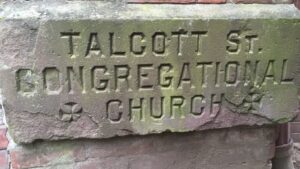
It was 1826 when the Talcott Street Congregational Church was built at Talcott and Market Streets in Hartford. The church, which would become the first for Black congregants in Harford and the site of the first school for the city’s Black children, began as a protest against the segregation of Blacks in other Harford churches. Today, all that remains is a condemned parking garage, with no marker, commemoration, or sign of the historic significance of the site, located near Capital Community College.
Pictured from left to right: Julian Hogan, CCC; Mercy Unoh, Trinity, and Aliyah Freeman-Johnson, CCC.
The grant will support three central activities: a permanent exhibition on the history of the Talcott Street Congregational Church that will be available to the public, a series of daylong seminars with readings and lectures by scholars and historians to support curriculum writing by 17 faculty from Capital and Capital Preparatory Magnet School, and an annual Pennington Lecture that will bring prominent humanities speakers to Hartford to engage in conversations about race and democracy.
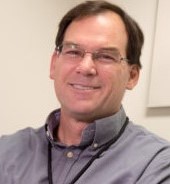
Jeffrey Partridge, English professor and chair of the Humanities Department at Capital Community College
Led by Jeffrey Partridge, an English professor and chair of the Humanities Department at Capital, the Action Lab Black Heritage Project team also included Capital students Aliyah Freeman-Johnson, Julian Hogan, and Armani Parnther; Trinity student Mercy Unoh ’23; and Trinity alum Jasmine Agosto ’10, the education and community outreach manager for the Hartford History Center in the Hartford Public Library, as the project’s community partner. Following the George Floyd murder and the outflow of support for the Black Lives Matter movement, Partridge was encouraged to turn several of the project’s recommendations into reality.
“The project is dedicated to bringing the history of Hartford’s Black community into the lived experience of the college,” said Partridge. “Our students, staff, and faculty walk by it on a daily basis without knowledge of its significance.”
According to Partridge, the church regularly assisted escapees from slavery in the South who were making their way to Canada on the Underground Railroad. He said two of its pastors, Pennington and Hosea Easton, were internationally prominent voices for emancipation.
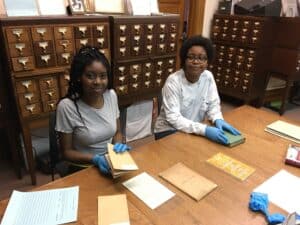
Trinity student Mercy Unoh ’23, left, and Aliyah Freeman-Johnson, a student at Capital Community College, worked with primary-source artifacts.
Trinity student Unoh said that when she started the project, she knew very little about Hartford’s history and even less about the background of the Talcott Street Church. “With the help of various community partners, I was introduced to archival research,” she said. “For the first time in my life, I held delicate primary-source artifacts in my hands.”
The work began when the Capital’s Hartford Heritage Project partnered with the Hartford History Center to propose a research project for the Action Lab, where project groups are composed of a community partner, a faculty fellow, and four or five students from Capital and Trinity. The Black Heritage Project was researched during the spring 2020 semester and was completed in May 2020.
“The students were amazed at the history of this church and were saddened that this history lay in the shadows for all these years,” said Partridge. “They set out to read and research, visiting the Connecticut Historical Society, Hartford History Center, Harriet Beecher Stowe Center, and Faith Congregational Church, the descendant church of Talcott, to gather information.”
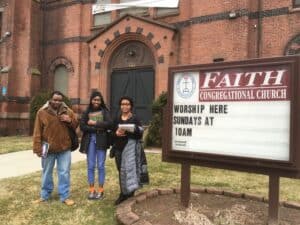
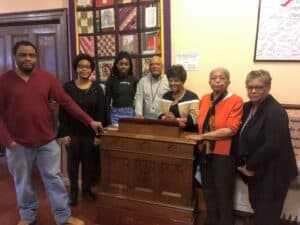
Pictured from left to right at Faith Congregational Church: Julian Hogan, CCC; Aliyah Freeman-Johnson, CCC; Mercy Unoh, Trinity; Herbert Knight, friend of Faith Congregational Church, and Faith Congregational Church members, Alice Lumpkin, Barbara Wiggins, and Gail Martin.
Unoh said she also learned about court cases at the Old State House, historical Black female writers, education for Black youth in Hartford during the 19th century, and more. She said that although she may not be pursuing a career in history, she now knows that she enjoys research and archiving.
“I would encourage students to get involved with Action Lab projects, especially if they wish to engage with Hartford further,” said Unoh. “I would regard this course as a highlight of my Trinity experience. I loved working with students from another school and getting to know the community partners and faculty advisers. Every class felt like a field trip.”
Trinity’s Summer Research Program supports intensive student involvement in ongoing faculty research. More than 100 Trinity students spent part of summer 2026 engaged in research projects with faculty mentors.
Through collaborative partnerships across campus, in Hartford, and beyond, Trinity’s Pre-Orientation Programs foster awareness, care, connection, conversations, and experiences as a community.
Trinity College’s Austin Arts Center and its resident theater company, HartBeat Ensemble, will present Athol Fugard’s South African drama “A Lesson from Aloes” from October 8 through October 17, 2026.