Fellowship Supports Professor’s Political Science Research
Content
Story
Posted
By
Ian Rothenberg
Category
Briefs
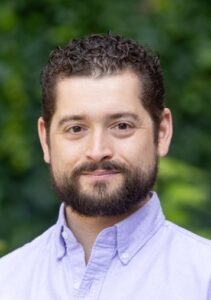
Gabriel Salgado, assistant professor of political science, has been awarded a four-month fellowship to pursue research examining the role of race in shaping the modern world, with a focus on early modern Latin America.
“My research aims to broaden our understanding of race by highlighting the theological underpinnings of categories like Indigeneity and Blackness,” Salgado said. “In my book project, I show how anti-Jewish and anti-Muslim policies from 15th-century Spain were redeployed to target Indigenous, African, and Asian peoples in 16th-century Mexico.”
During the fellowship, Salgado plans to make use of the special collections of the Yale University libraries to aid his research. He noted that the Mexico Collection features royal decrees, ordinances, and inquisitorial documents which may provide relevant insights, and the Beinecke Rare Book and Manuscript Library contains several manuscripts he hopes to utilize, including documents related to Christopher Columbus’ family and instructional books used by missionaries in colonial Mexico.
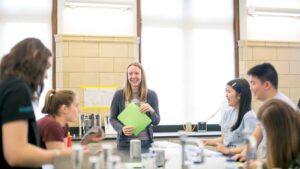
While the fellowship will primarily provide Salgado with the time and access to resources that will help him complete his book manuscript, he is also thinking about the ways it will strengthen his teaching at Trinity. “This past year I developed and taught a new course titled ‘Slavery and the Archive.’ In addition to introducing students to archival research, I connected with the [Connecticut-based] Witness Stones Project, and we launched a project with the Wadsworth Atheneum Museum of Art [in Hartford], researching the connections the museum’s holdings have to enslaved individuals,” he said.
In the classroom, Salgado hopes to inspire critical engagement in his students. “What I’m trying to do with this book, and through my teaching as well, is provide a more expansive understanding of what race has meant and how racism has operated,” he said. “I want to broaden our understanding of race beyond a simple binary and emphasize its connection to religious discrimination.”
The American Academy of Arts and Letters has recognized Associate Professor of English Ethan Rutherford with the Rosenthal Family Foundation Award for Literature for his debut novel, North Sun: Or, the Voyage of the Whaleship Esther.
Professor of Chemistry Michelle Kovarik has been named the recipient of the 2026 J. Calvin Giddings Award for Excellence in Education by the American Chemical Society (ACS) Division of Analytical Chemistry.
Christopher Swist, Trinity College lecturer in music and director of recording arts and chair of the Music Department, was the featured performer at a recent concert hosted by the New Britain Museum of American Art.