‘Trinity 2040’ Strategic Planning Process Begins with Community Survey and Forum
Content
Story
Posted
Category
Announcement
Trinity College has begun the process of building a new strategic plan, Trinity 2040, and is seeking input from members of the Trinity community.
Rich Majerus, Trinity’s vice president for strategic planning and marketing and communications, said that this process builds directly on prior campus and strategic plans at the College, recent work to articulate campus values, and the ongoing work related to reaccreditation.
“Trinity is moving deliberately with this important planning effort to capitalize on our current momentum and to ensure that Trinity strengthens its market position as a top college in the increasingly dynamic higher education landscape,” Majerus said.
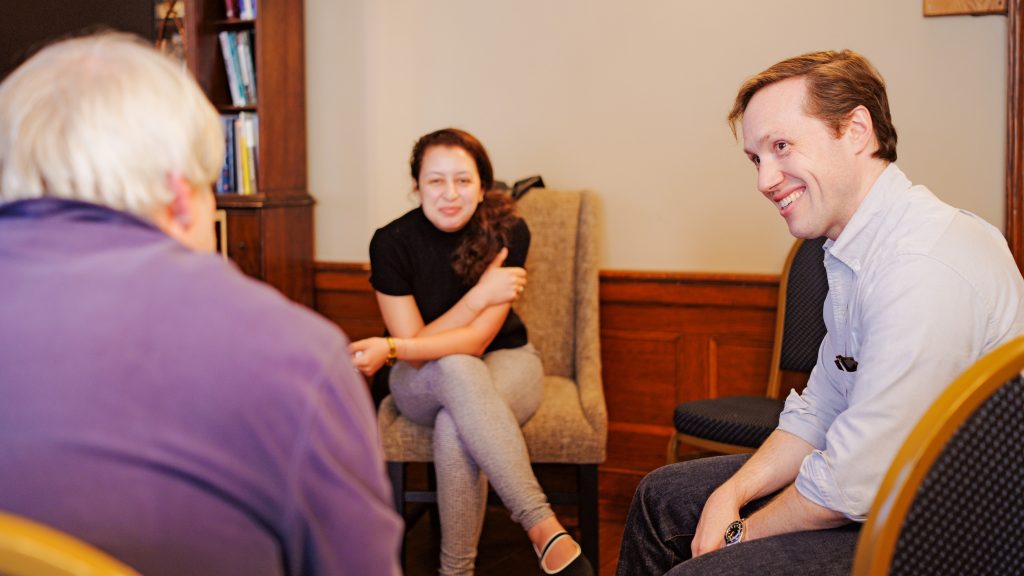
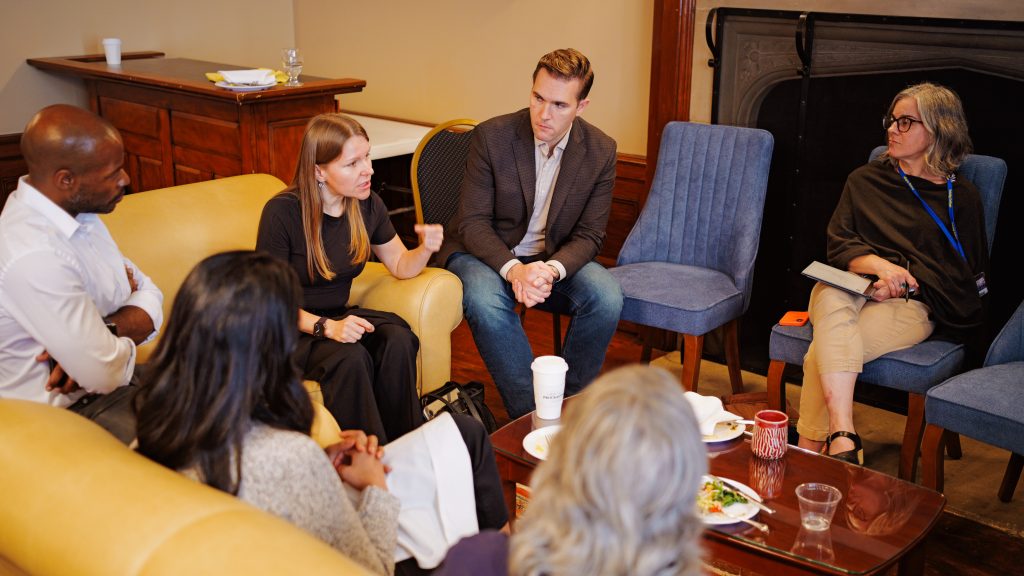
Faculty and staff members attend a strategic planning discussion forum. Photos by Helder Mira.
The Board of Trustees has directed the College to move forward in a planning process with workstreams focused on Arts and STEM (science, technology, engineering, and mathematics), the Learner Lifecycle, and the Neighborhood. See more information about the workstreams below.
“These current areas of emphasis are not new to the College community, and these workstreams are not intended to be mutually exclusive or exhaustive,” Majerus added. “Areas of connection and opportunities will span multiple workstreams and additional areas at the College.”
The members of the faculty and staff who comprise each Trinity 2040 workstream began meeting in the fall 2026 semester. (Trinity’s previous strategic plan, Summit, was approved by the Board of Trustees in October 2017 and concluded on June 30, 2025.)
Faculty and staff members attend a strategic planning discussion forum.
The three workstreams are at different stages of gathering forward-looking ideas from people on campus and beyond. As part of this effort, a survey distributed on October 29 asked Trinity faculty and staff members to provide input on the strategic planning process. Employees may complete the “Strategic Planning—Trinity Community Survey” here by logging in with their Trinity credentials. The survey will close at the end of the day on Friday, November 20.
The faculty and staff community also provided input in person at a strategic planning discussion forum with members of each workstream on November 4 in the Hamlin Hall Emeriti Lounge. Individual and group conversations on campus will follow in the coming weeks, inviting input from additional members of the Trinity community.
“The strategic planning workstreams are focused on aggregating input and ideas from on and beyond campus,” said Majerus. “The early response to the survey has been encouraging and helpful for this work. I am thankful for all of the faculty and staff who have already provided their input and I am hopeful that many more will do so in advance of the Thanksgiving break.”
The Trinity 2040 Workstreams:
Arts and STEM
The need for modern arts and science facilities on campus has long been understood. The 2006 Campus Plan highlighted consolidating, improving, and expanding arts spaces and enhancing science and engineering facilities as top priorities. College leadership intends to deliver on these needs while realizing that facilities alone are not sufficient to elevate the visibility and impact of the arts and STEM on and beyond campus.
Learner Lifecycle
Centered in our mission to engage, connect, and transform, Trinity has an opportunity to build a cohesive learner experience from applicant to alumni. The particular focus is on the 60 months between a student applying and their first destination within six months of graduating, as well as an emphasis on how alumni can enhance the student experience and outcomes during this time.
Neighborhood
The College is considering opportunities to expand connections to and relationships in Hartford, with a particular emphasis on Trinity’s efforts to collaboratively and productively contribute to the neighborhoods adjacent to campus.
Trinity College faculty members were recognized for their outstanding achievements in scholarship, teaching, service, and leadership at the 2026 Faculty Excellence Awards ceremony, held October 29 in Mather Hall’s Washington Room.
Trinity College’s endowment has grown to more than $1 billion for the first time in the history of the institution. Trinity joins an elite group of fewer than 200 colleges and universities in the country with endowments exceeding $1 billion.
This year’s cohort of President’s Fellows includes some of Trinity’s most accomplished seniors. These 32 student scholars from the Class of 2027 have compiled exemplary academic records in their years at the College.
The Class of 2026 inductees are Mickey Kobrosky ’37, Susan Cutler Beyer ’85, Kate Hunter ’05, Gustav Detter ’09, Kanzy El Defrawy ’16, and former coach/administrator Chet H. McPhee. Doug Tansill ’61, P’91, ’96 was selected for the inaugural Blue & Gold Award.