‘A Unicorn’ in the Archives: Trinity College’s Watkinson Library Makes a Rare Discovery
A page of text from the 15th century with connections to famed printer Johannes Gutenberg—hidden for more than 100 years in an uncatalogued scrapbook in the Watkinson’s archives—may represent one of the earliest generations of European printing.
Content
Story
Posted
By
Andrew J. Concatelli and Andrea Cuevas
Category
Announcement
As soon as his well-trained eyes alighted on the bold, Gothic lettering, Eric Johnson-DeBaufre knew he was looking at something special.
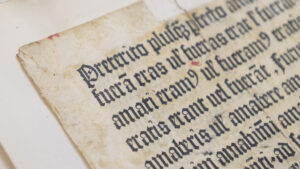
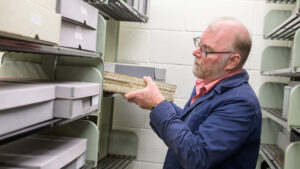
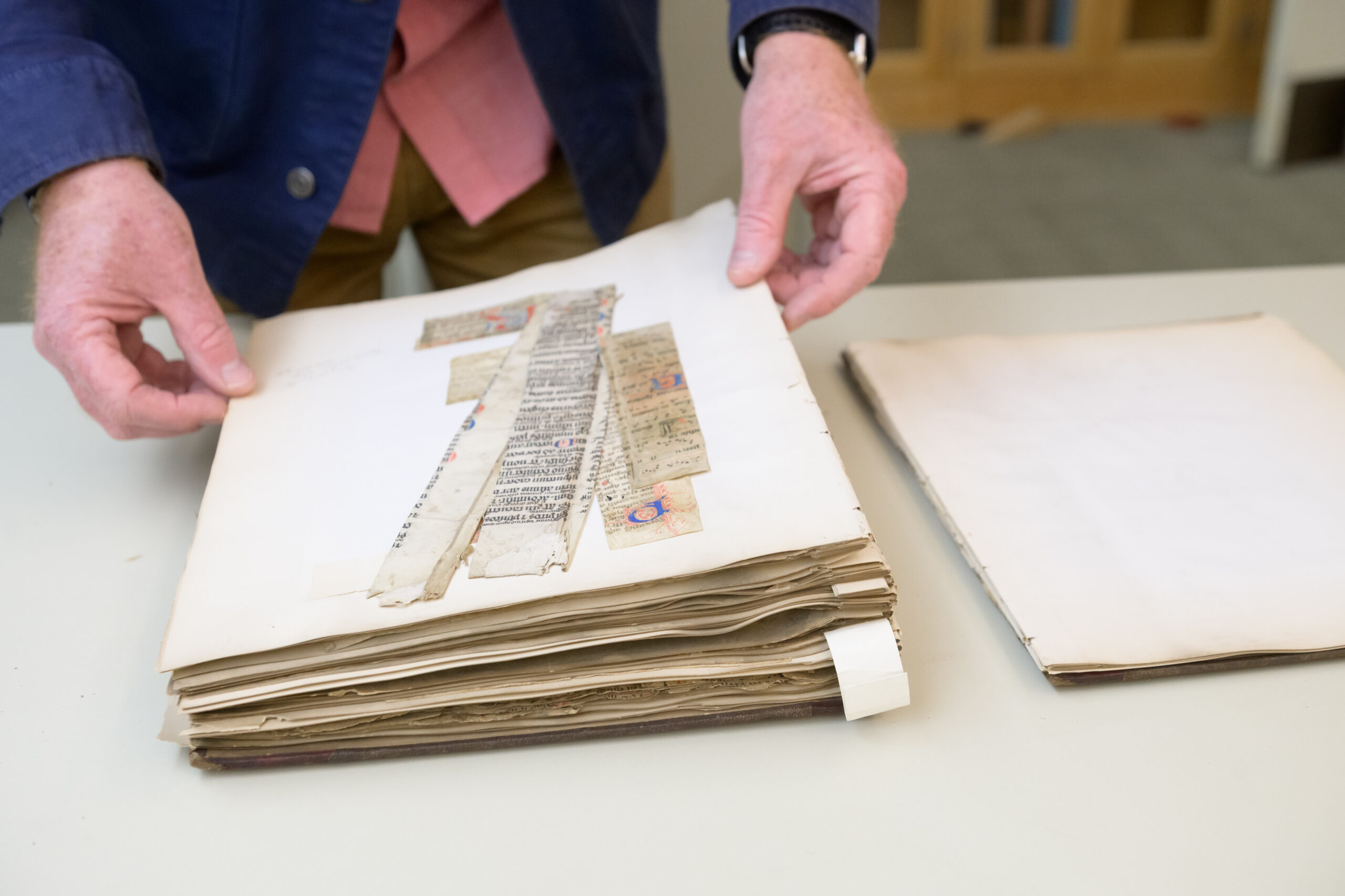
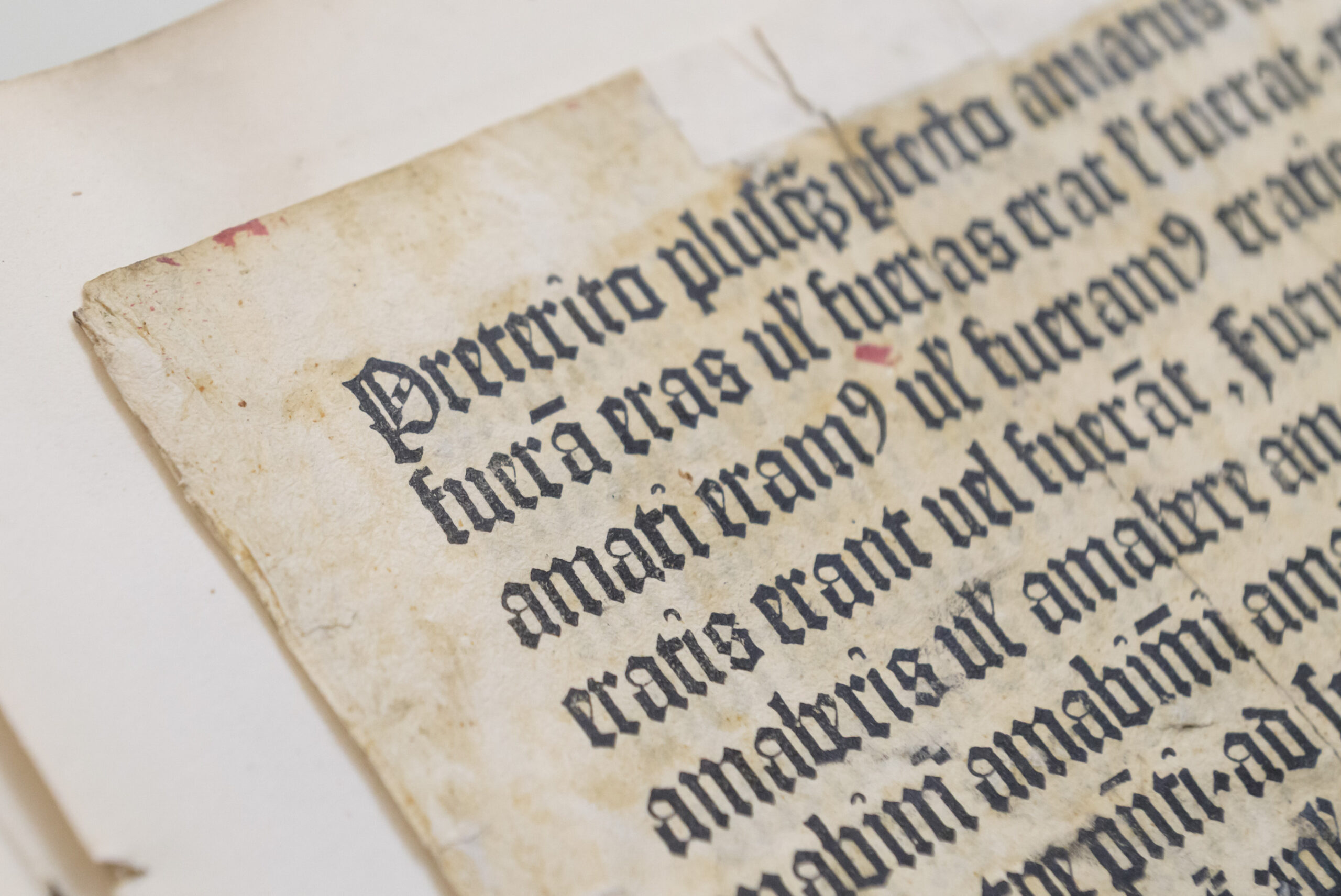
The rare books and special collections librarian in Trinity College’s Watkinson Library was examining a scrapbook from a collection that was donated to the Watkinson more than 100 years ago but had never been officially catalogued. The font on the printed page before him looked similar to type produced in Germany in the 15th century by famed printer Johannes Gutenberg, the inventor of the moveable-type printing press.
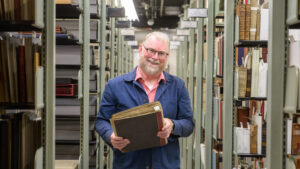
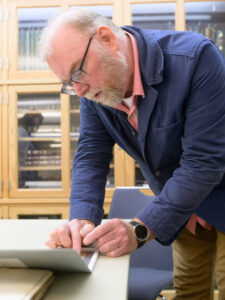
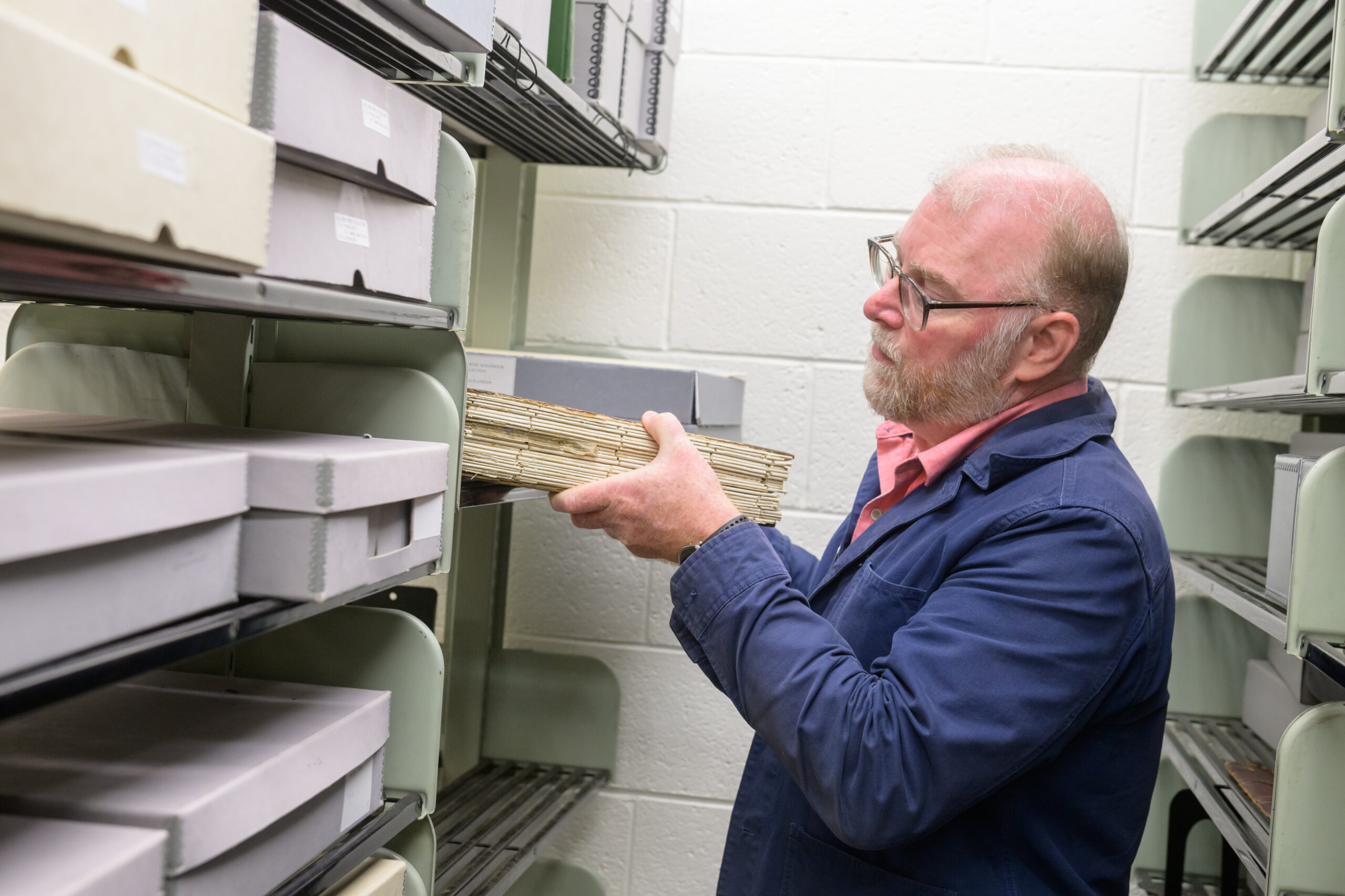
Eric Johnson-DeBaufre, rare books and special collections librarian in Trinity College’s Watkinson Library, in the archives with the scrapbook that contained a printed page from a Latin grammar textbook believed to be from the mid 15th century. Photos by Nick Caito.
Johnson-DeBaufre would come to identify the page as a rare, previously unrecorded 15th-century printing connected to associates of Gutenberg. He said that it may represent one of the earliest generations of European printing. “This document is something that scholars around the world are going to want to study,” Johnson-DeBaufre said.
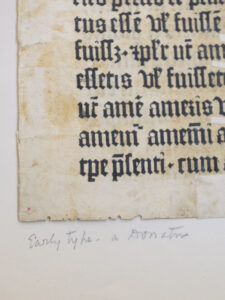
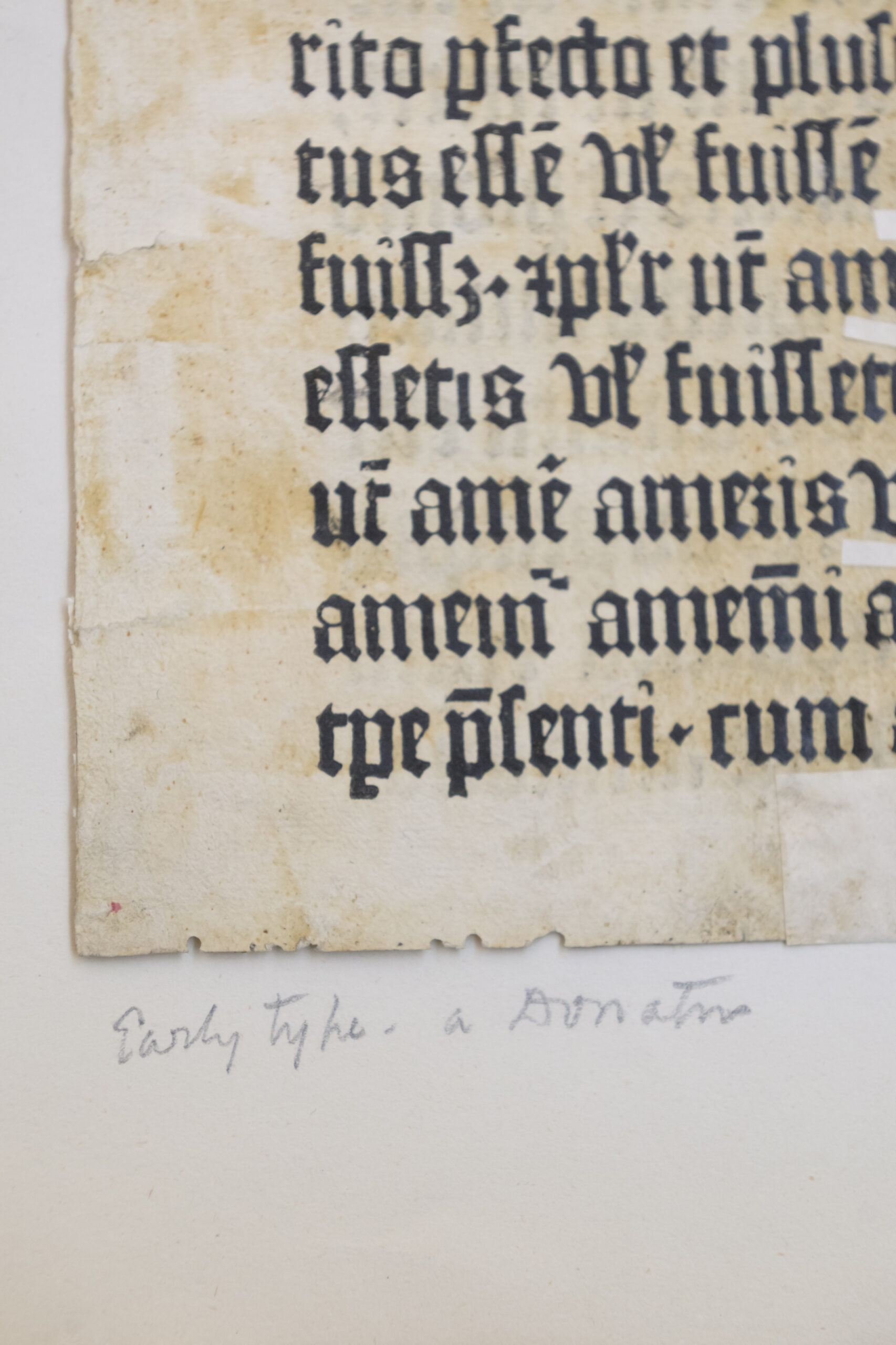
The fragment is classified as an incunable, the term used for books and printed texts produced during the first 50 years (1450-1500) of movable-type printing in Western Europe. Scholars have identified the Watkinson discovery as a leaf from the Latin grammar textbook Ars minor, written by 4th-century Roman grammarian Aelius Donatus, printed using type developed by Gutenberg associates Johann Fust and Peter Schöffer.
While previously unknown incunables are seldom found anywhere in the world, Johnson-DeBaufre said, discoveries of this kind in the United States are even more unusual.
“Any new discovery of a book from this period, especially of an unrecorded book—one that we had no record of anywhere at all—is always a big event,” said Johnson-DeBaufre. “And when it’s one that’s connected to Mainz, Germany, which is where printing in the West began, it’s especially exciting. For a discovery like this to happen here in the United States is almost unheard of.”
The Watkinson Library holds the rare books, special collections, and college archives at Trinity College and is directed by College Librarian Christina Bleyer. Founded in 1858 by the gift of David Watkinson, the library moved to its present location on the Trinity campus in 1951. Its collections support research, teaching, and learning and are open to members of the public. “Our collections at the Watkinson Library at Trinity are amazing,” said Johnson-DeBaufre. “They are so rich for a liberal arts college to have. You have to go to a museum to see these sorts of things.”
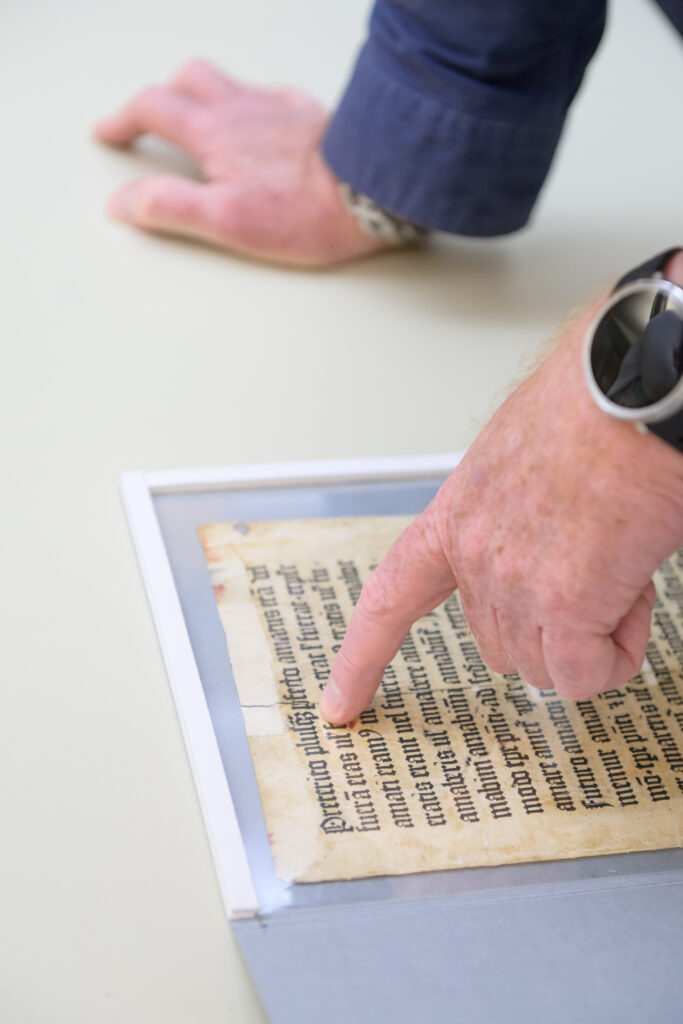
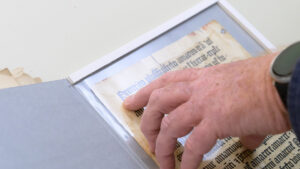
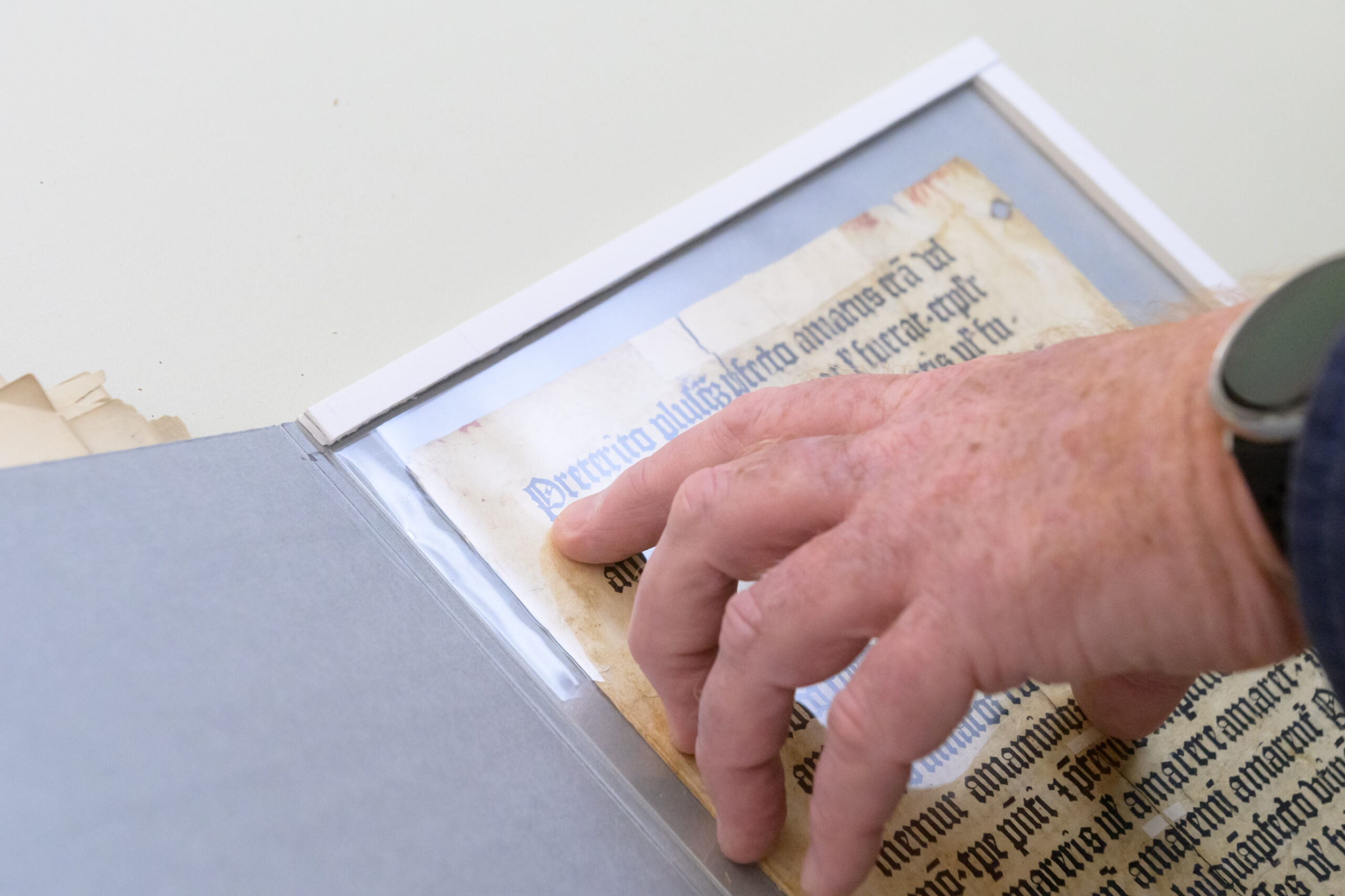
Eric Johnson-DeBaufre points out notable characteristics of the printed text in the Watkinson Donatus.
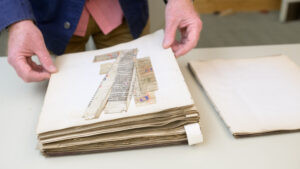
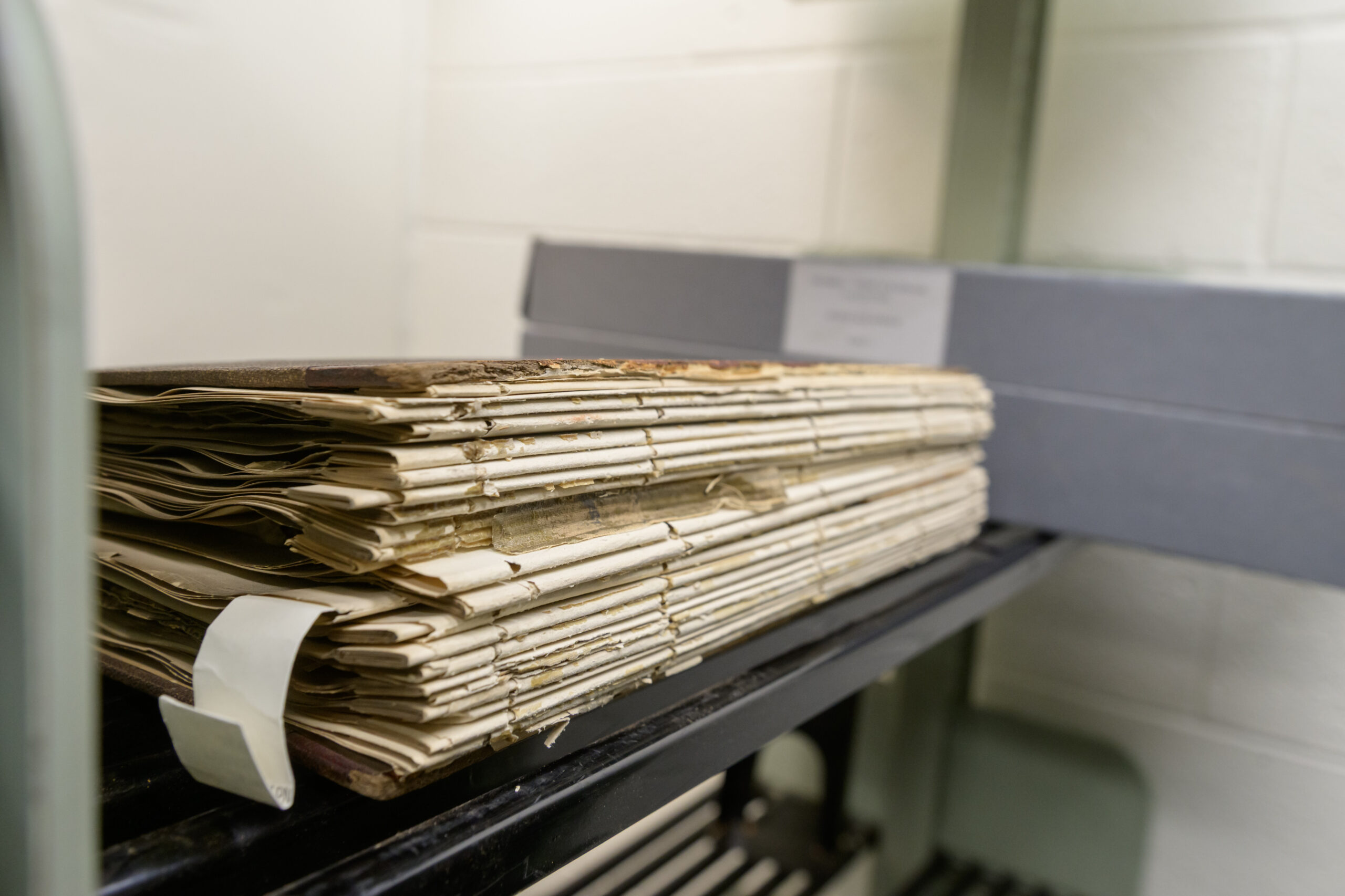
The fragment was discovered in the fall of 2025 in a scrapbook devoted to pieces of binding waste collected by William Cowper Prime, founder of the Art History Department at Princeton University and the first vice president of the Metropolitan Museum of Art. Prime donated more than 40 scrapbooks—many containing original prints by artists such as Albrecht Dürer, Jost Amman, Lucas Cranach, and Rembrandt—as well as nearly 1,500 books printed in the 15th and 16th centuries to the Watkinson Library in 1905. The Watkinson Donatus nevertheless remained unidentified for more than a century, filed away on a shelf in the library’s underground archives.
Johnson-DeBaufre said, “These scrapbooks sat in the Watkinson as a sort of hidden collection, until Celia Lanza ’26 was working on an inventory of the collection and called me over to look at ‘this strange scrapbook filled with lots of trash.’”
The identification of the page was subsequently confirmed by Princeton University’s Paul Needham (Scheide Librarian, Emeritus) and Eric White (Scheide Librarian and assistant university librarian for special collections, rare books, and manuscripts).
“It’s an important discovery for early book history,” said White. “The Trinity fragment represents a 15th-century printing of a schoolbook, the Latin grammar of Donatus, that has never been seen before and was never expected to exist.”
Donatuses were among the first texts to be printed by Gutenberg and his associates, Johnson-DeBaufre said, as they offered both a dependable stream of income and a chance to test the quality of the types before their use in more ambitious projects such as the Gutenberg Bible.
“Printing in the West was a new thing, so they were experimenting. I think that scholars will look at the Watkinson Donatus to see the ways in which there was experimentation going on here,” Johnson-DeBaufre said. “With the Gutenberg Bibles, things are all known; we know where they are, we know how many there are. This is like a unicorn. It’s unique, so it’s difficult to compare to anything. It’s going to make a big impact on our understanding of this early period of printing.”
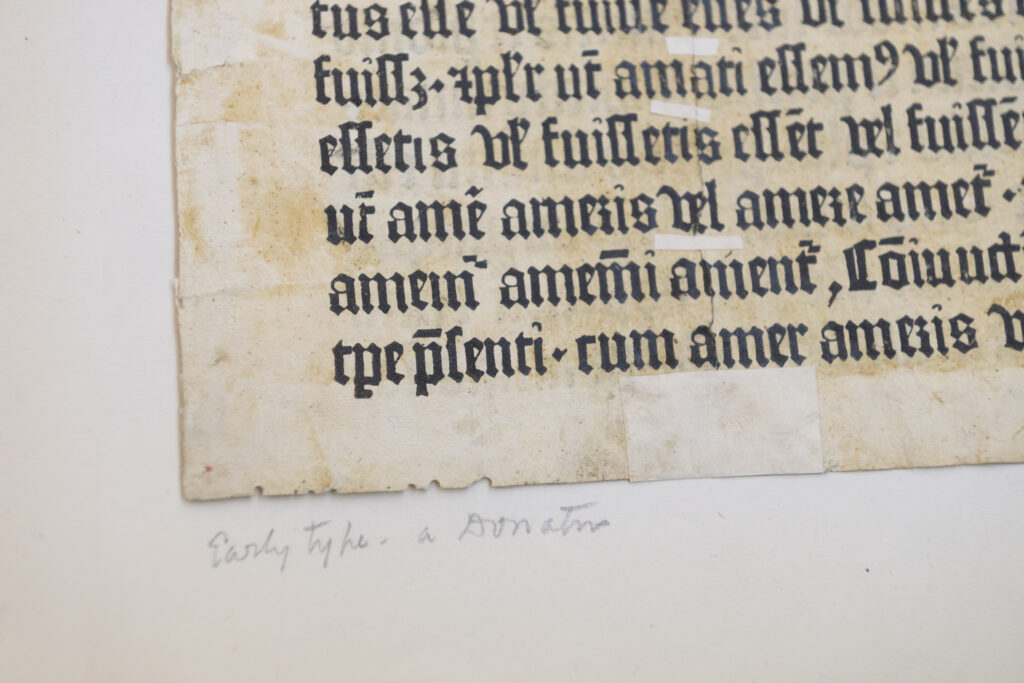
The Watkinson Donatus, as it was found in the scrapbook that was donated to the Watkinson Library in 1905.
According to Vincent E. Tomasso, associate professor of classical studies and chair of Trinity’s Classical Studies Department, the Donatus text was essentially a classroom textbook: “The book that this leaf is from taught the parts of speech, like, ‘here’s what a noun looks like in Latin; here’s how we use it,’” he said.
The Watkinson Donatus is unusual because it was printed on paper rather than on the more durable vellum, which needed to withstand handling by generations of schoolboys. Scholars believe the paper may have served as a proof sheet before the text was printed on its final medium. The types used in the fragment derive from the first state of those used to print the Mainz Psalter, a landmark book of early European printing completed in 1457, just after the Gutenberg Bible.
“We almost can’t overestimate how valuable this is, in terms of telling us something about the lives of the people then,” Tomasso said. “The discovery gives us an understanding of their method of printing, and it gives us great insights into what people at that time were thinking about, what they would throw away or reuse. It really is a discovery without parallel.”
Johnson-DeBaufre, Needham, and White are continuing their examination of the fragment and hope high-quality scans made at Princeton will yield additional information about the date and circumstances of its printing. They plan to publish their findings in a scholarly journal before making the page more broadly accessible through Trinity College’s digital repository, where it will be available to researchers everywhere.
See more photos below.
1/8
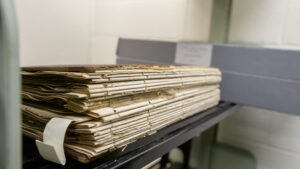
The scrapbook in which the Watkinson Donatus was found was donated to the library in 1905 by William Cowper Prime. Photos by Nick Caito.
2/8
Eric Johnson-DeBaufre, rare books and special collections librarian in Trinity College’s Watkinson Library, in the archives with the scrapbook that contained a printed page from a Latin grammar textbook believed to be from the mid 15th century.
3/8
Eric Johnson-DeBaufre, rare books and special collections librarian in Trinity College’s Watkinson Library, in the archives with the scrapbook that contained a printed page from a Latin grammar textbook believed to be from the mid 15th century.
4/8
The scrapbook in which the Watkinson Donatus was found was donated to the library in 1905 by William Cowper Prime.
5/8
The Watkinson Donatus, as it was found in the scrapbook that was donated to the Watkinson Library in 1905.
6/8
The Watkinson Donatus, as it was found in the scrapbook that was donated to the Watkinson Library in 1905.
7/8
Eric Johnson-DeBaufre points out notable characteristics of the printed text in the Watkinson Donatus.
8/8
Eric Johnson-DeBaufre points out notable characteristics of the printed text in the Watkinson Donatus.
The digital humanities website Public Art CT—sponsored in part by Trinity College and created by a Trinity faculty member—has received a 2026 Award of Excellence from the American Association for State and Local History (AASLH).
A book by Associate Professor of American Studies Juliet Nebolon was named a co-winner of the 2026 Association for Asian American Studies (AAAS) History Book Award.
Sarah Bollinger will be the next executive director of the Trinity College Career Center. Bollinger has led career development and student success initiatives that connect experiential learning, faculty mentoring, employer relations, and alumni engagement.
Demonstrating valuable return on investment and continued alumni success, Trinity has earned recognition this fall in multiple college guides, including an elevated ranking at #31 on the 2027 U.S. News & World Report list of Best National Liberal Arts Colleges.