Trinity Faculty Members Receive Awards and Computing Resources for AI Projects
Content
Story
Posted
By
Andrew J. Concatelli
Category
Faculty
Two Trinity College Computer Science Department faculty members have been awarded funding to help put their artificial intelligence projects into practice.
Assistant Professor of Computer Science Chandranil Chakraborttii and Visiting Professor of the Practice in Computer Science Kenneth A. Kousen are among the recipients of the first awards presented by the Connecticut AI Alliance’s AI Computing Access Program.
The Connecticut AI Alliance (CAIA) is a consortium of 21 Connecticut higher education institutions dedicated to advancing AI education, research, and workforce development across the state. As part of a two-year initiative funded by the Connecticut Office of Higher Education (OHE), CAIA launched the AI Computing Access Program—a statewide effort to provide faculty and students at member institutions with access to advanced cloud-based AI computing resources that would otherwise be cost-prohibitive or unavailable through institutional infrastructure alone.
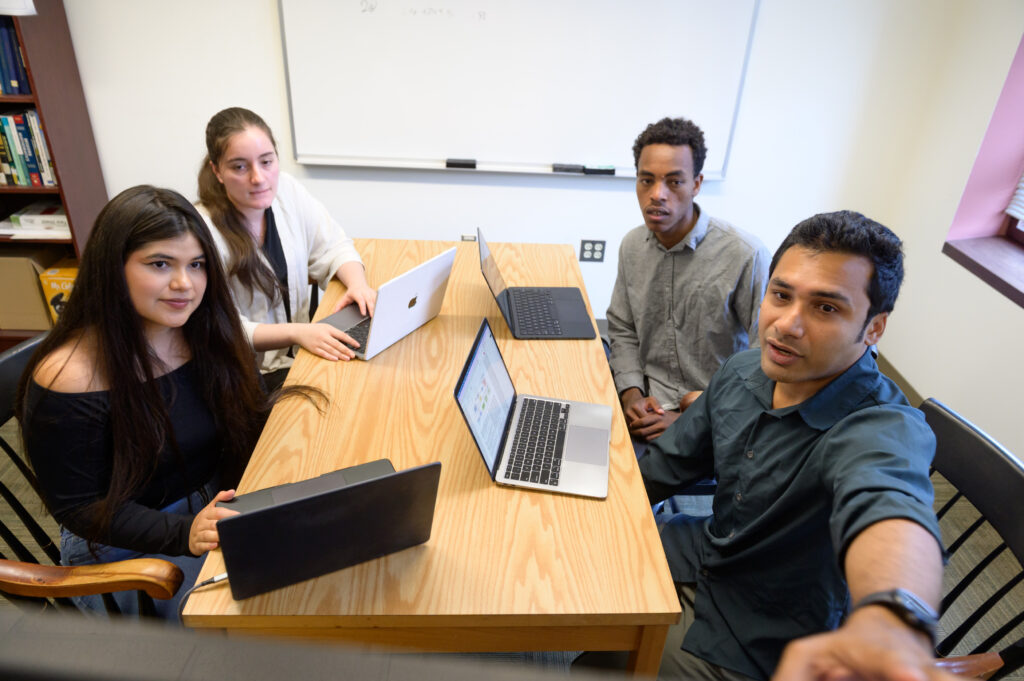
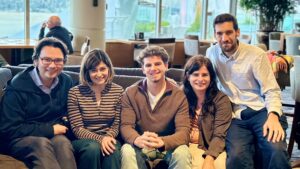
Jackie Garcia Alvarado ’28, Sitora Abdulofizova ’29, and Talakinet Wabelo ’29 work with Assistant Professor of Computer Science Chandranil Chakraborttii on addressing the ‘Verification Gap’ during summer 2026.
Chakraborttii said, “This project addresses the ‘Verification Gap’—the disconnect between a software program claiming data is deleted and its actual physical persistence in remote storage.” The project’s approach combines hardware and software safeguards by utilizing rotating encryption keys, repairing the database’s internal search graph so removed items become untraceable, and issuing a cryptographic “certificate of erasure” that outside auditors can verify. “We aim to turn data privacy and deletion from an unverifiable software notification into a hardware-enforced guarantee,” Chakraborttii added. The project’s goals include producing publications and hands-on security training for undergraduate students.
The CAIA award provides the project with high-performance computing credits on the Unity supercomputing cluster. “This gives our lab the computational power needed to simulate and validate our security architecture under enterprise-scale AI workloads,” Chakraborttii said. “This support also directly empowers five Trinity undergraduate researchers with hands-on experience using state-of-the-art supercomputing infrastructure.”
AI-Powered Traffic Video Analysis
Kousen, who also serves as associate director for STEM initiatives in Trinity’s Elting Center for Innovation and Entrepreneurship, was awarded $3,500 to continue work on the project, “AI-Powered Traffic Video Analysis.”
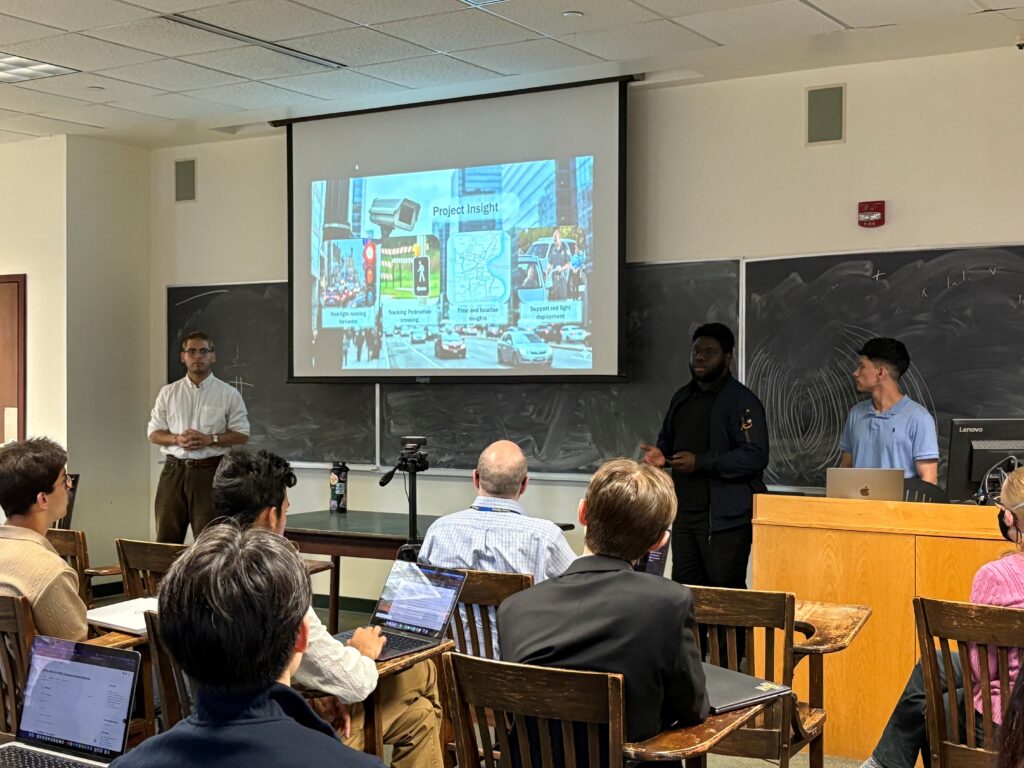
Francois Carpe Elias ’26, Kwadwo Osarfo-Akoto ’26, and Alex Sanchez ’26 partnered with the City of Hartford and Trinity College for a spring 2026 Applied AI project analyzing traffic camera footage.
This project uses computer vision (YOLOv8-style object detection) to analyze traffic and security camera footage in Hartford, flagging vehicles, pedestrians, cyclists, traffic violations, and near-miss incidents to improve street safety and walkability. “An LLM component turns the detection results into plain-language reports for city planners and public safety staff,” Kousen said. Now in its second year with Cisco and NVIDIA, the pipeline blurs faces and license plates and does no individual identification.
The grant will pay for models from Google that specialize in analyzing video data, and will help support the anonymization efforts needed to protect individual identities, Kousen said.
Kousen worked with Trinity students on a similar application in spring 2026’s Applied AI Innovation Sandbox pilot program. He met with students weekly to advise on this pilot program, which was designed to prepare students for the workforce and to help them discover the many possible uses of AI.
“We don’t know what impact AI will have on our lives, but any student who can work with these tools will have an advantage,” Kousen said. “These students have the opportunity to work with companies that are well established in the field, try out all the AI tools, apply them to real problems, and learn for themselves what they can and can’t do.”
About the AI Computing Access Program
According to the CAIA, the AI Computing Access Program “addresses a fundamental barrier to AI education and research: the gap between what faculty and students want to accomplish and the computing power available to them. Through cloud computing credits—including access to GPUs and large language model APIs—the program removes financial and technical barriers that can otherwise limit institutions’ ability to pursue computationally intensive AI projects.” This program bridges that gap by distributing $275,200 in cloud computing credits across four targeted tracks, each designed to serve a distinct community of need within Connecticut’s higher education ecosystem.
CAIA said that following a strong response to the inaugural funding cycle, 31 awards were made across 13 CAIA member institutions for projects taking place during Summer and Fall 2026. A second funding cycle is anticipated for the 2026–2027 academic year.
The first group of awardees demonstrates the breadth of AI activity underway across Connecticut higher education. The CAIA said, “Projects range from AI-powered traffic safety analysis and rural microtransit to cybersecurity, biomedical research, wildlife conservation, and rare earth element discovery. Awards are also helping faculty integrate AI into disciplines and courses including journalism, educational leadership, management, logistics, and e-commerce. Together, these projects illustrate one of CAIA’s core goals: ensuring that opportunities to participate in AI innovation extend across institutions, disciplines, and communities—regardless of an institution’s size or existing computing infrastructure.”
To see the complete Summer–Fall 2026 awardee list and project descriptions, click here.
Trinity’s Summer Research Program supports intensive student involvement in ongoing faculty research. More than 100 Trinity students spent part of summer 2026 engaged in research projects with faculty mentors.
Anthony M. Messina, John R. Reitemeyer Professor of Political Science, Emeritus, has received a 2026 Career Achievement Award from the American Political Science Association’s Section on Migration and Citizenship.
For one Trinity College alumnus, the work of conducting research with faculty-scholars didn’t stop at graduation. Jacob Loor ’25—now a second-year law student at Yale Law School—recently had an article that he co-wrote with two Trinity faculty members published in a peer-reviewed journal.
Trinity College’s Austin Arts Center and its resident theater company, HartBeat Ensemble, will present Athol Fugard’s South African drama “A Lesson from Aloes” from October 8 through October 17, 2026.